Web Application Development for Financial Services
Fintech application development is the practice of building web applications that process financial data, manage transactions, and serve regulated financial workflows - with SOC 2 and PCI DSS compliance engineered into the architecture from discovery. Financial services applications handle money movement, identity data, payment card data, balances, investor records, loan decisions, and audit evidence, so they must be secure, accurate, traceable, and resilient before launch.
Fintech development differs from general web application development because the application must satisfy two compliance pressures at once. SOC 2 evaluates organizational controls relevant to security, availability, processing integrity, confidentiality, and privacy. PCI DSS applies when an application stores, processes, transmits, or could impact the security of cardholder data. Add real-time transaction processing, fraud detection, banking API integration, and reconciliation, and the engineering complexity exceeds standard business software.
Kavara builds financial services applications around four common needs: payment processing platforms, lending management systems, investor dashboards, and compliance monitoring tools. These applications may look different to users, but the requirements are consistent: encrypted transaction processing, role-based access control, audit-ready logging, payment processor integration, data reconciliation, and secure infrastructure that can withstand customer, investor, and partner diligence.
Kavara's fintech development services serve mid-market financial services companies with $5M-$100M in revenue: regional banks, private lenders, wealth management firms, insurance technology companies, payment companies, and fintech startups. These fintech development services help teams build web applications that launch under compliance scrutiny and scale while supporting the audit requirements banking partners, investors, and enterprise customers expect.
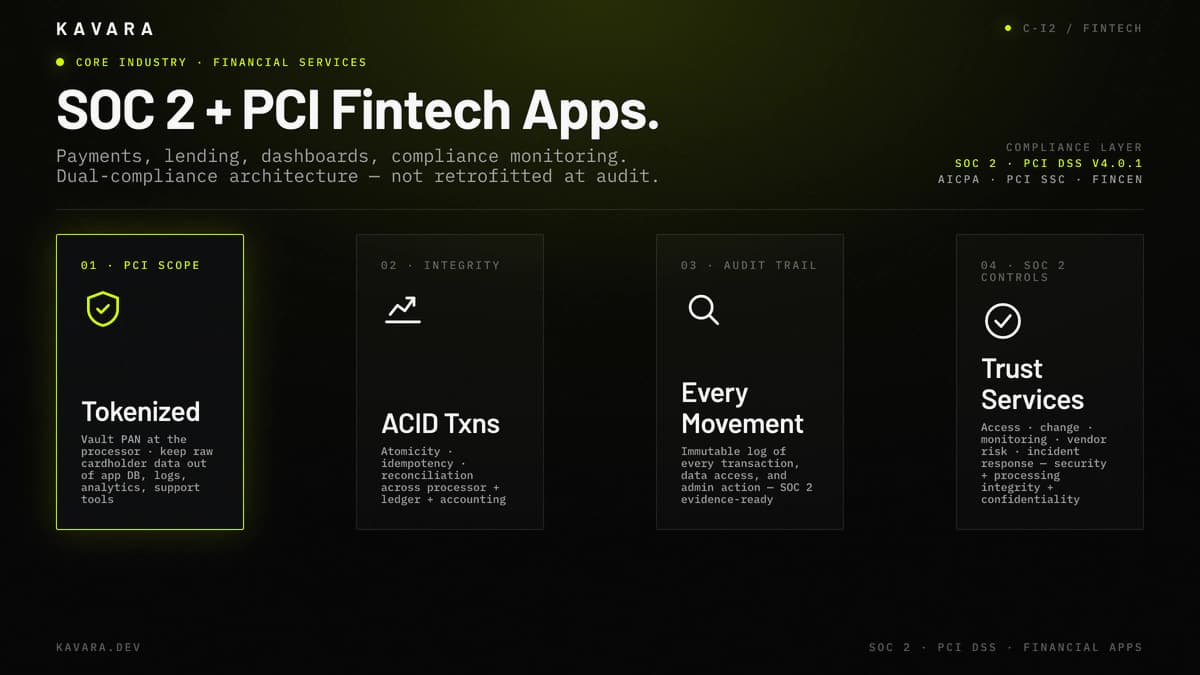
The diagram below maps four architecture pillars — PCI tokenization, ACID transactions, audit trail, and SOC 2 trust controls — that anchor every fintech application we build.
What Is Fintech Application Development
Fintech application development is a specialized form of custom software development for financial applications with dual compliance requirements, secure transaction processing, and financial data integration.
Fintech application development differs from standard web application development because every architecture decision must account for security evidence, payment data, transaction accuracy, and auditability. The same tools used in custom web application development may still apply: React, Node.js or Python, PostgreSQL, event queues, cloud hosting, and API integrations. Database design must separate cardholder data from application data. Transaction processing must be accurate, reversible when required, and auditable. APIs need rate limiting, fraud detection hooks, request signing, and comprehensive logging. Authentication must enforce least-privilege access for users who view accounts, approve loans, initiate payments, or export reports.
IBM's 2025 Cost of a Data Breach Report with the Ponemon Institute reports average breach costs of $4.44 million globally and $10.22 million in the U.S. That risk makes data separation, access control, and evidence collection launch requirements, not audit paperwork.
The dual compliance challenge shapes the system from the first sprint. SOC 2 governs how the organization manages customer data security through access controls, monitoring, change management, incident response, vendor risk, and evidence collection. PCI DSS governs how the application handles cardholder data through scope reduction, tokenization, encryption, vulnerability management, and cardholder data environment controls. Financial applications often need both: SOC 2 for enterprise customer trust and PCI DSS for payment processing capability.
Fintech application development is a specialized practice within custom web application development, applying the same engineering discipline with compliance and transaction processing architecture that non-regulated industries do not require. Mid-market fintech companies, regional banks, lenders, wealth managers, insurance technology firms, and payment processors invest in custom financial applications when off-the-shelf systems cannot support their product model, customer workflow, or data integration needs.
Understanding the compliance foundation clarifies what types of financial services applications require this level of architecture, and each type carries distinct regulatory and engineering requirements.
Types of Financial Services Applications We Build
We build four types of compliant web applications for financial services organizations:
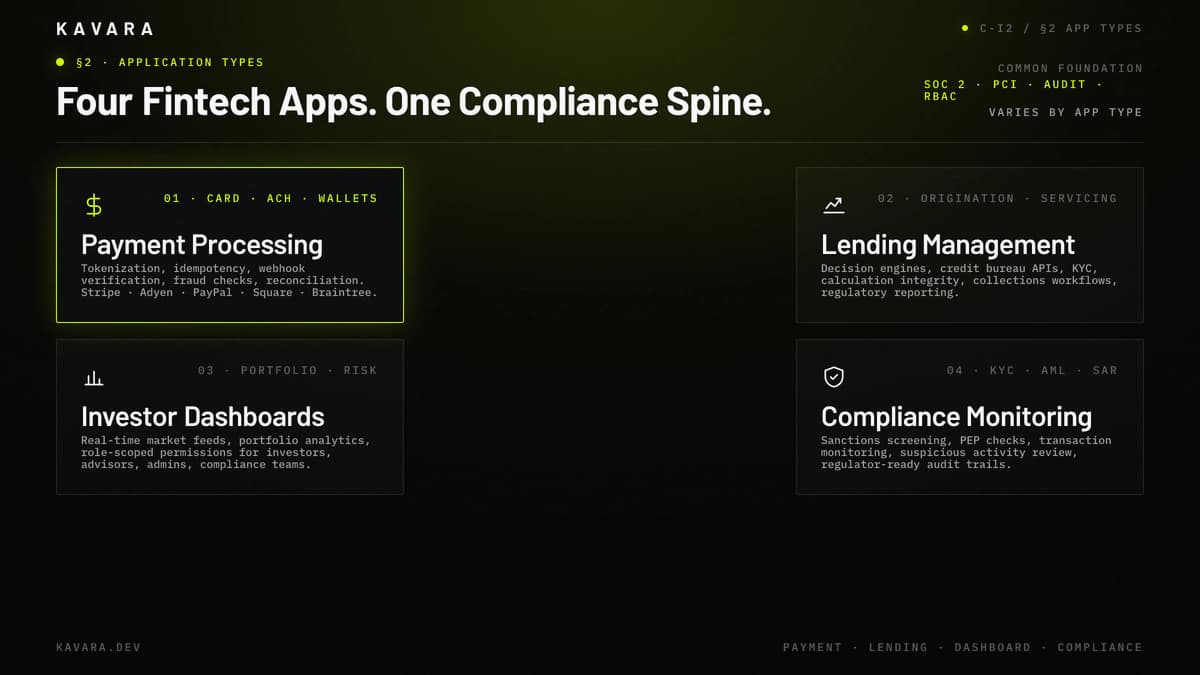
- Payment Processing Platforms - Payment processing platforms handle card payments, ACH transfers, digital wallets, refunds, chargebacks, multi-currency transactions, and settlement workflows. Payment platforms require PCI DSS compliance architecture, including tokenization to minimize cardholder data exposure, encrypted transaction processing, real-time fraud checks, and reconciliation systems that match transactions across the processor, application database, and accounting records. Integration with payment processors such as Stripe, Adyen, PayPal, Square, or Braintree must handle idempotency, webhook verification, retry behavior, and payment status transitions.
- Lending Management Systems - Lending systems support loan origination, underwriting, servicing, payment schedules, collections workflows, and portfolio monitoring. Lending management systems process applications through decision engines, integrate with credit bureaus, verify identity through Know Your Customer (KYC) providers, calculate interest and repayment schedules, and generate operational or regulatory reporting. SOC 2 processing integrity controls matter in lending because calculation errors, missing approvals, or incomplete workflow records create financial and compliance risk.
- Investor and Financial Dashboards - Investor dashboards provide portfolio analytics, risk summaries, account performance, compliance monitoring, cash flow visibility, and advisor reporting. Financial dashboards may process real-time market data feeds, calculate portfolio metrics, and present permission-scoped information to investors, advisors, administrators, and compliance teams. When those dashboards expose account data to clients or advisors, they use the same permission model as financial services portal development. Role-based access ensures investors see only their own accounts while advisors see authorized client panels, with audit trails for every data access event.
- Compliance Monitoring and Reporting Tools - Compliance monitoring tools support KYC and Anti-Money Laundering (AML) workflows, sanctions screening, suspicious activity review, transaction monitoring, regulatory report generation, and audit trail management. Compliance tools integrate with identity verification vendors, sanctions lists, politically exposed person databases, and transaction monitoring platforms. These applications exist because off-the-shelf compliance software often cannot model organization-specific risk scoring, exception handling, and internal approval workflows.
Many fintech products are subscription-based platforms, and our SaaS application development practice provides the multi-tenant architecture and billing infrastructure that fintech SaaS products require, with compliance architecture layered on top. Every financial services application type depends on the same compliance foundation: SOC 2 security controls and PCI DSS data protection architecture working together.
SOC 2 and PCI DSS Compliance Architecture
Financial services applications face dual compliance requirements: SOC 2 governs data security controls, while PCI DSS governs cardholder data handling. Both must be built into the architecture, not retrofitted after development.
The architecture diagram below maps these dual-compliance controls across the UI, API, data, and infrastructure layers.
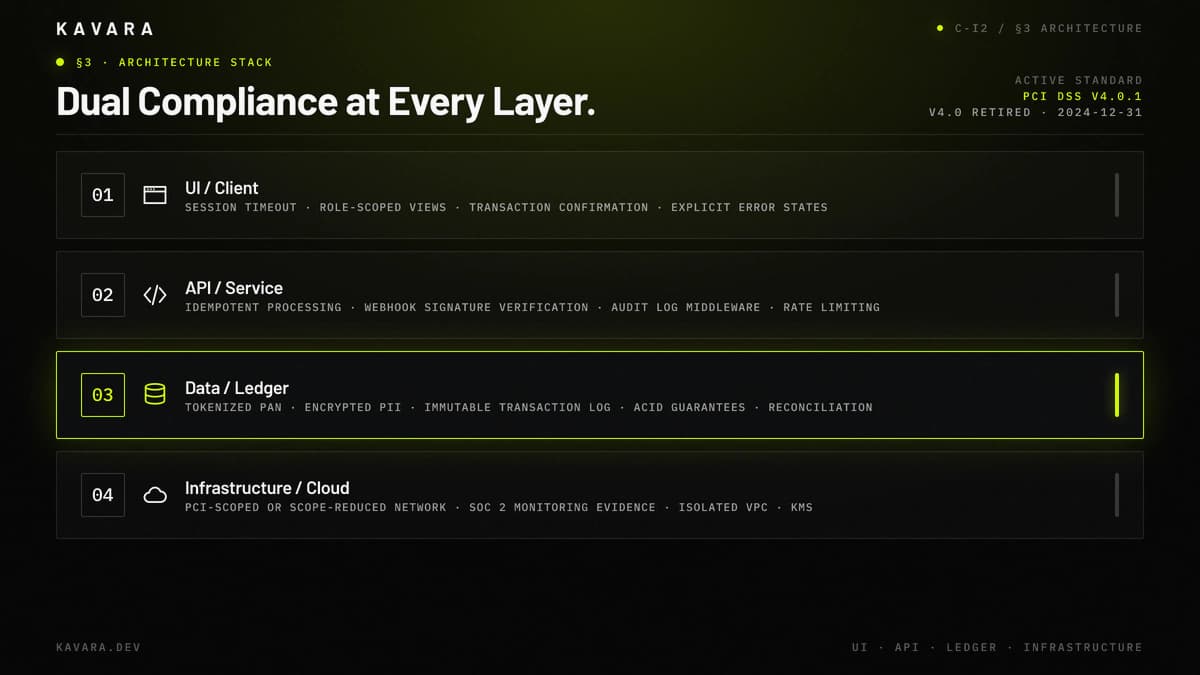
SOC 2 security controls require access management, change management, incident response, monitoring, vendor risk management, and audit evidence. AICPA & CIMA state that SOC 2 reports address security, availability, processing integrity, confidentiality, and privacy. Fintech applications usually emphasize security, processing integrity, and confidentiality because they protect customer data, process transactions correctly, and preserve financial records.
PCI DSS data protection applies to systems that store, process, transmit, or could impact the security of cardholder data. The PCI Security Standards Council states that PCI DSS provides baseline technical and operational requirements to protect payment account data for merchants, processors, acquirers, issuers, service providers, and entities affecting the cardholder data environment. PCI SSC also states that PCI DSS v4.0.1 became the only active supported version after PCI DSS v4.0 retired on December 31, 2024. Visa's November 2024 "What To Do If Compromised" guide lists non-compliance assessments from $5,000 to $100,000 by tier, with some incident-reporting failures assessed up to $100,000 per incident.
Tokenization reduces PCI DSS scope by replacing raw cardholder data with non-sensitive tokens from a payment processor or vault service. Scope reduction matters because every raw-card-data system adds audit cost and breach exposure. A payment application that keeps raw card data out of its own databases, logs, analytics tools, and support systems reduces audit complexity.
Transaction integrity ensures financial actions are processed completely, accurately, and with proper authorization. Reconciliation systems verify that transaction records match across payment processors, application databases, ledgers, and accounting systems. Audit trail architecture records every financial transaction, data access event, and administrative action in immutable logs. PCI DSS requires access monitoring for system components and cardholder data, while SOC 2 auditors expect evidence that controls operated over time.
SOC 2 and PCI DSS security requirements build on our broader web application security best practices guide, with fintech-specific transaction integrity, tokenization, and cardholder data controls layered on top.
Compliance architecture determines how the application handles data internally, but financial applications also need to exchange data with external financial systems and services.
Financial Data Integration and Real-Time Processing
Financial applications connect to payment networks, banking platforms, market data feeds, identity verification services, and regulatory systems. Each integration has distinct API patterns, authentication requirements, data formats, rate limits, and failure modes.
The integration topology below shows how a SOC 2 and PCI DSS compliant application connects to Stripe, Plaid, Onfido, Jumio, Experian, Bloomberg, and QuickBooks or NetSuite.
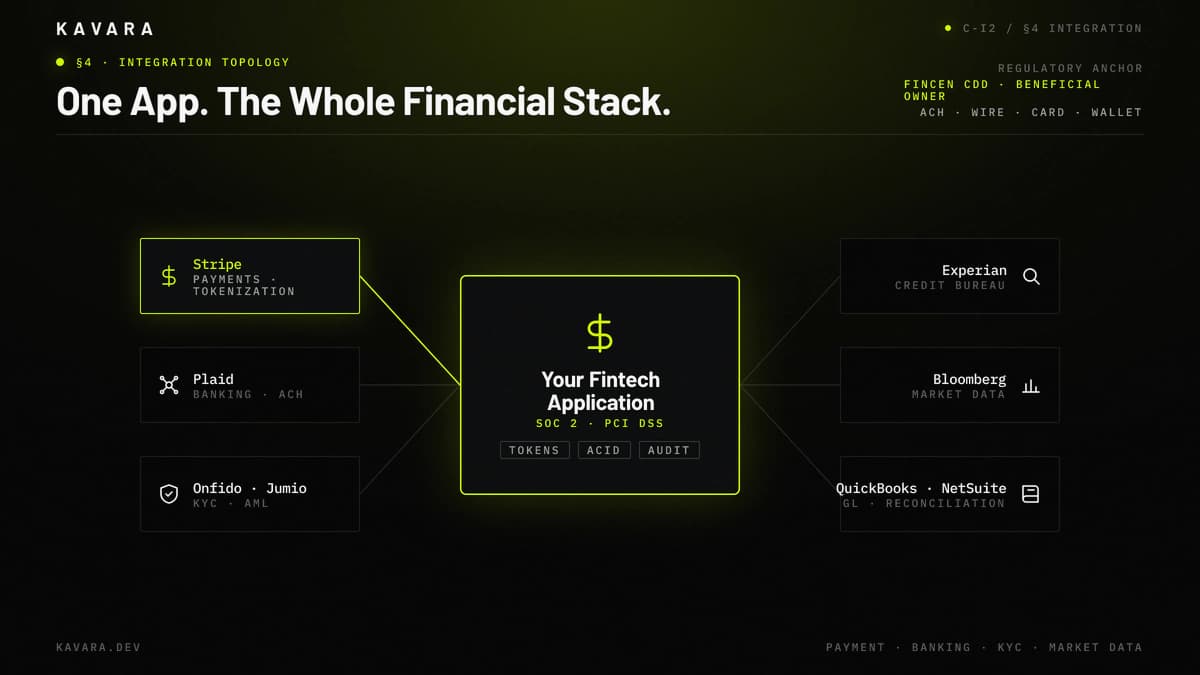
Payment processor integration connects applications to Stripe, Adyen, Square, PayPal, Braintree, or other payment infrastructure. Payment integration requires idempotent transaction processing so retries do not create duplicate charges. It also requires webhook verification, retry logic for temporary failures, and reconciliation routines that compare processor records with internal ledger data.
Banking API integration connects applications to account verification, balance retrieval, transaction history, ACH movement, and cash flow analysis. Open banking providers such as Plaid, MX, and Yodlee simplify bank connectivity, but the application still needs consent capture, token management, stale credential handling, and clear error states when a bank connection fails. ACH transfers require settlement delay handling because funds movement does not behave like instant card authorization.
KYC and AML integrations support identity verification, beneficial ownership review, sanctions screening, politically exposed person checks, and suspicious activity monitoring. FinCEN's Customer Due Diligence Rule requires covered financial institutions to identify and verify beneficial owners of legal entity customers, and FinCEN states that customer due diligence strengthens requirements across banks, mutual funds, brokers, and futures intermediaries. Fintech applications that facilitate money movement therefore need workflows that collect, verify, store, and review identity data under a defined risk model.
Real-time transaction processing requires ACID guarantees: atomicity, consistency, isolation, and durability. Race conditions in financial processing can create duplicate withdrawals, incorrect balances, missed reversals, or unreconciled ledger entries. Architecture must handle transaction queues, database locking, retry logic, rollback behavior, ledger immutability, and partial-failure alerting. These requirements make fintech application development more demanding than standard web application development services.
Building applications with this compliance and integration architecture requires a development process adapted for financial-services-specific requirements at every phase.
Our Fintech Development Process
We build financial services applications through our structured development process with compliance and transaction security addressed at every phase:
- Discovery - Discovery scopes SOC 2 and PCI DSS requirements, maps transaction flows, identifies cardholder data exposure, selects payment processors, defines KYC and AML workflows, and documents regulatory reporting needs.
- Design - Design covers financial data presentation, role-based views, transaction confirmation screens, error states, session management, approval flows, and compliance-driven UI patterns.
- Architecture - Architecture defines tokenization strategy, PCI scope reduction, transaction processing with ACID guarantees, audit logging, encryption, role-based access, payment processor integration, and banking API design.
- Development - Development implements payment integrations in sandbox environments, builds transaction reconciliation logic, connects KYC and AML services, creates evidence-generating logs, and secures administrative workflows.
- QA - QA verifies transaction accuracy, calculation correctness, PCI vulnerability scan results, penetration test findings, role-based access boundaries, reconciliation behavior, and audit trail completeness.
- Deployment - Deployment moves the application into PCI-scoped or scope-reduced infrastructure, configures SOC 2 monitoring evidence, obtains payment processor production credentials, and validates operational alerting.
- Support - Support includes SOC 2 audit preparation, PCI DSS scan remediation, payment API version management, fraud rule tuning, security patching, and transaction monitoring refinement.
Our fintech development methodology follows our structured development process with SOC 2 and PCI DSS compliance requirements addressed at every phase. Fintech development investment reflects the compliance architecture, integration complexity, and specialized testing that regulated financial applications require.
How Much Does Fintech Application Development Cost
Fintech application development typically costs 25% to 50% more than equivalent non-regulated applications due to SOC 2 and PCI DSS compliance architecture, payment integration complexity, and specialized security testing. Payment processing platforms cost $150,000 to $350,000 because PCI DSS scope, tokenization, fraud checks, reconciliation, and payment processor integration add engineering depth. Lending management systems cost $150,000 to $300,000 because credit decisioning, servicing workflows, compliance reporting, and bureau integrations increase complexity.
Investor dashboards with real-time data cost $130,000 to $250,000 depending on market data feeds, role-based access, portfolio calculations, and report exports. Compliance monitoring tools cost $100,000 to $200,000 depending on KYC and AML integration, risk scoring, transaction monitoring, and audit trail depth.
Ongoing compliance costs include SOC 2 Type II audit support, PCI DSS assessment or self-assessment support, quarterly vulnerability scans where applicable, penetration testing, fraud monitoring tooling, and security monitoring. Workstreet's 2026 SOC 2 audit cost guide places most startup and mid-market audits at $10,000 to $50,000, making that range a practical baseline for narrow-to-midmarket scopes. PCI DSS assessment cost depends on payment volume, architecture scope, and whether a QSA assessment is required.
For detailed cost ranges across all application types and the compliance premium that financial services projects carry, see our web application development cost guide.
Those costs are driven by two compliance frameworks that affect architecture, audit evidence, and payment-network exposure.
What Are SOC 2 and PCI DSS and How Do They Affect Development
SOC 2 is a compliance reporting framework developed by the AICPA for evaluating controls at a service organization relevant to customer data and system trust. AICPA & CIMA describe SOC 2 controls as relevant to security, availability, processing integrity, confidentiality, and privacy. Financial services applications commonly need security, processing integrity, and confidentiality because users and partners need evidence that transactions process correctly and sensitive financial data stays protected.
PCI DSS, or the Payment Card Industry Data Security Standard, applies to entities that store, process, transmit, or can impact the security of cardholder data. PCI Security Standards Council says PCI DSS provides technical and operational requirements to protect payment account data, and PCI DSS v4.0.1 is the active supported version. PCI DSS organizes payment-security work into 12 requirement categories, including account-data protection, access control, vulnerability management, logging, and monitoring. SOC 2 and PCI DSS overlap around encryption, access control, logging, monitoring, vulnerability management, and incident response, so building one compliance architecture is more efficient than treating them as separate projects.
How Long Does Fintech Application Development Take
Fintech application development typically takes 5 to 10 months from discovery to launch, or about 25% to 40% longer than equivalent non-regulated applications, due to compliance architecture, payment integration credentialing, and specialized security testing. A payment processing platform usually takes 5 to 8 months. A lending management system usually takes 6 to 9 months. An investor dashboard with market data usually takes 4 to 7 months. A compliance monitoring tool usually takes 5 to 8 months.
Primary timeline factors include payment processor production credentialing, SOC 2 readiness preparation, PCI DSS vulnerability scanning, penetration testing, and remediation cycles. Payment processor production credentialing often adds 2 to 6 weeks because processors review the business model, underwriting risk, bank accounts, dispute handling, and compliance posture before enabling live processing. Teams reduce timeline risk by defining transaction flows, compliance scope, and integration vendors during discovery.
What Financial Systems Can Custom Applications Integrate With
Custom fintech applications integrate with payment processors, banking platforms, financial data services, and regulatory compliance systems:
- Payment - Stripe, Adyen, Square, PayPal, Braintree, and processor-specific settlement or dispute APIs.
- Banking - Plaid, MX, Yodlee, ACH networks, account verification APIs, and bank transfer workflows.
- KYC / AML - Onfido, Jumio, Socure, sanctions screening services, beneficial ownership checks, and transaction monitoring providers.
- Market Data - Bloomberg, Reuters, Alpha Vantage, exchange feeds, and portfolio data providers.
- Accounting - QuickBooks, Xero, NetSuite, general ledger systems, and reconciliation workflows.
- Credit - Experian, Equifax, TransUnion, alternative credit data providers, and underwriting APIs.
Financial dashboards and investor analytics platforms apply the same data pipeline architecture as our fintech compliance dashboards, with real-time market data feeds and compliance-scoped role-based data access layered on top. Fintech applications increasingly embed AI for fraud detection, credit risk scoring, and compliance automation through our AI implementation services, with SOC 2-compliant data pipeline architecture.
How to Choose a Fintech Development Partner
Evaluate a fintech development partner on five criteria beyond standard software evaluation:
- SOC 2 and PCI DSS architecture experience demonstrated through project history, not compliance claims.
- Payment integration depth with the processors, banking APIs, and settlement workflows your application requires.
- Financial domain knowledge for transaction processing, reconciliation, lending workflows, and regulatory reporting.
- Security testing methodology covering penetration testing, PCI vulnerability scanning, transaction integrity verification, and access boundary review.
- Ongoing compliance support for SOC 2 audit preparation, PCI DSS scans, fraud rule tuning, and payment API maintenance.
A development partner who proposes adding compliance later creates security, audit, and launch risk. Beyond fintech-specific criteria, our guide to choosing a development company covers process transparency, team composition, technical diligence, and post-launch support evaluation.
Next Steps
Fintech application development helps mid-market financial services companies build, launch, and secure payment platforms, lending systems, investor dashboards, and compliance monitoring tools with SOC 2 and PCI DSS architecture from discovery. Kavara builds compliance architecture through tokenization, transaction integrity controls, encrypted storage, audit-ready logging, and role-based access at every layer. These applications typically take 5-10 months and carry a 25% to 50% compliance premium over non-regulated builds. Explore our custom web application development services to see how fintech applications connect to our SaaS, portal, dashboard, and enterprise practices. Contact Kavara to scope compliance requirements, map payment integrations, and plan your fintech application build.