Agency vs Freelancer vs In-House: How to Build Your Development Team
Before choosing which development company to hire, you need to decide what kind of team to engage — an agency, freelancers, or an in-house team. Each model has different cost structures, management requirements, quality controls, and risk profiles. The cheapest hourly rate does not produce the cheapest project because custom web application development delivery depends on coordination, rework, QA, architecture quality, and launch readiness.
The total cost paradox appears when rate comparisons ignore the work required to build, deploy, and support production applications. A US agency billing $200 per hour that delivers a project in 2,000 hours costs $400,000 in direct fees. An offshore or independent team billing $50 per hour that requires 5,000 hours because of communication overhead and rework costs $250,000 in direct fees. But the hidden costs can exceed the rate savings when internal management time, delayed launch, missed requirements, and technical debt are included.
Agency, freelancer, and in-house models also allocate accountability differently. An agency brings a pre-assembled development team with project management, design, engineering, QA, and deployment support. Freelancers provide targeted execution capacity, but the buyer usually owns product management, QA, technical direction, and coordination. An in-house team provides maximum control, but it converts application development into a fixed payroll commitment before the application has shipped.
This page compares all three team models using total cost of ownership, management overhead, project-type fit, ramp-up time, and transition strategy. Team choice also determines who will integrate third-party systems, deploy production infrastructure, and support the application after launch. The goal is not to make every project look like an agency project. The goal is to help mid-market companies choose the team model that can build web applications, launch production software, and scale the platform without turning hourly savings into operating risk.
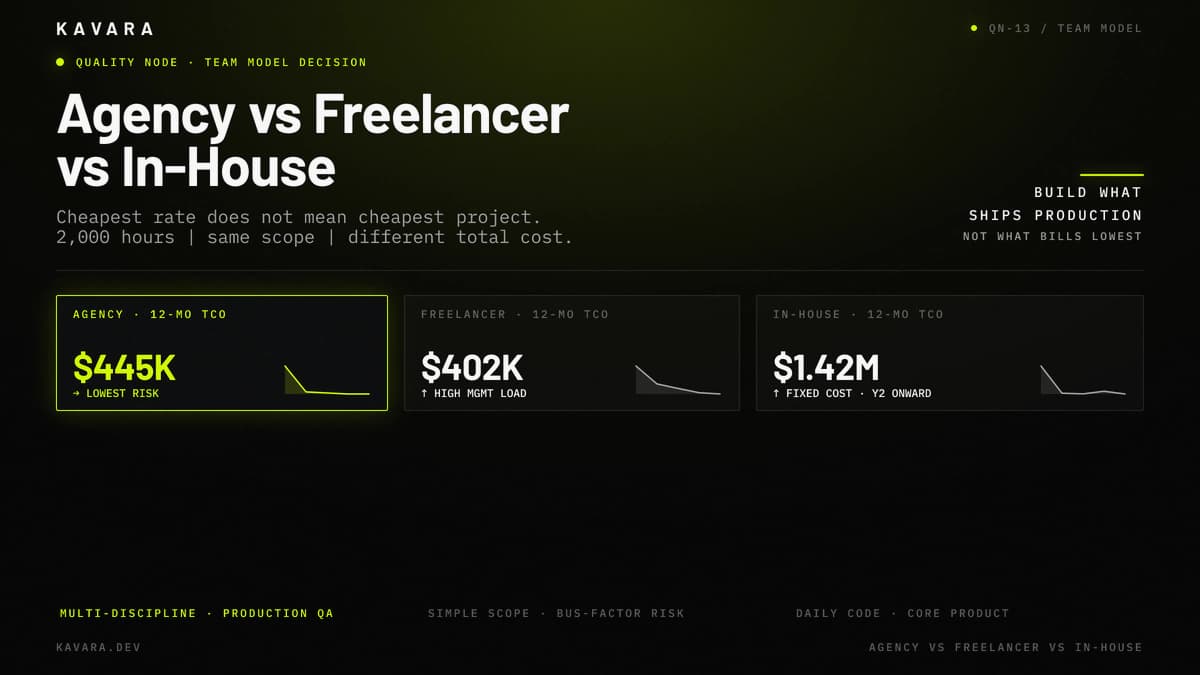
The diagram below shows the three team-model 12-month totals — Agency $445K, Freelancer $402K, In-House $1.42M — for an identical 2,000-hour mid-complexity web application.
Three Team Models for Custom Development
Custom development team models are engagement structures that define who builds the application, who manages the work, and who owns delivery risk. Agency, freelancer, and in-house models can all produce strong software when they match the project type, but each model changes the cost equation and the management load for the buyer.
Deloitte's 2022 Global Outsourcing Survey reported that 76% of surveyed executives outsource IT functions and 52% outsource business functions. That makes team-model selection a mainstream sourcing decision for technology work, not only a startup staffing shortcut or procurement exercise.
The comparison cards below position each engagement model with hourly rates, team sizes, and best-fit project types.
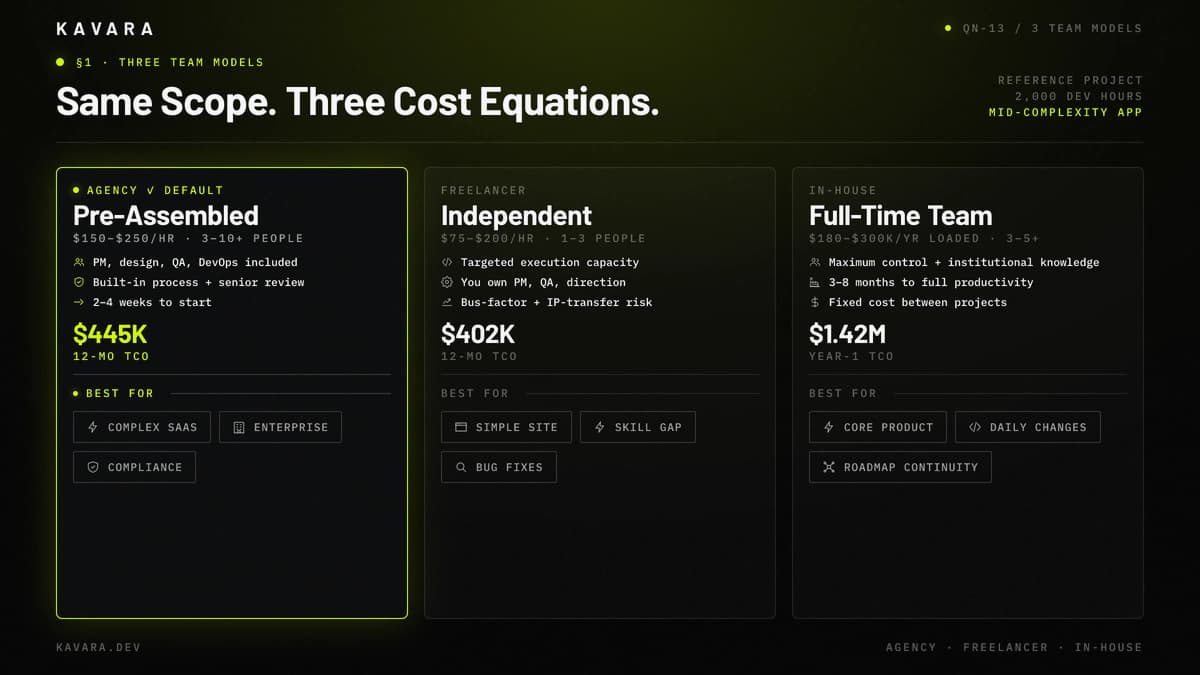
| Factor | Agency | Freelancer | In-House |
|---|---|---|---|
| Hourly Rate (US) | $150-$250/hr | $75-$200/hr | $180-$300/hr fully loaded |
| Team Size | 3-10+ pre-assembled | 1-3 assembled per project | Hired individually |
| Time to Start | 2-4 weeks | 1-3 weeks | 3-8 months |
| Process & QA | Built-in methodology | Varies by individual | You build it |
| Management Overhead | Low, PM included | High, you manage | Medium, you manage team |
| Accountability | Contractual plus reputation | Contractual only | Employment relationship |
| Best For | Complex defined projects | Simple projects, skill gaps | Ongoing product development |
| Risk | Higher hourly rate | Quality variance, bus factor | Highest fixed cost |
Hourly rate is the least reliable predictor of total project cost. An agency billing $200 per hour with 95% first-time code quality can cost less than a freelancer billing $75 per hour with 60% first-time code quality because every reworked feature is paid for twice. The rate difference looks obvious in procurement, but the delivery difference appears in QA cycles, missed edge cases, integration defects, and post-launch support.
The built-in methodology that agencies provide - structured discovery, sprint-based development, QA testing, deployment pipelines, and project reporting - is detailed in our web application development process guide. Understanding what professional process includes helps evaluate whether an agency's claimed process is real delivery infrastructure or marketing language.
The table shows rate differences. TCO analysis reveals the full cost picture for each model.
Agency Development: Total Cost and When It Works
Agency development is a delivery model where a specialized company provides the cross-functional team, process, and accountability required to build and launch a defined software project. Agency rates are higher than freelancer rates because the blended rate usually includes project management, UX/UI design, frontend development, backend development, QA, DevOps, and senior technical oversight across the engagement.
PMI's 2026 Pulse of the Profession report found that roughly one-third of complex projects fail, compared with a 13% failure rate for projects overall. That is why agency process value should be measured through coordination, risk control, and delivery accountability rather than rate alone.
The direct cost for a US agency typically ranges from $150 to $250 per hour. For a mid-complexity web application requiring 2,000 development hours, a blended $200 hourly rate produces $400,000 in direct development cost. Client management overhead is comparatively low because the agency project manager handles sprint planning, backlog coordination, QA tracking, and day-to-day communication. A client executive or product owner may spend 2 to 4 hours per sprint on demos, decisions, and feedback, producing roughly $15,000 in internal management cost across a 6 to 9 month engagement.
Rework cost is lower when the agency has disciplined discovery, senior review, automated testing, and dedicated QA. Based on project data from custom web application development engagements, established agency teams with process discipline typically plan 5% to 15% rework inside the delivery model rather than letting defects accumulate until launch. In a $400,000 project, a 10% rework allowance represents about $30,000 of correction and refinement effort after accounting for features that pass review the first time.
The 12-month TCO for this agency example is approximately $445,000: $400,000 in direct fees, $15,000 in client management time, and $30,000 in rework allowance. This cost works when the project requires multiple disciplines, production security, scalable architecture, performance standards, integrations, and reliable deployment. Agency engagement also works when the buyer lacks internal technical leadership to manage individual contributors.
Agency development does not fit every project. A simple landing page, a small bug-fix backlog, or a narrow one-person task may not justify a full agency team. A budget that cannot support $150+ hourly rates may also require a smaller scope or a freelancer model. Agency rates are higher, but freelancer rates are lower; the cost equation includes more than the rate.
Freelancer Development: Total Cost and When It Works
Freelancer development is a delivery model where one or more independent specialists build specific parts of a software project under the buyer's direction. Freelancers can be effective when the project is simple, the scope is well-defined, and the buyer has enough technical or product management capacity to direct the work.
The direct cost for US freelancers typically ranges from $75 to $200 per hour. A mid-complexity project estimated at 2,000 hours and billed at $125 per hour produces $250,000 in direct development cost. That number rarely includes the full development team required for a production application. Design, QA, DevOps, architecture review, analytics setup, and documentation often require separate hires or internal staff, adding another $40,000 or more for a project that must launch cleanly.
Management overhead is the freelancer model's largest hidden cost. The buyer becomes the project manager, product owner, QA coordinator, and often the technical reviewer. For a CTO, VP, founder, or operations leader earning the equivalent of $200,000 per year, spending 25% of working time managing the freelancer relationship creates roughly $50,000 in internal cost. That cost includes briefing, reviewing, coordinating, chasing status, handling quality issues, testing features, and translating business requirements into implementation details.
Freelancer rework varies widely because individual quality, availability, communication, and testing practices vary widely. Based on practitioner project data, individual freelancers without dedicated QA often create higher rework exposure than established agency teams, with 15% to 40% rework risk depending on skill level and project complexity. A 25% rework allowance on direct and additional labor produces about $62,500 in correction cost for the example project.
The 12-month TCO for this freelancer example is approximately $402,500: $250,000 in direct development, $40,000 in additional design and QA support, $50,000 in management overhead, and $62,500 in rework exposure. The freelancer model can still be cost-effective for simple projects, single features, bug fixes, or short-term skill gaps in an existing development team.
Freelancer development does not work well when the project requires coordinated design, frontend, backend, QA, DevOps, and security work. It also creates bus factor risk: if the freelancer becomes unavailable, the project can stop. The IP ownership issue also needs contract attention. The U.S. Copyright Office explains that commissioned work is not automatically work made for hire without the right written agreement and qualifying conditions, and 17 U.S.C. Section 204 requires copyright transfers to be written and signed. Freelancers trade management overhead for lower rates. In-house teams trade ongoing fixed cost for maximum control.
In-House Development: Total Cost and When It Works
In-house development is a team model where the company hires employees to build, maintain, and scale software as part of its internal operating capability. In-house teams provide maximum control, institutional knowledge, and long-term ownership, but they require recruiting, management, payroll, tooling, career development, and enough ongoing development volume to justify the fixed cost.
Fully loaded cost per developer typically ranges from $180,000 to $300,000 per year when salary, benefits, payroll taxes, equipment, tools, recruiting fees, management overhead, and office or remote-work costs are included. The U.S. Bureau of Labor Statistics reported a May 2024 median annual wage of $133,080 for software developers, with the highest 10% earning more than $211,450. BLS Employer Costs for Employee Compensation data for December 2025 also shows private-industry benefits at 29.9% of total compensation, while professional and related occupations carried benefits at 30.6% of compensation. Those figures support why a software developer's fully loaded cost rises well above base salary.
A minimum viable in-house team for a production web application usually includes 3 to 5 people: frontend, backend, QA, and either product management, design, or DevOps depending on the application. A five-person team at an average fully loaded cost of $220,000 creates $1,100,000 in annual salary and benefits. Recruiting costs can add $75,000 when search fees, internal recruiter time, interview time, and onboarding costs are included. Tools, equipment, cloud environments, and development systems can add another $50,000.
Ramp-up creates another hidden cost because hiring is not productivity. The Linux Foundation's 2024 State of Tech Talent Report found that 64% of organizations spend more than four months filling open technical roles, with front-end and back-end developer roles averaging 5.5 months to hire and onboarding averaging 4.8 months. SHRM's 2025 recruiting benchmarking data also reports that job positions continue to take about a month and a half to fill across broader hiring markets. For a first-year in-house team, 3 to 5 months of sub-full productivity can conservatively cost $150,000.
The 12-month TCO for a five-person in-house development team can reach about $1,450,000: $1,100,000 in salaries and benefits, $75,000 in recruiting, $50,000 in equipment and tools, $75,000 in management time, and $150,000 in ramp-up productivity loss. In-house development works when software is the company's core product, daily code changes are continuous, and institutional knowledge is a strategic asset.
In-house development does not work well for one-time or periodic projects because the fixed cost continues between projects. It also does not fit companies that cannot attract, evaluate, and retain engineering talent. Each model has its cost structure. Comparing them side by side reveals where the real economics diverge.
Total Cost of Ownership Comparison
For a mid-complexity web application requiring 2,000 development hours, full design, QA, and deployment, total cost of ownership compares the full delivery economics rather than the surface hourly rate.
CISQ's 2022 Cost of Poor Software Quality report estimated US poor-software-quality cost at $2.41 trillion and accumulated technical debt at about $1.52 trillion, so rework and quality risk belong inside TCO rather than outside it.
The chart below shows all three TCO numbers on a shared $0 to $1.5M scale, with in-house carrying a $975K fixed-cost premium over agency.
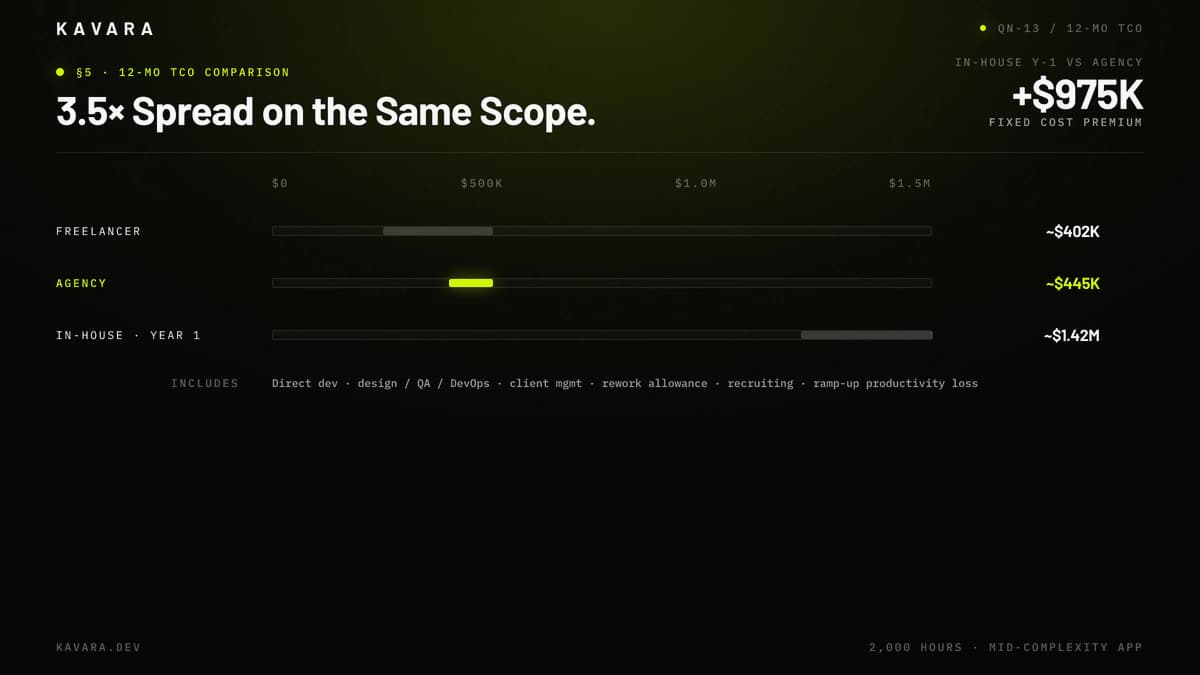
| Cost Component | Agency | Freelancer | In-House (Year 1) |
|---|---|---|---|
| Direct development | $400,000 | $250,000 | $1,100,000 team salary |
| Design / QA / DevOps | Included | $40,000 additional | Included in team |
| Management overhead | $15,000 | $50,000 | $75,000 |
| Recruiting | $0 | $0 | $75,000 |
| Rework estimate | $30,000 | $62,500 | $20,000 |
| Ramp-up / productivity | $0 | $0 | $150,000 |
| 12-MONTH TCO | ~$445,000 | ~$402,500 | ~$1,420,000 |
The freelancer TCO is $42,500 less than the agency in this model, or about 10% savings. That comparison assumes a capable freelancer, manageable rework, clear scope, and a buyer with the time and skill to manage delivery. A below-average freelancer with 40% rework produces a TCO higher than the agency while adding lower process maturity and single-person risk.
These TCO figures align with the cost ranges in our development cost guide, which breaks down development investment by application type, phase, and team model. The same model also explains why a low hourly rate can still create a high total cost when delivery quality is inconsistent.
This TCO approach - comparing total cost over years rather than upfront price - applies equally to the custom vs off-the-shelf decision, where five-year ownership cost often reverses the initial price advantage of off-the-shelf licensing. Team model decisions and build-versus-buy decisions both require the same discipline: calculate operating cost, transition cost, support cost, and opportunity cost before choosing the cheaper-looking option.
Second-year economics make the difference sharper. In Year 2, the in-house team still costs $1,100,000 or more regardless of project needs. The agency costs $0 until the next project or retainer. This is the fundamental economic difference: agencies are variable cost, while in-house teams are fixed cost, so the next decision is matching each cost structure to the project type.
How to Match Team Model to Project Type
Team model selection should start with project type, project complexity, and development continuity. The best model is the one that matches the work pattern, not the one with the lowest rate.
The matrix below maps seven project types against the three team models with BEST, FIT, or poor-fit verdicts per cell.
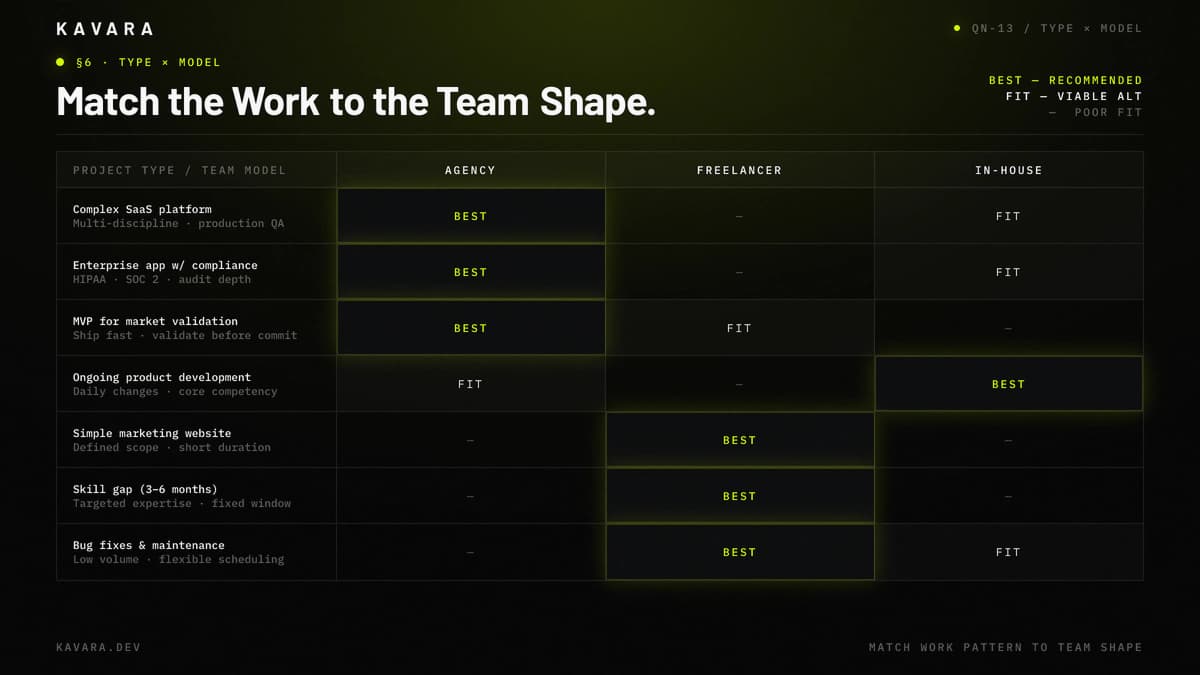
| Project Type | Recommended Model | Why |
|---|---|---|
| Complex SaaS platform | Agency | Multi-discipline team, production QA, scalable architecture |
| Simple marketing website | Freelancer | Single developer, defined scope, short duration |
| Ongoing product development | In-House | Daily code changes, institutional knowledge, core competency |
| MVP for market validation | Agency or Freelancer | Speed to market, validation before commitment |
| Specific skill gap for 3-6 months | Freelancer or Staff Augmentation | Targeted expertise, defined duration |
| Enterprise application with compliance | Agency | Security testing, compliance architecture, QA depth |
| Bug fixes and maintenance | Freelancer or Retainer | Low volume, defined tasks, flexible scheduling |
The decision is not permanent. Many mid-market companies start with an agency for the initial build, then transition maintenance to a smaller team, a freelancer, or 1 to 2 in-house developers. The optimal model changes as the product matures, the roadmap stabilizes, and the internal team gains enough context to support the application.
MVP projects benefit from agency engagement when production-quality architecture is needed from day one. Our build an MVP approach validates core hypotheses without creating technical debt that blocks future growth.
The pricing model also interacts with team model. A fixed-price agency proposal shifts scope-definition risk into discovery and change control, while a time-and-materials engagement keeps scope flexible but requires active budget governance. Freelancers usually work hourly, so the buyer carries more scope and QA control. See our fixed price vs time and materials comparison for risk analysis.
The model choice becomes stronger when the buyer plans for hybrid ownership instead of assuming one team model must last forever.
Can You Combine Team Models
Yes - and most mid-market companies with mature technology practices use hybrid models. A hybrid model is a development team structure that combines agency, freelancer, and in-house capacity under one ownership plan.
Common hybrid patterns include agency for the initial build plus a freelancer or small in-house team for maintenance. Another pattern uses an in-house technical lead to direct an agency that provides execution capacity. A third pattern uses an in-house core team for roadmap continuity and an agency for surge capacity during major features, new products, or integrations. A fourth pattern uses agencies for complex features and freelancers for routine updates.
The hybrid approach works when there is clear ownership. Someone, either an in-house technical lead or an agency project manager, must own the product roadmap, architecture direction, backlog priority, and release quality. Hybrid development fails when no one is accountable for the whole application and every participant owns only a narrow task.
How Long Does Each Model Take to Get Started
Agency teams typically start in 2 to 4 weeks, freelancers typically start in 1 to 3 weeks after agreement, and in-house teams typically require 3 to 8 months to reach full productivity. Compared side by side, freelancers can start slightly faster than agencies, while in-house teams take dramatically longer because recruiting and onboarding come before delivery. The timeline depends on scope clarity, contract speed, talent availability, and onboarding needs.
An agency starts faster than an in-house team because the development team is pre-assembled. A freelancer can start quickly, but finding the right freelancer may take 2 to 6 weeks before the agreement starts. An in-house team takes longer because recruiting, interviews, offers, onboarding, and ramp-up must happen across multiple roles.
If a project needs to start within 30 days, in-house is usually not an option. The recruiting and onboarding timeline eliminates it for near-term custom software development deadlines.
What Happens When You Need to Switch Models
Switching team models requires handoff planning, code documentation, architecture context, and ownership clarity. The cheapest transition is the transition designed from the start.
Agency-to-in-house transitions work when the agency builds V1, documents the architecture, transfers repository access, explains deployment workflows, and trains the internal team. Budget 4 to 8 weeks for handoff, and confirm that the in-house team can maintain the architecture the agency designed.
Freelancer-to-agency transitions are common when a project outgrows one developer. The agency may need to review architecture, refactor fragile code, add tests, or rebuild parts of the application if the freelancer's work does not meet production standards.
In-house-to-agency transitions work when the in-house team needs capacity for a specific initiative. The in-house technical lead should direct the agency so the project fits existing architecture, standards, and release practices.
Once you have decided on the agency model, our partner evaluation guide provides the five-criteria evaluation framework for selecting a specific partner.
Agency, freelancer, and in-house development teams each serve different project profiles. The cheapest hourly rate does not produce the cheapest project because TCO includes management overhead, rework, ramp-up time, recruiting, QA depth, and ongoing fixed cost. For mid-market companies with $5M to $100M in revenue building complex custom applications, agency engagement typically produces the lowest TCO with the highest delivery quality for defined projects. In-house makes sense when continuous daily development justifies full-time engineering salaries, and freelancers make sense when scope is simple and management capacity exists. The right model should build, integrate, deploy, launch, and scale production-grade web applications with accountable ownership before work begins. Treat team selection as a custom web application development services decision, not a staffing-rate comparison. Explore our application development services to see how agency engagement delivers production-grade applications for mid-market companies. reach out to Kavara to discuss your project scope and determine the right engagement model.