Custom Web Application Development Services
Custom web application development is the process of designing, building, and deploying software applications tailored to specific business requirements, workflows, and growth objectives. Unlike off-the-shelf software that forces organizations to adapt their processes to generic features, custom applications are architected around how a business actually operates: its data structures, user roles, compliance requirements, integrations, and competitive differentiators.
Kavara builds custom web applications for mid-market companies with $5 million to $100 million in revenue. We deliver production-grade SaaS platforms, enterprise portals, analytics dashboards, MVPs, and enterprise software through a structured development process that moves from discovery and scoping through design, architecture, development, quality assurance, deployment, and ongoing iteration.
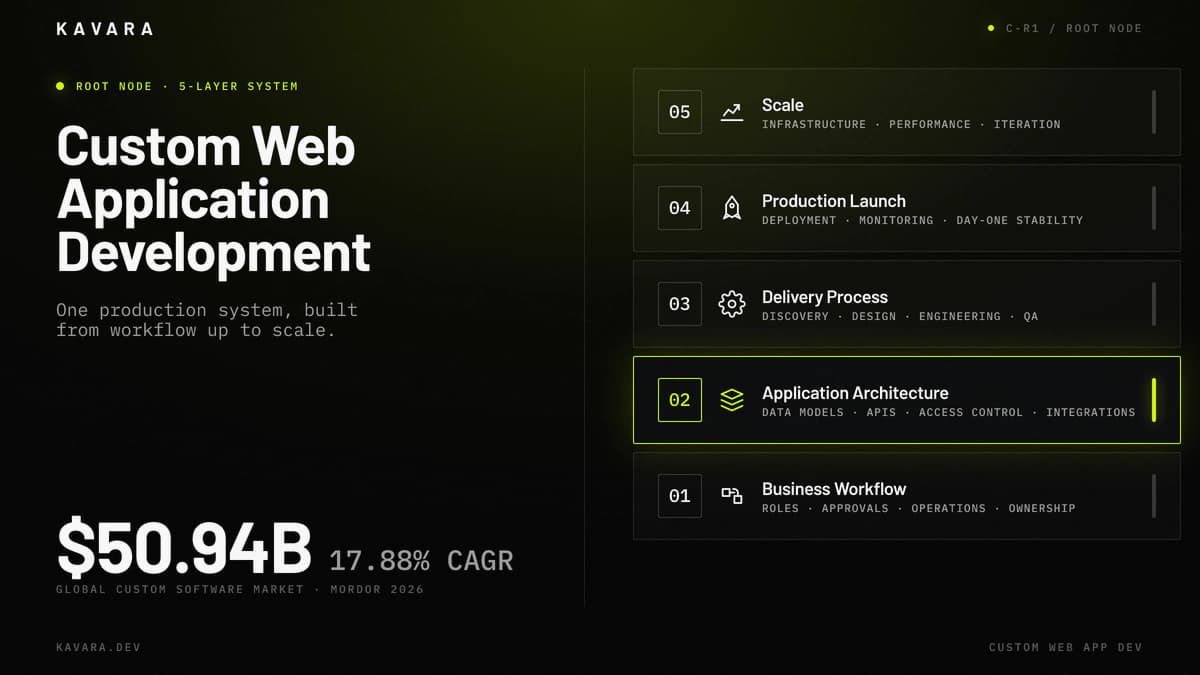
Mid-market companies often outgrow earlier tools before they operate full in-house platform engineering teams. According to Mordor Intelligence, the custom software development market is estimated at $50.94 billion in 2026 and is forecast to reach $115.95 billion by 2031 at a 17.88% CAGR, reflecting demand for tailored systems that match business process, compliance, and differentiation goals.
Custom web application development services from Kavara cover the full technology stack: React and Next.js frontends, Node.js and Python backends, PostgreSQL and MongoDB databases, and deployment across AWS, Azure, and Google Cloud. We build web applications that solve operational problems, create competitive advantages, and deliver measurable ROI for companies that need technology to work the way their business works.
At the root level, custom web application development connects business workflow, application architecture, delivery process, production launch, and scale.
The diagram below maps five production-system layers: workflow, architecture, delivery, launch, and scale.
What Is Custom Web Application Development
Custom web application development is the practice of building browser-based software from the ground up to meet requirements that off-the-shelf products cannot address. It differs from template websites and packaged SaaS tools because architecture, feature logic, technology selection, and integrations are determined by the business problem.
In practice, "custom" means the development team makes deliberate choices about database schema design, API architecture, authentication, user roles, and deployment infrastructure. Different workflows need different data models, and generic tools force workarounds when business logic diverges from the vendor's assumptions.
The spectrum ranges from focused tools, such as approval workflows, to complex platforms that process transactions, serve many roles, and integrate with external systems. Mid-market companies invest when operational complexity exceeds packaged software, data ownership becomes strategic, or differentiation requires capabilities no existing product provides.
For Kavara, custom web application development is not generic IT services. It describes browser-based business software with users, permissions, workflows, data models, integrations, and infrastructure designed around a specific operating model. The Consortium for Information & Software Quality estimated the 2022 U.S. cost of poor software quality at $2.41 trillion, with technical debt at about $1.52 trillion; that is why discovery, architecture, QA, deployment, and support work as one delivery system.
The clearest fit for custom web application development services is a business process that creates revenue, reduces operating cost, or protects compliance exposure. If the application only displays information, a business website may be enough. If it processes approvals, routes tasks, manages customer data, exposes dashboards, or connects systems, it needs production-grade web application architecture and a development partner that can build web applications as durable operating software.
That distinction keeps scope honest: content sites need publishing systems; custom web application development needs product planning and operational ownership.
Types of Web Applications We Build
We build seven primary types of custom web applications for mid-market companies, each addressing distinct operational needs and architectural requirements:
These application categories share a production foundation: user roles, workflow logic, data models, integrations, deployment infrastructure, and ongoing iteration.
The map below positions seven application categories on one shared production foundation.
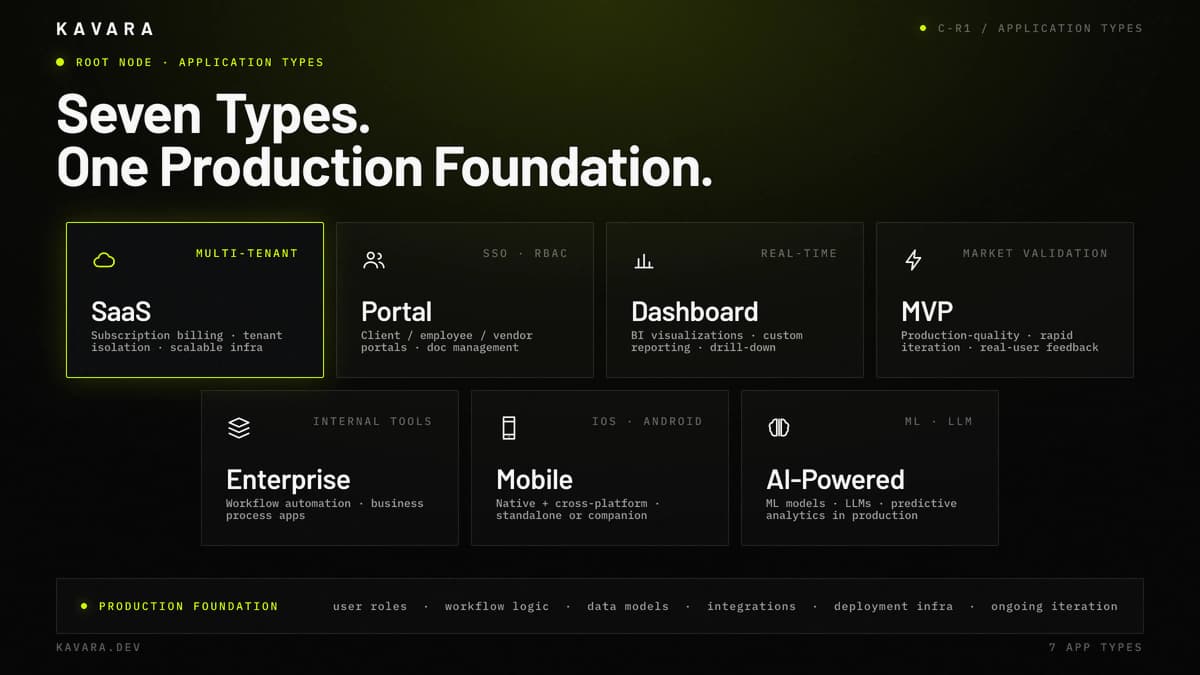
- SaaS Applications - Multi-tenant platforms with subscription billing, user management, tenant isolation, and scalable infrastructure. SaaS development serves companies building software products where the application is the revenue engine. Our SaaS application development services practice delivers production-grade multi-tenant architecture designed to scale from early adopters to enterprise customers.
- Enterprise Portals - Client-facing, employee, or vendor portals with role-based access control, document management, workflow automation, and integration with existing systems. Portal applications centralize communication, data access, and operations for internal and external stakeholders. We architect enterprise web portal development projects around security, SSO integration, and granular permission management.
- Dashboards and Analytics Applications - Business intelligence platforms with real-time visualization, custom reporting, interactive filtering, and drill-down analytics. Dashboard development turns operational data into insight for decision-makers. Our dashboard and analytics application development approach handles SQL-based reporting and streaming real-time data pipelines.
- MVP Products - Minimum viable products for startups and enterprise innovation teams. MVPs validate market hypotheses with production-quality architecture that supports rapid iteration. MVP development services for startups and enterprises at Kavara focus on shipping core functionality fast without creating technical debt that blocks future growth.
- Enterprise Software - Internal tools, workflow automation systems, and business process applications custom-built for specific operational needs. Enterprise software replaces the spreadsheets, manual processes, and disconnected tools that slow operations as companies scale. Our custom software development services cover these broader projects when the work extends beyond one browser-based product surface.
- Mobile Applications - Native iOS, Android, and cross-platform mobile apps as standalone products or companions to web applications. Mobile app development extends platform capabilities to field teams, customers, and users beyond the desktop browser. Mobile application development services keep the mobile layer aligned with the same backend, permissions, and data model.
- AI-Powered Applications - Applications integrating machine learning models, large language models, predictive analytics, and intelligent automation into workflows. AI implementation and integration services embed AI capabilities into production applications rather than isolated proof-of-concept demos.
Each application type requires different architectural patterns, technology choices, compliance considerations, and scaling strategies. Custom web application development services must account for these differences from the first discovery conversation because early architecture decisions shape the application's constraints for years.
These differences matter most for mid-market companies, where off-the-shelf limitations and lean internal teams create the gap custom development is positioned to solve.
Why Mid-Market Companies Invest in Custom Web Applications
Mid-market companies with $5 million to $100 million in revenue face a specific technology challenge: they have outgrown earlier tools, but they do not yet have the resources or time to build full in-house engineering teams. The U.S. Bureau of Labor Statistics projects 15% employment growth for software developers, QA analysts, and testers and about 129,200 openings annually from 2024 to 2034. Custom web application development bridges this talent gap through an external partner.
Mid-market software development becomes necessary when workflow fit, system sprawl, data ownership, compliance risk, and scale control exceed what packaged tools can support.
The scorecard below shows the five custom-development triggers that determine when mid-market companies need custom software over packaged tools.
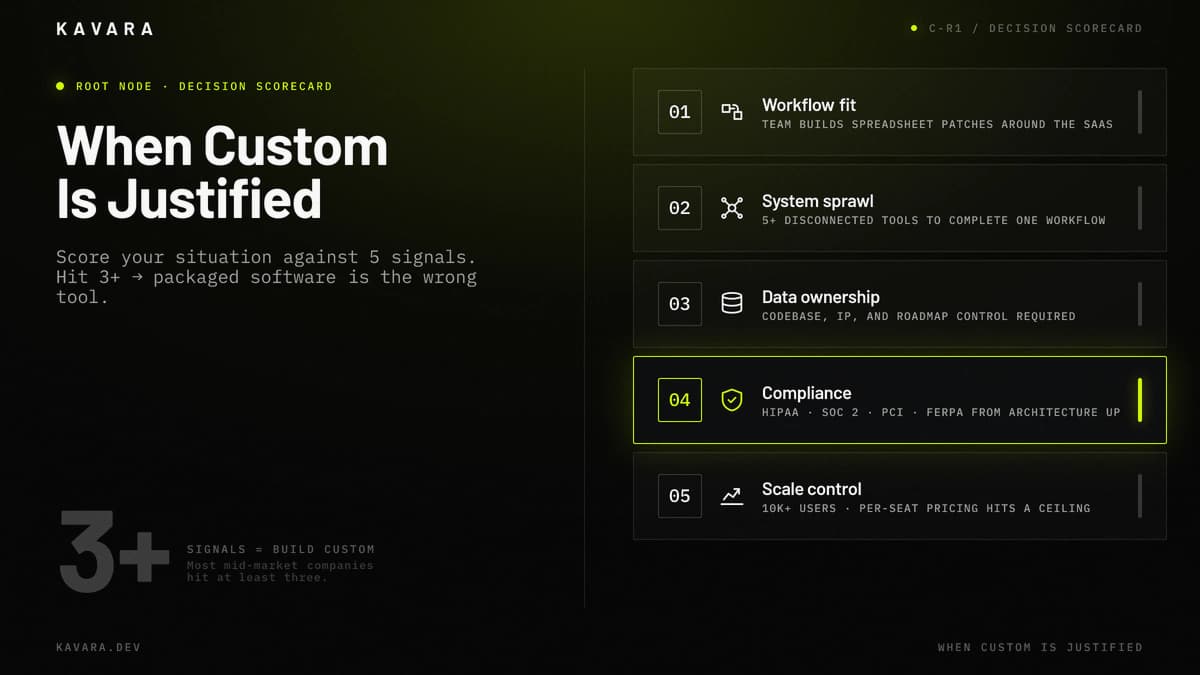
Workflow Fit - Generic software forces organizations to change their processes to match the tool's assumptions. Custom applications adapt to how the business actually operates: approval chains, data structures, reporting hierarchies, exception handling, and customer-specific rules.
System Sprawl - A company running five or more disconnected tools for one workflow is already paying an integration tax. Staff reconcile records by hand and create error-prone workarounds. Understanding the custom vs off-the-shelf software decision is critical when tool sprawl starts creating operational drag.
Data Ownership - Custom applications integrate directly with existing systems such as ERP, CRM, accounting, and HRIS platforms through purpose-built APIs. Companies retain ownership of their data, codebase, and technology roadmap instead of depending on a vendor's product decisions.
Compliance - Industries with regulatory requirements need applications built to specific standards from the architecture level. IBM's 2025 Cost of a Data Breach Report placed the global average breach cost at $4.4 million, which makes access control, audit logging, encryption, and governance economic requirements.
Scale Control - Custom applications scale on infrastructure the company controls. There are no per-seat pricing surprises, no feature gates, and no forced migrations when a vendor changes direction. That control reduces vendor lock-in because the application grows with the business and the business owns the code and architecture.
These triggers also create competitive differentiation. A company that builds and launches a custom routing platform operates differently from competitors running generic logistics software. Recognizing the pattern early prevents workaround costs from becoming technical debt.
Once custom development is the right path, the next question is how the application actually gets built: what phases the project moves through, what each phase delivers, and how stakeholders stay involved from discovery through launch.
Our Development Process
We build web applications through a structured seven-phase development process with specific deliverables and stakeholder sign-off at every gate. PMI's 2026 Pulse of the Profession report found that nearly one-third of complex projects fail, more than twice the 13% rate for projects overall, so Kavara treats scope, architecture, QA, and launch readiness as managed phases rather than informal activities.
The timeline below shows our seven phases from discovery through ongoing support, with stakeholder sign-off at every gate.
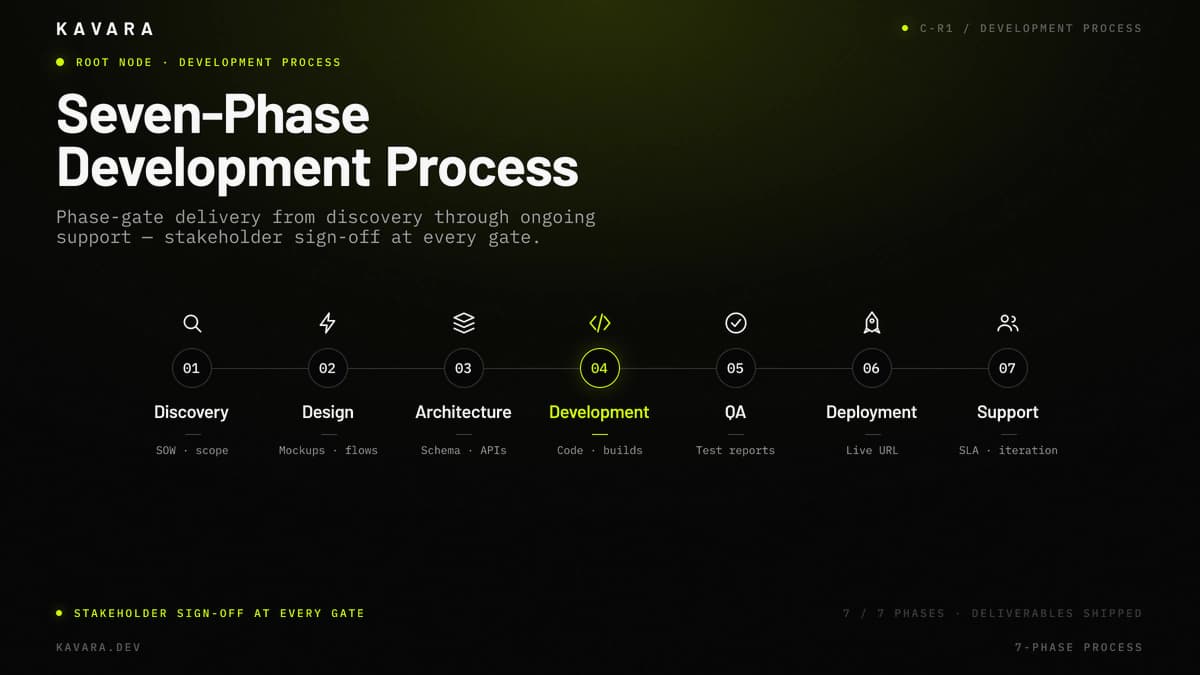
- Discovery & Scoping - We interview stakeholders, map workflows, document requirements, identify integrations, and test feasibility. Deliverables include requirements, estimate, risk register, and decision log.
- UX & UI Design - We translate workflows into user journeys, wireframes, prototypes, and interface states. Deliverables include user flows, screen designs, component patterns, and usability notes.
- Architecture & Technology Selection - We define the database model, API structure, authentication approach, infrastructure plan, and security requirements. Deliverables include the architecture plan, stack recommendation, integration map, and deployment model.
- Development - We build features in structured sprints with code review, continuous integration, and regular demos. Deliverables include working increments, reviewed code, sprint notes, and scoped backlog decisions.
- Quality Assurance - We test business logic, integrations, permissions, performance, and release-blocking paths. Deliverables include test coverage, QA notes, defect reports, and user acceptance checkpoints.
- Deployment & Launch - We validate staging, configure production infrastructure, set monitoring, and run the launch checklist. Deliverables include the live URL, deployment record, rollback plan, monitoring setup, and support window.
- Ongoing Support & Iteration - We monitor performance, resolve bugs, prioritize improvements, and scale infrastructure as usage grows. Deliverables include support cadence, SLA expectations, performance notes, and post-launch roadmap.
For deeper phase-by-phase detail, timelines, team composition, and communication cadence, see our web application development process page.
For a buyer-side evaluation framework you can use across any vendor, read the process evaluation guide.
This process adapts to the specific demands of each industry because compliance requirements, data models, and user expectations differ fundamentally across verticals.
Industries We Serve
We build custom web applications for mid-market companies across regulated and high-growth industries where compliance requirements, data complexity, or operational specificity demand tailored software:
The grid below maps the six industries we serve and the compliance, integration, or operating constraints that shape each application.
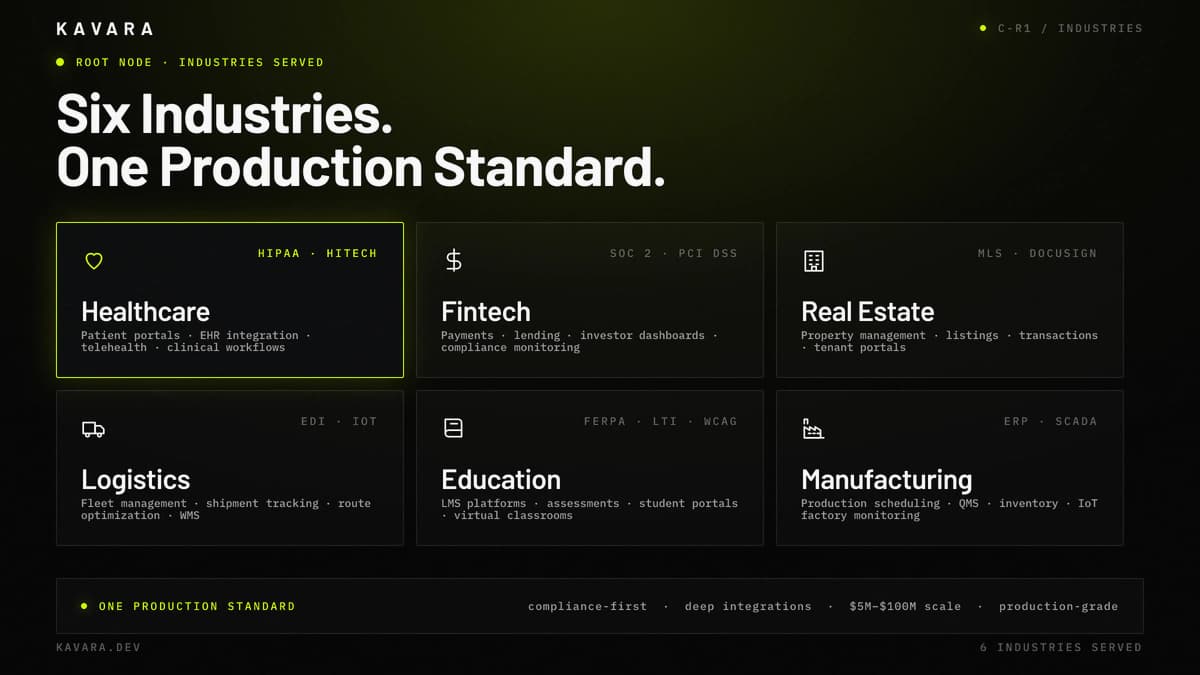
- Healthcare and Health Tech - Patient portals, EHR integration platforms, telehealth applications, and clinical workflow tools. Every web application development for healthcare project is architected for HIPAA compliance with encrypted data storage, audit logging, and role-based access controls.
- Financial Services and Fintech - Payment processing platforms, lending management systems, investor dashboards, and compliance monitoring tools. Our web application development for financial services practice builds applications that meet SOC 2 and PCI DSS requirements at production scale.
- Real Estate and PropTech - Property management portals, listing platforms, transaction management systems, and tenant communication tools built with MLS integration and real-time data synchronization. Real estate application development unifies property data across systems.
- Logistics and Supply Chain - Fleet management applications, shipment tracking platforms, warehouse management systems, and route optimization tools. Logistics application development handles IoT data, carrier APIs, and operational dashboards for supply chain visibility.
- Education and EdTech - Learning management systems, assessment platforms, student portals, and virtual classroom applications built with FERPA-compliant data handling, WCAG accessibility standards, and LTI integration. Education application development serves institutions that need more than off-the-shelf LMS platforms can deliver.
- Manufacturing - Production scheduling applications, quality management systems, inventory tracking platforms, and IoT-connected dashboards for factory floor monitoring. Manufacturing application development integrates with existing ERP systems and delivers real-time operational visibility across production lines.
Industry expertise affects application quality because compliance requirements, data models, and user expectations differ across verticals. A team that understands HIPAA builds security architecture differently from one that has only worked with non-regulated data. Custom web application development services for regulated industries require practitioners who build compliance into the foundation, not teams that treat it as a final checklist.
Technology Stack
Technology selection for custom web application development is driven by project requirements, not developer preference. Kavara selects the stack based on performance needs, team scalability, ecosystem maturity, security requirements, and long-term maintenance.
| Layer | Technologies | When We Use |
|---|---|---|
| Frontend | React, Next.js, TypeScript, Vue.js | React for complex SPAs, Next.js for SEO-critical apps, Vue for rapid development |
| Backend | Node.js, Python, Go | Node.js for real-time apps, Python for AI/ML integration, Go for high-performance services |
| Database | PostgreSQL, MongoDB, Redis | PostgreSQL for relational data, MongoDB for document-heavy apps, Redis for caching |
| Cloud | AWS, Azure, Google Cloud | AWS as default, Azure for Microsoft-heavy organizations, GCP for AI-intensive projects |
| Mobile | React Native, Swift, Kotlin | React Native for cross-platform, native for performance-critical apps |
| AI | LLMs, ML models, vector databases | AI layers for retrieval, prediction, automation, and workflow intelligence |
The stack is selected as an integrated system: frontend, backend, data, cloud infrastructure, mobile access, and AI capabilities must support the same production workflow.
The stack diagram below shows how frontend, backend, data, cloud, mobile, and AI layers compose one operating system.
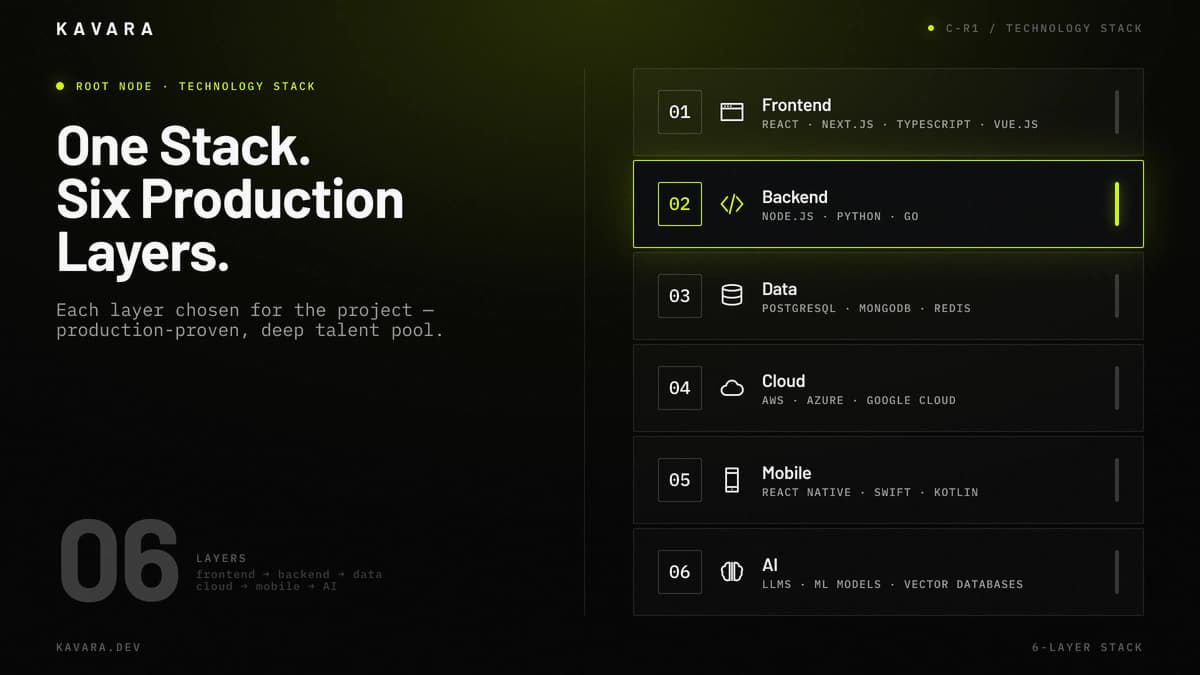
Every technology in this stack is production-proven, supported by mature ecosystems, and staffed by deep talent pools. We avoid experimental frameworks in production applications because technology risk compounds over the multi-year lifecycle of custom software.
Architecture decisions follow the same pragmatic approach. We deploy microservices architecture when discrete services need independent scaling, and monolithic architecture when a simpler model serves the project. Gartner forecast worldwide public cloud end-user spending at $723.4 billion in 2025 and predicted 90% hybrid-cloud adoption through 2027, so cloud decisions now affect scalability, integration, governance, and operating cost.
Our web application architecture guide explains how architecture choices balance scalability, maintainability, and development speed so today's decisions do not constrain scale.
How Much Does Custom Web Application Development Cost
Custom web application development typically costs $50,000 to $500,000+ depending on application complexity, feature scope, technology requirements, and team composition. Simple web apps such as MVPs and basic CRUD tools often fall between $50,000 and $150,000. Medium-complexity SaaS platforms, portals, and dashboards usually land between $150,000 and $350,000. Complex enterprise applications with extensive integrations, compliance requirements, or high-scale infrastructure can reach $350,000 to $500,000+.
Ongoing costs include hosting, maintenance, security updates, monitoring, QA, and feature iteration. A practical planning range is 15-25% of the initial build cost annually, depending on uptime requirements and roadmap velocity. Clutch's 2026 verified review data reports an average software development project cost of $132,480.29 and an average timeline of about 13 months, which supports the same point: scope and complexity drive the budget more than the category name alone.
The most reliable estimate comes after discovery clarifies user roles, workflows, integrations, security requirements, and release priorities. Early budget ranges should therefore be treated as planning bands, not fixed promises, until the technical scope is documented.
For detailed cost breakdowns by application type and complexity tier, phase-by-phase budget allocation, team model comparisons, hidden costs, and ROI framework, read our complete web application development cost guide.
How Long Does It Take to Build a Custom Web Application
Building a custom web application typically takes 3 to 12 months from discovery to launch, depending on complexity, scope, and team size. MVPs require 2 to 4 months. Mid-complexity applications like SaaS platforms and portals take 4 to 8 months. Complex enterprise applications with extensive integrations and compliance requirements require 8 to 12 months or more.
Three factors most significantly affect timeline: scope clarity at the start of development, stakeholder decision speed during design and review cycles, and integration complexity with external systems or legacy platforms. Projects with well-documented requirements and empowered decision-makers consistently launch faster than those where scope evolves throughout development.
The fastest path is not skipping phases; it is reducing ambiguity before engineering begins. Discovery, design review, architecture sign-off, and QA checkpoints prevent late rework that stretches the launch window.
Understanding our development process helps set realistic timeline expectations by showing how each phase contributes to the total project duration and where delays most commonly occur.
What Is the Difference Between a Web Application and a Website
A website primarily displays information for users to consume, while a web application enables users to perform actions, process data, and complete tasks through interactive functionality. Websites are content-first: blogs, marketing pages, and informational resources. Web applications are feature-first: they include user accounts, data processing, workflow automation, and dynamic interfaces that respond to user input.
A company's marketing site is a website. The customer portal where clients log in, view invoices, upload documents, and communicate with their account team is a web application. The distinction matters for development because web applications require backend architecture, database design, authentication systems, and API layers that static websites do not.
Kavara builds web applications: interactive, data-driven software that users work with, not just read. If your primary need is a content-focused business website rather than an interactive application, our custom website development services cover the different technology approach, timeline, and investment that work requires.
Should You Build Custom or Use Off-the-Shelf Software
Build custom when workflow fit, compliance architecture, integration depth, or competitive differentiation justify ownership; use off-the-shelf when the function is commoditized across your industry.
Custom fits when the workflow is revenue-critical, the data model is specific to your operation, integrations determine productivity, compliance must be built into the architecture, or ownership creates competitive advantage.
Off-the-shelf fits when the workflow is standard, the vendor's data model is acceptable, integration needs are light, compliance is already handled by the platform, and speed matters more than ownership.
The decision should be based on operating leverage, not preference. If custom software changes how the company serves customers, controls data, or reduces manual work, ownership can justify the investment; if it only recreates common features, a packaged product is usually the better starting point.
For the five-factor scoring model, TCO calculation, comparison dimensions, and scenario-based recommendations, read our custom vs off-the-shelf decision framework.
How to Choose a Web Application Development Company
Evaluating a development company comes down to five criteria that predict project outcomes more reliably than portfolio aesthetics: technical expertise, relevant industry experience, process transparency, team composition, and post-launch support.
Technical expertise means the company can explain architecture, security, integrations, and trade-offs in your stack. Industry experience means they understand the compliance rules, workflows, and user expectations that shape the product. Process transparency means you can see deliverables, review gates, communication cadence, and decision ownership before work starts. Team composition means the people selling the work are not disconnected from the people delivering it. Post-launch support means the application has a maintenance path after release.
Ask for examples of scope decisions, architecture trade-offs, QA artifacts, and post-launch support plans.
For the full evaluation framework, interview questions, red flags, due diligence steps, proposal comparison methods, and contract considerations, read our complete guide to choosing a web application development company.
What Engagement Models Are Available for Custom Development
Custom web application projects can be delivered through an agency, freelancers, or an in-house team, and each model carries different cost, management, and risk implications.
An agency fits when the project needs a complete team, structured delivery process, QA, project management, and post-launch accountability. Freelancers fit narrow scopes where one or two specialists can complete the work without heavy coordination. An in-house team fits when software development is a permanent operating capability, the roadmap is continuous, and the company can recruit, manage, and retain the required roles.
The wrong model usually fails at the management layer. A complex application needs someone accountable for scope, architecture, quality, and release coordination.
Pricing matters inside each engagement model. Fixed price works best for defined scope, time and materials works best for evolving requirements, and retainers work best for ongoing iteration after launch. For total cost of ownership analysis, management overhead quantification, and project-type recommendations across all three models, see our agency vs freelancer vs in-house comparison.
Next Steps
Custom web application development gives mid-market companies the technology they need to operate efficiently, differentiate competitively, and scale without the constraints of vendor-controlled software. Kavara builds, launches, and supports production applications across SaaS, portal, dashboard, MVP, mobile, AI, and enterprise software categories, delivering tailored solutions from discovery through deployment and ongoing iteration.
The right starting point is a discovery conversation. request a scoping conversation to discuss your application requirements, evaluate technical feasibility, and receive a scoped estimate based on your specific business needs. From first conversation to production launch, we build custom web applications that work the way your business works.
That is the operating promise behind Kavara's development work.