Custom Software Development Services
Custom software development is the practice of designing, building, and deploying applications engineered to specific business requirements — replacing generic tools that force organizations to adapt their operations to the software rather than the other way around. Custom software gives a company control over workflow logic, data models, integrations, user permissions, and the roadmap that determines how the system evolves.
Kavara builds custom software for mid-market companies with $5 million to $100 million in revenue. These companies have usually outgrown off-the-shelf tools, but they do not yet maintain the full in-house engineering teams of larger enterprises. They need a development partner that can build, launch, engineer, integrate, deploy, and maintain production-grade software without turning every operational need into a hiring program.
Custom web application development is the most common category of custom software. SaaS platforms, enterprise portals, dashboards, and MVPs are browser-based systems that users access through the web, but custom software development also includes desktop applications, mobile applications, system-level integration tools, workflow automation platforms, legacy modernization projects, and enterprise software. The common thread is deliberate engineering around business requirements rather than configuration around vendor constraints.
Kavara's custom software development services cover the full lifecycle: discovery, architecture, UX/UI design, full-stack development, quality assurance, deployment, and ongoing support. This lifecycle matters because mid-market buyers need a partner that can turn requirements into shipped software, not a vendor that only produces prototypes or staff augmentation resumes. We build web applications and broader software systems that launch with production stability, connect to the systems a business already runs, and scale as operational demand increases.
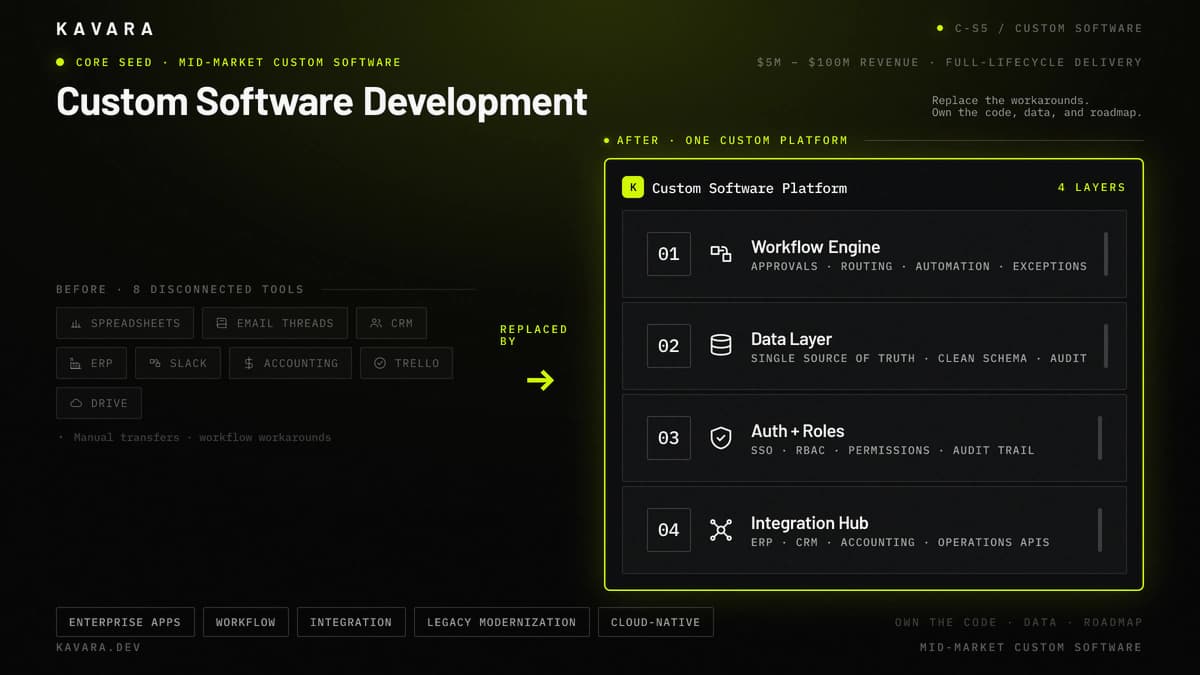
The diagram below shows the eight disconnected tools mid-market companies typically run replaced by one unified custom platform with four architectural layers.
What Is Custom Software Development
Custom software development is software engineering for business-specific workflows, data structures, user roles, and integrations that off-the-shelf products cannot satisfy. Custom software differs from generic web development because the architecture, database design, API structure, user roles, and deployment model are determined by the business problem, not by a template or packaged product.
Off-the-shelf tools serve common workflows, but common workflows break down when a company's operations become specific. A logistics business with carrier-specific exception handling, a healthcare organization with HIPAA-controlled intake flows, and a financial services team with approval logic tied to risk scoring all need different software behavior. The "custom" in custom software means deliberate engineering choices at every level, from database schema to access control to integration architecture.
The custom software spectrum ranges from focused internal tools solving one workflow problem to complex multi-service platforms processing millions of transactions. Custom web application development — covering SaaS platforms, portals, dashboards, and MVPs — is the most common category of custom software and our primary focus at Kavara. Our web application development services for mid-market teams sit inside the broader custom software category, which also includes enterprise desktop applications, native mobile applications, system-level integration tools, and embedded software.
Mid-market companies invest in custom software when tailored solutions become economically rational: the cost of workarounds, manual processes, vendor limitations, and disconnected systems exceeds the cost of building software that matches the business. The types of custom software we build each address distinct operational challenges — from automating internal workflows to modernizing legacy systems to connecting disparate enterprise platforms.
Types of Custom Software We Build
We build six categories of custom software for mid-market companies, each addressing distinct operational challenges:
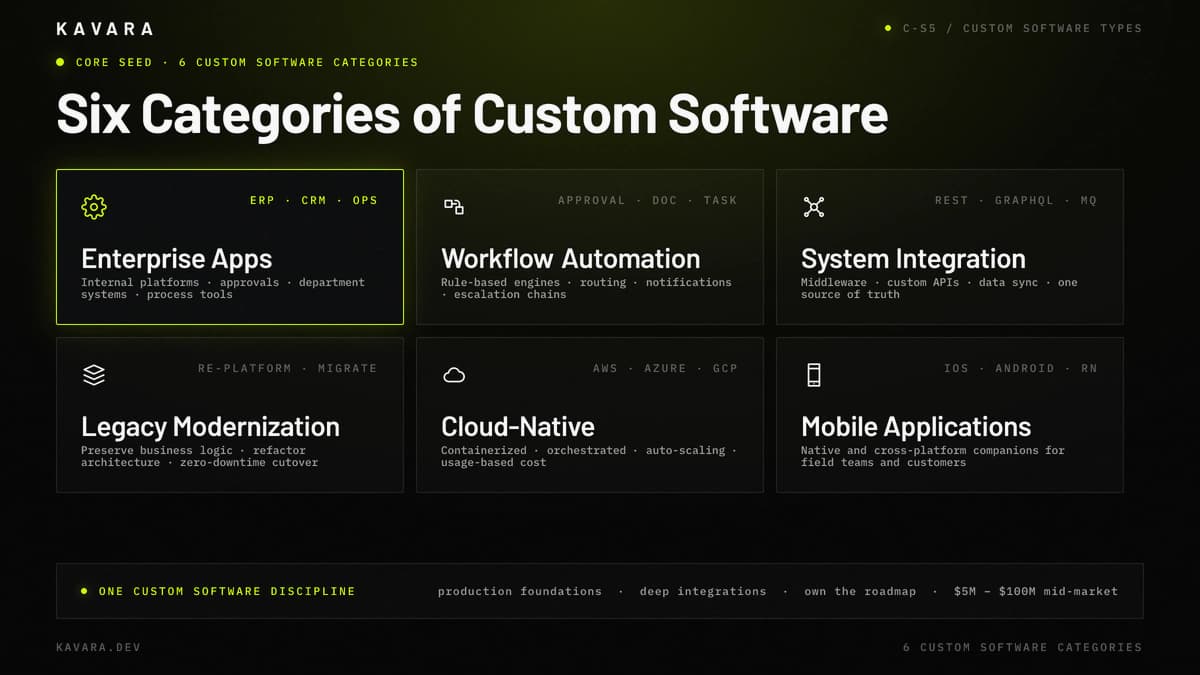
- Enterprise Applications — Enterprise applications are internal tools, business process platforms, and operational systems built for specific organizational workflows. Our internal business application development work covers ERP customization, CRM extensions, resource planning tools, and department-specific platforms that off-the-shelf solutions cannot accommodate. Enterprise software replaces the spreadsheets, manual approvals, and disconnected tools that slow operations as companies scale.
- Workflow Automation Systems — Workflow automation systems are rule-based applications that move tasks, documents, approvals, notifications, and exceptions through defined business processes. Custom workflow automation replaces manual handoffs with configurable logic that adapts as organizational processes evolve. Our workflow automation development builds configurable systems for approval chains, document workflows, notification engines, and task routing.
- System Integration and API Platforms — System integration platforms are middleware, custom APIs, and synchronization services that connect ERP, CRM, HRIS, accounting, and operational systems into unified data flows. Integration software eliminates manual data transfers and creates single-source-of-truth visibility across disconnected platforms. Our API development and system integration services connect enterprise systems through purpose-built middleware, secure APIs, and real-time data synchronization.
- Legacy Software Modernization — Legacy modernization is the process of re-platforming, re-architecting, or migrating aging systems to modern technology without disrupting ongoing operations. Modernization preserves business logic and institutional data while replacing outdated interfaces, insecure infrastructure, and brittle deployment patterns. Our legacy software modernization practice moves aging systems to modern architectures while protecting the operational knowledge embedded inside them.
- Cloud-Native Applications — Cloud-native applications are software systems designed for cloud infrastructure from the ground up: containerized, orchestrated, auto-scaling, monitored, and resilient. Cloud-native architecture reduces capacity planning constraints and aligns infrastructure cost with actual usage. Our cloud-native application development delivers applications designed for AWS, Azure, or Google Cloud deployment from the first architecture decision.
- Mobile Applications — Mobile applications are native iOS, Android, or cross-platform apps that extend custom software capability to field teams, customers, and users beyond the desktop browser. Mobile work has its own platform, performance, and store-compliance requirements distinct from web custom software. For native and cross-platform mobile architecture, cost ranges, and development methodology, see our mobile application development services.
These categories often overlap in practice. A legacy modernization project may include API integration, and an enterprise application may require workflow automation. Custom software development addresses the intersection of these needs when one packaged product cannot support the full operational model.
Beyond these six categories, custom software also encompasses the application types covered by our dedicated service practices: SaaS platforms, enterprise portals, analytics dashboards, and MVPs. SaaS application development is the most common category of custom software for companies building subscription-based software products for their own customers. These categories explain what we build; the investment decision depends on why a company has outgrown generic tools.
Why Mid-Market Companies Invest in Custom Software
Mid-market companies invest in custom software when operational complexity exceeds what generic tools can handle. Generic tools serve generic workflows. When business logic diverges from a vendor's assumptions — unique approval chains, proprietary data models, industry-specific compliance, or unusual customer workflows — off-the-shelf software creates workarounds that compound into operational drag.
Mordor Intelligence's 2026 market analysis estimates custom software development at USD 50.94 billion in 2026 and forecasts USD 115.95 billion by 2031, citing migration from packaged applications toward tailored systems for process, compliance, and differentiation.
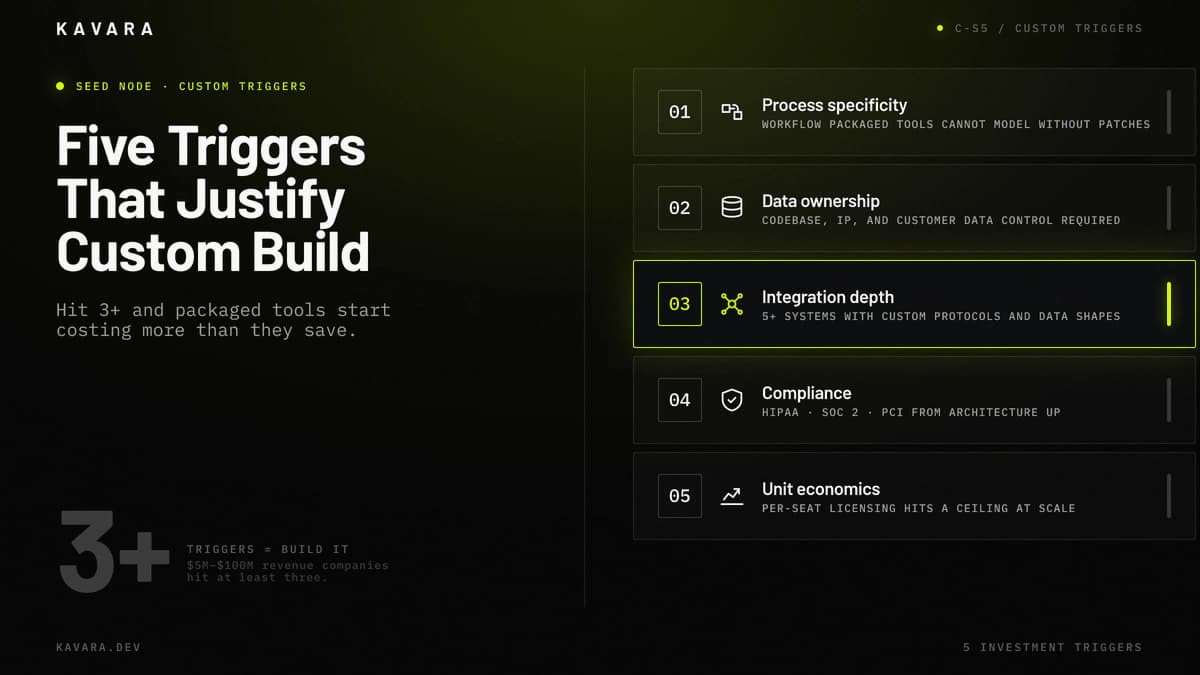
The scorecard below shows the five custom-development triggers — hit three or more and packaged tools start costing more than they save.
Custom software also gives the company ownership of the code, the data, and the roadmap. Data ownership and vendor independence matter when a business cannot tolerate per-seat pricing surprises, forced migrations, missing features, or vendor-controlled release cycles. The software evolves on the company's schedule because the company controls the application instead of waiting for a vendor to prioritize the request.
Competitive differentiation is another reason mid-market companies build custom software. Off-the-shelf software gives every competitor the same operational capabilities. Custom software creates advantages that cannot be replicated by purchasing the same subscription, especially when the application encodes proprietary process knowledge, pricing logic, customer experience, or decision workflows.
Integration and consolidation become decisive when teams maintain five or more disconnected tools for one workflow. Custom software can consolidate those tools into a unified platform with shared data, role-based access, and consistent reporting. Regulated industries add another requirement: compliance architecture. Healthcare, financial services, education, and payment workflows need HIPAA, SOC 2, FERPA, or PCI controls built into the architecture instead of added after launch.
Understanding the custom vs off-the-shelf decision framework — including total cost of ownership, flexibility analysis, and decision criteria — is critical for companies evaluating whether generic tools still serve their growth trajectory. Making the decision to build custom is the first step; the next is ensuring the architecture supports the business for years, not months.
Custom Software Architecture and Technology
Custom software architecture follows the same pragmatic approach across all application types: choose the technology that serves the project's actual requirements, not the technology that generates the most conference talks. Kavara selects technology based on performance needs, long-term maintainability, ecosystem maturity, integration requirements, and the talent pool available to support the system after launch.
Cloud and hybrid deployment pressure makes integration, data synchronization, and operational visibility part of custom architecture from the first design decision.
The architecture diagram below shows the five layers of a custom software platform, with integration hub as the differentiator that packaged tools refuse to expose.
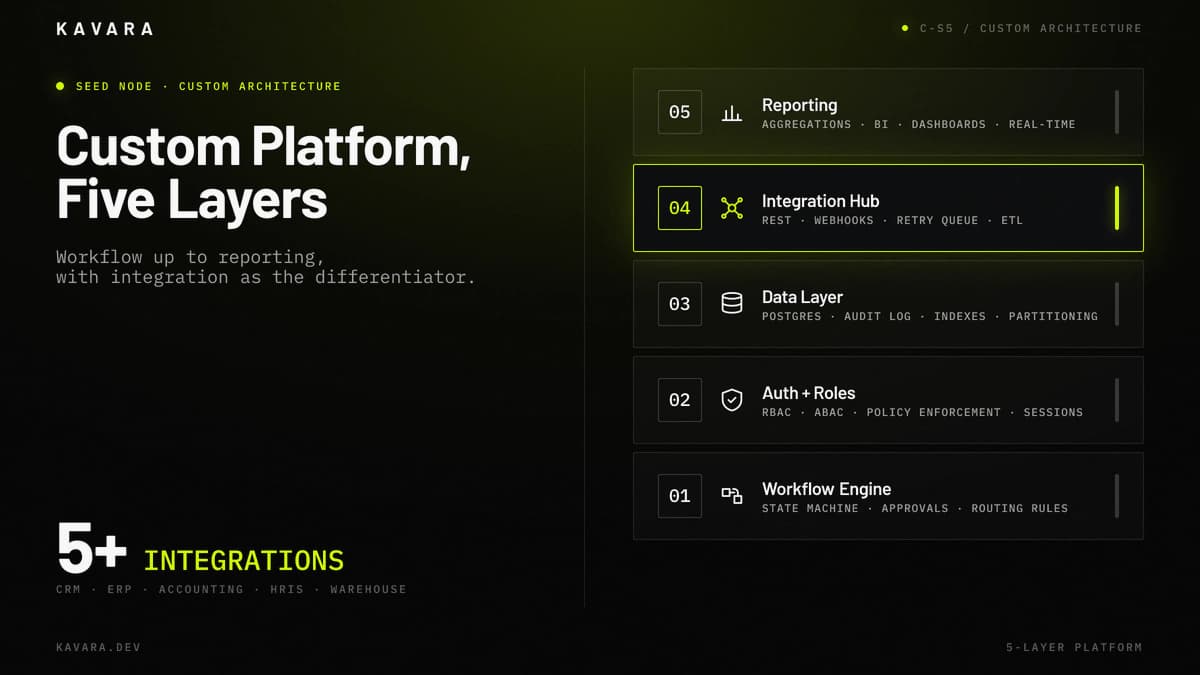
The table below maps those functional layers to technology choices.
| Layer | Technologies | Rationale |
|---|---|---|
| Workflow Engine | Node.js or Go services, state machines, job queues | Encodes approvals, routing rules, exceptions, and automation logic as maintainable software behavior |
| Auth + Roles | SSO, RBAC, ABAC, policy enforcement | Protects sensitive workflows with role-based access, permission boundaries, sessions, and audit trails |
| Data Layer | PostgreSQL, MongoDB, Redis | Stores business records, audit logs, document-heavy models, relational data, indexes, and cache-heavy workloads |
| Integration Hub | REST, GraphQL, webhooks, ETL queues | Connects ERP, CRM, accounting, HRIS, and operations APIs through reliable synchronization patterns |
| Reporting | SQL views, BI dashboards, event streams | Turns operational data into real-time visibility, executive reporting, and workflow performance measurement |
This functional layer model keeps each technology decision tied to business behavior: workflow, access, data, integration, and reporting.
Architecture decisions follow the project, not the trend. We deploy microservices when independent scaling of discrete services is required, monolithic architecture when simpler deployment serves the requirements, and serverless functions for event-driven workloads. Pragmatism prevents over-engineering while still protecting scalable architecture.
The architecture layer connects directly to existing enterprise systems, so API design, authentication, observability, and deployment pipelines matter from the beginning. Our production application architecture guide covers the architectural patterns — monolithic vs microservices, database selection, scalability strategies — that inform every custom software project. Architecture and technology selection happen within a structured development process that produces predictable outcomes for mid-market companies.
Our Custom Software Development Process
We build custom software through a structured seven-phase development process: discovery and scoping, UX/UI design, architecture and technology selection, agile development in two-week sprints, quality assurance, deployment, and ongoing support. Each phase produces specific deliverables and requires stakeholder sign-off before the project proceeds.
PMI's 2026 Pulse of the Profession report found that 31% of complex projects fail to achieve intended benefits, more than twice the overall project rate, so Kavara treats stakeholder sign-off as an operating control.
Discovery defines requirements, business logic, integration points, compliance needs, and success metrics. Design translates those requirements into user flows and interface systems. Architecture selects the stack, data model, API strategy, and deployment model. Development ships working software in sprint increments. QA validates functionality, security, performance, and edge cases. Deployment moves the software into production with monitoring and rollback plans. Support keeps the application secure, stable, and aligned with user feedback after launch.
This phase-gate process prevents the scope drift and architectural rework that cause cost overruns in custom software development services. Learn more about our complete Kavara development process, including timelines, deliverables, and communication structure for each phase. The investment required for custom software development varies by application type and complexity — from focused internal tools to complex enterprise platforms.
How Much Does Custom Software Development Cost
Custom software development typically costs between $50,000 and $500,000 or more depending on application complexity, feature scope, technology requirements, and team composition.
Clutch's May 2026 pricing data reports an average verified software-development project cost of $132,480.29 and a usual timeline of about 13 months, so these are planning bands.
The chart below positions the five core non-mobile categories on a shared $0K to $500K scale, with legacy modernization carrying the widest range.
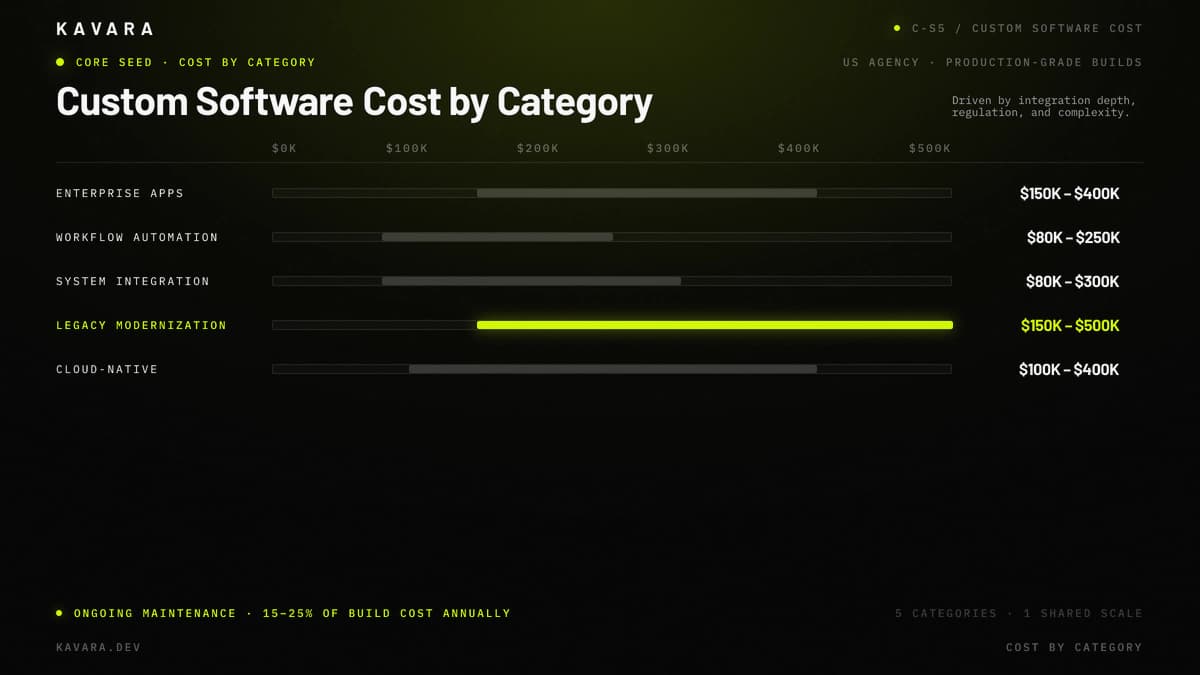
Core category ranges are $150,000 to $400,000 for enterprise applications, $80,000 to $250,000 for workflow automation, $80,000 to $300,000 for system integration and API platforms, $150,000 to $500,000 or more for legacy modernization, and $100,000 to $400,000 for cloud-native application development.
Ongoing maintenance usually adds 15% to 25% of the initial build cost annually for hosting, monitoring, security updates, bug fixes, dependency updates, and feature iteration. For SaaS platform pricing, portal cost ranges, dashboard development cost, MVP cost tiers, and the broader cost comparison across all web application types, read our complete web application development cost guide. Cost establishes the budget boundary; the next question is whether custom software is the right investment compared with off-the-shelf alternatives.
Should You Build Custom Software or Use Off-the-Shelf
Build custom when off-the-shelf tools create workflow friction, limit competitive differentiation, or cannot meet compliance requirements specific to your industry. Use off-the-shelf software when standard features meet 80% or more of your needs and customization is not a competitive factor.
Custom software is the right investment when one workflow depends on five or more disconnected tools, when staff spend significant hours transferring data manually, when compliance requires architecture-level controls, or when competitive advantage depends on unique capabilities. Custom software also fits when integration depth matters more than feature breadth because the business needs one operational system instead of several disconnected products. Off-the-shelf works when the use case is generic, vendor support reduces operational burden, and five-year licensing cost remains lower than custom build and maintenance.
The right decision depends on total cost of ownership, flexibility, integration depth, and strategic value. Read our custom vs off-the-shelf comparison for a detailed decision framework including TCO analysis.
How Long Does Custom Software Development Take
Custom software development typically takes 3 to 12 months from discovery to launch, depending on complexity, scope, and team size. MVPs and internal tools usually take 2 to 4 months. SaaS platforms and portals usually take 4 to 8 months. Complex enterprise applications with extensive integrations, migration requirements, and compliance controls usually take 8 to 12 months or more.
Timeline depends on three primary factors: scope clarity at the beginning, stakeholder decision speed during design and review, and integration complexity with external systems. System integration can add weeks when legacy platforms have limited API documentation, inconsistent data quality, or manual approval requirements. Projects with documented requirements, empowered decision-makers, and well-understood integration targets launch faster because the development team can move through discovery, build, deploy, and validation without unresolved business decisions blocking the schedule.
What Industries Need Custom Software
Custom software serves industries where operational complexity, regulatory requirements, or competitive differentiation demands technology tailored to specific workflows:
- Healthcare — HIPAA-compliant patient management, clinical workflows, and EHR integration. Our healthcare application development practice architects regulated software from the foundation.
- Financial services — SOC 2 and PCI-aware transaction processing, compliance monitoring, and reporting systems.
- Real estate — Property management, MLS integration, transaction platforms, and stakeholder portals.
- Logistics — Fleet management, shipment tracking, route optimization, and carrier API integration.
- Education — FERPA-aware student portals, LMS platforms, assessment tools, and role-based data access.
- Manufacturing — Production scheduling, quality management, IoT monitoring, and ERP-connected operations.
For many organizations, enterprise portal development becomes the entry point for custom software investment because portals centralize stakeholder access, document management, and workflow automation across departments.
How to Choose a Custom Software Development Company
Evaluate five criteria when choosing a custom software development company: technical expertise with your required stack, relevant industry experience and case studies, transparent development process and communication structure, team composition and retention, and post-launch support commitment.
Technical expertise means production experience, not surface familiarity. Industry experience matters when compliance, data models, and user expectations shape architecture. Process transparency shows how the team manages sprints, demos, change requests, and risks. Team composition reveals whether senior engineers will start and finish the project. Post-launch support determines whether bugs, security updates, and feature iteration are handled after launch.
For comprehensive evaluation frameworks, specific interview questions to ask development partners, and red flags to watch for during selection, read our guide to choosing a web application development company.
Next Steps
Custom software development gives mid-market companies technology engineered to specific operations, compliance requirements, and competitive strategy. Custom software replaces the workarounds, manual processes, and disconnected tools that accumulate as companies outgrow off-the-shelf solutions. Kavara builds, launches, and engineers custom software across enterprise applications, workflow automation, legacy modernization, cloud-native development, SaaS platforms, portals, dashboards, and MVPs.
Explore how custom web application development connects to Kavara's broader web application development services across SaaS, portal, dashboard, MVP, and enterprise software categories. request a scoping conversation to start a discovery conversation and scope a custom software build from requirements through production launch.