MVP Development Services
MVP development is the process of building a product with the minimum feature set required to validate a market hypothesis with real users — not a rough prototype, but a production-quality application with enough functionality to prove whether the market will pay for what you are building. The value of MVP development comes from resolving a practical tension: build fast enough to validate before budget runs out, but build well enough that the application does not need to be rebuilt when the market says yes.
Kavara builds MVPs for two buyer types. Startup founders use MVP development services to launch new products, test demand, raise funding, and iterate from real user behavior. Enterprise innovation teams use MVP development to validate internal tools, new workflow platforms, or productized business capabilities inside established organizations. Both groups need validation speed, but both also need production-grade foundations: authentication, clean data architecture, API design, basic security, and deployment infrastructure that can scale. Companies that build web applications through an MVP model need speed and discipline in the same plan.
CB Insights' current startup failure analysis identifies poor product-market fit as a leading cause, cited in 42% of analyzed shutdowns. MVPs exist to prevent that failure mode. A minimum viable product gives users something real to try, pay for, reject, request, and use repeatedly. Custom web application development for an MVP should therefore reduce features, not engineering discipline. Kavara builds MVPs designed to validate and scale — narrow enough to launch quickly, stable enough to support the next phase when evidence justifies expansion.
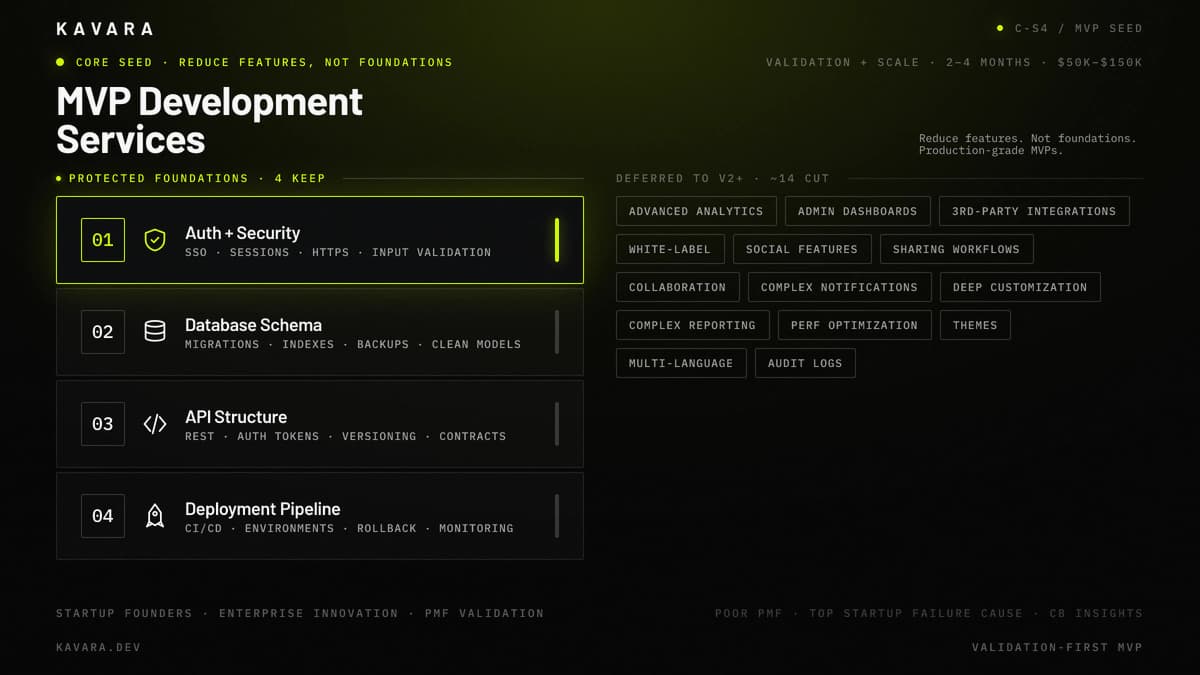
The diagram below shows the four protected foundations on the left versus the fourteen deferred V2+ features on the right.
What Is MVP Development
MVP development is a validation-focused application development process that builds the smallest complete product capable of testing a market hypothesis with real users. MVP development is not a compromise on quality; it is a deliberate constraint on scope so the product can launch, collect evidence, and avoid speculative feature investment.
"Minimum" means the minimum set of features required to test a specific hypothesis. Minimum does not mean half-built workflows, broken onboarding, or placeholder functionality that users cannot trust. A strong minimum viable product includes a complete core workflow, secure user access, enough onboarding to reach value, and enough measurement to determine whether users activate, return, and pay.
"Viable" means users can actually use the product to accomplish the core task. Viable products are reliable, professional, and clear enough to generate meaningful behavior. An MVP that embarrasses users does not validate the market; it validates that poor execution produces poor reception. MVP development falls within the broader custom web application development category — the same engineering discipline applies, with a deliberately constrained feature scope and accelerated timeline.
"Product" means a real deployable application, not a prototype, proof of concept, or investor demo. A proof of concept proves technical feasibility. A prototype tests user experience and interaction flow. An MVP tests whether users will pay for the solution, return to the product, and request improvements that confirm the market direction. In that sense, an MVP is a deliberately scoped custom software development project — the same production standards, with a feature set optimized for validation speed.
Understanding what an MVP is clarifies who builds them, and the answer extends beyond the startup world.
Who Builds MVPs and Why
Kavara builds MVPs for two buyer profiles: startup founders chasing product-market fit and enterprise innovation teams validating internal capabilities. Their constraints differ, but both need production foundations that can survive real users.
The comparison below contrasts the two MVP buyer profiles — startup founders and enterprise innovation teams — on scope and cost.
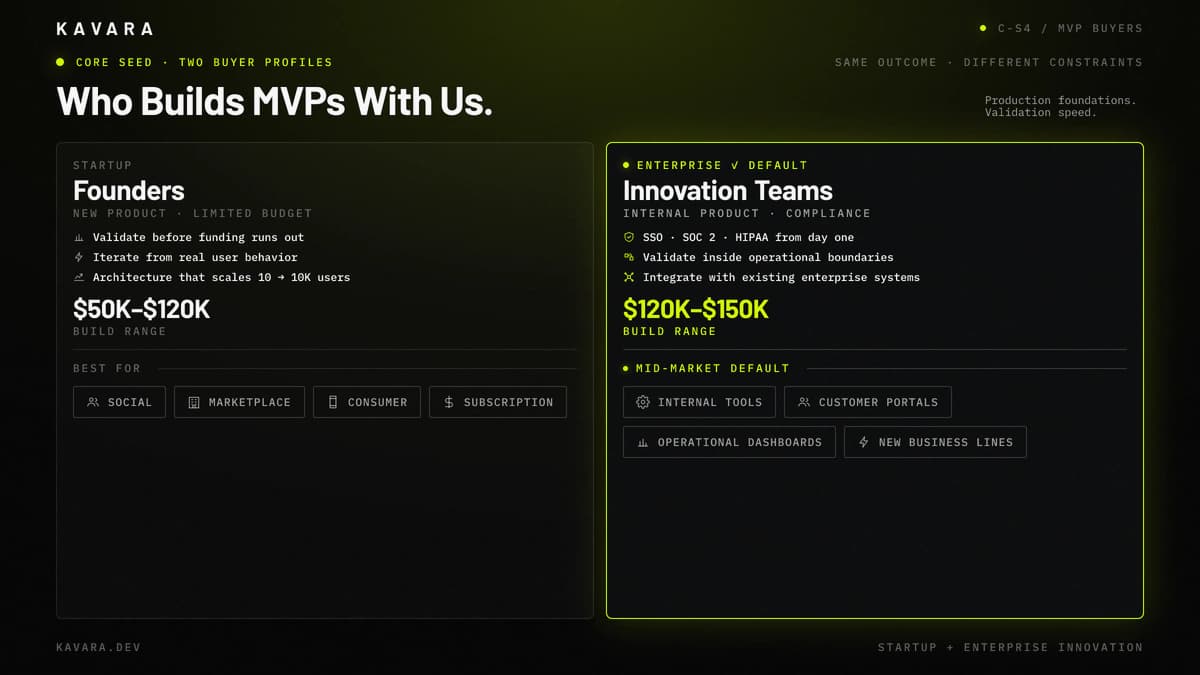
Startup founders build MVPs to test whether a product deserves more capital before funding or market timing runs out. Most startup MVPs fit the $50,000 to $120,000 validation or launch-ready ranges because they narrow scope to one core workflow, onboarding, payment when needed, and enough analytics to prove demand. The goal is to prove users understand the value proposition and will pay without sacrificing scalable architecture from 10 users to 10,000.
Enterprise innovation teams need evidence before committing full organizational resources. Mid-market companies use MVP development to validate internal workflow tools, customer portals, operational dashboards, or new business lines while controlling budget and risk. Enterprise MVPs usually occupy the $120,000 to $150,000 range when SSO, SOC 2 expectations, HIPAA-aligned workflows, audit logging, procurement rules, or existing-system integrations are required.
Despite different contexts, both buyer types need the same outcome: a product complete enough to generate real user data and architectural enough to support expansion without rebuilding. Product-market fit is discovered through evidence that users engage with the core functionality, return for value, and show willingness to pay or adopt the workflow.
MVPs also need the operating discipline of custom web application development because the validation product is still a production application. A validation build may defer advanced reporting, admin automation, integrations, or white-labeling, but it still needs secure authentication, a maintainable database, a deployment pipeline, and enough analytics to support a decision. Kavara's web application development services preserve the path from MVP validation into SaaS, portal, dashboard, or custom software expansion.
But what does validation-first development actually look like in practice? It defines the hypothesis before the feature list, prioritizes learning speed over feature count, and measures real user behavior instead of speculative functionality. Both startup and enterprise MVPs succeed through the same methodology — validation-first development that prioritizes learning over feature count.
Our MVP Development Approach
We build MVPs through a validation-first approach that prioritizes learning speed over feature count — shipping the smallest product that generates the most learning about whether the market wants what you are building. Every feature is sorted through MoSCoW prioritization — must-have, should-have, could-have, won't-have — so the scope cut is explicit before the first sprint.
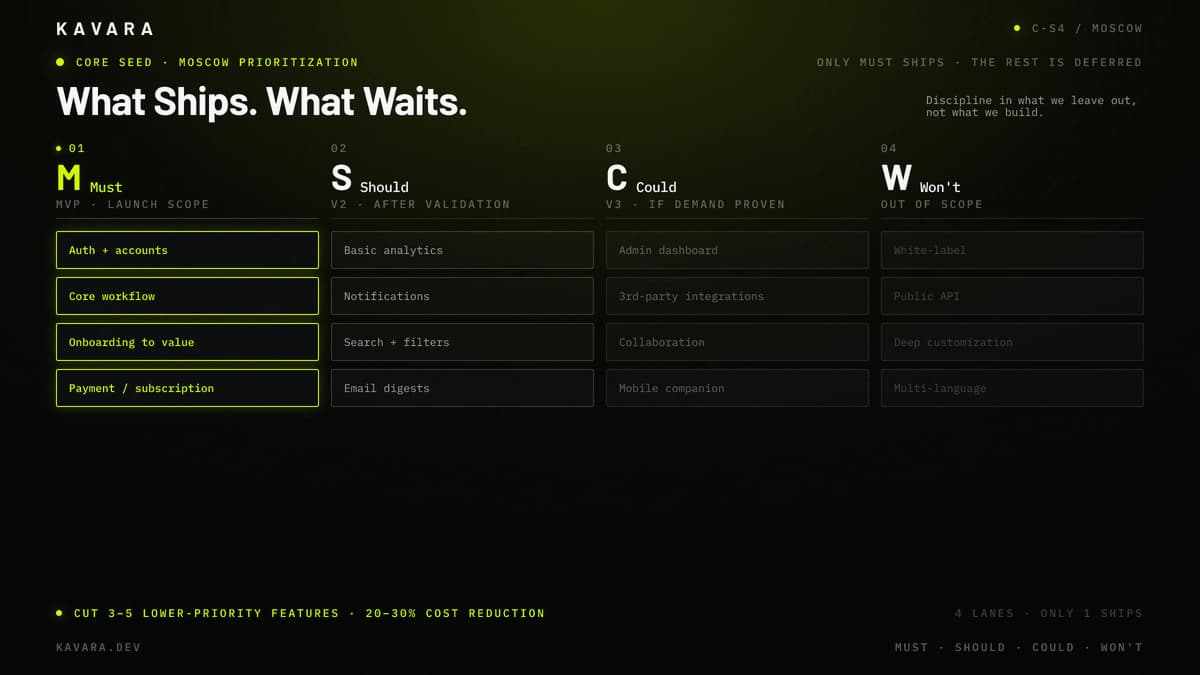
The MoSCoW board below shows the four lanes — Must, Should, Could, Won't — with only the Must lane shipping in the MVP.
- Hypothesis Definition — Define what you are testing before feature planning because MVP development exists to test a claim. "Users will pay $99 per month to automate this reporting workflow" is a testable hypothesis. "Build a great dashboard" is not. Every feature in the MVP must connect to the hypothesis, or the feature becomes scope noise.
- Feature Prioritization — Use MoSCoW categories: must-have features go into the MVP, should-have features move to version two, and could-have or won't-have features are explicitly deferred. Cutting three to five lower-priority features can reduce development cost by 20% to 30% without damaging validation value. The discipline is not in what the team builds; the discipline is in what the team leaves out.
- Architecture for Scale Without Over-Engineering — Keep the foundations production-grade while limiting the feature set. Authentication, database schema, API design, basic security, and deployment infrastructure are not optional. These foundations may require 10% to 15% of the MVP budget, but they can save three to five times that cost if the minimum viable product validates and the platform scales.
- Rapid Development — Run two-week agile sprints with working features delivered every 14 days. Stakeholders review software, not status reports. Proven technology stacks such as React, Next.js, Node.js, Python, and PostgreSQL keep delivery predictable because MVP development is not the right place to experiment with immature frameworks.
- Launch and Measure — Put the MVP in front of real users so the team can measure sign-ups, activation, retention, workflow completion, willingness to pay, and support friction. The MVP succeeds when the team has enough data to decide whether to double down, pivot, or stop. Launch is not the finish line; launch is when validation begins.
- Iterate or Scale — Expand the product only after usage data identifies what matters. If the MVP validates, Kavara expands features based on real behavior and customer requests. If the MVP does not validate, the team can pivot with limited sunk cost. Our complete MVP development process guide details the phase-by-phase timeline, deliverables, and how we manage the build-measure-learn cycle from concept through launch and iteration.
This methodology works because the MVP architecture is designed to support both outcomes — scaling when validated and pivoting when the data says otherwise.
MVP Architecture: Building for Today Without Blocking Tomorrow
The most expensive MVP mistake is building something that works for 10 users but requires complete re-architecture for 1,000. The second most expensive mistake is over-engineering for 1,000 users when you have not yet proven that 10 will pay. Standish Group CHAOS research has long put outright IT project success near 35%, so custom web application development for an MVP should reduce uncertainty before the team expands scope.
The architecture diagram below maps the four MVP foundations — auth, database schema, API structure, deployment pipeline — that cannot be deferred without a 3 to 5 times retrofit cost.
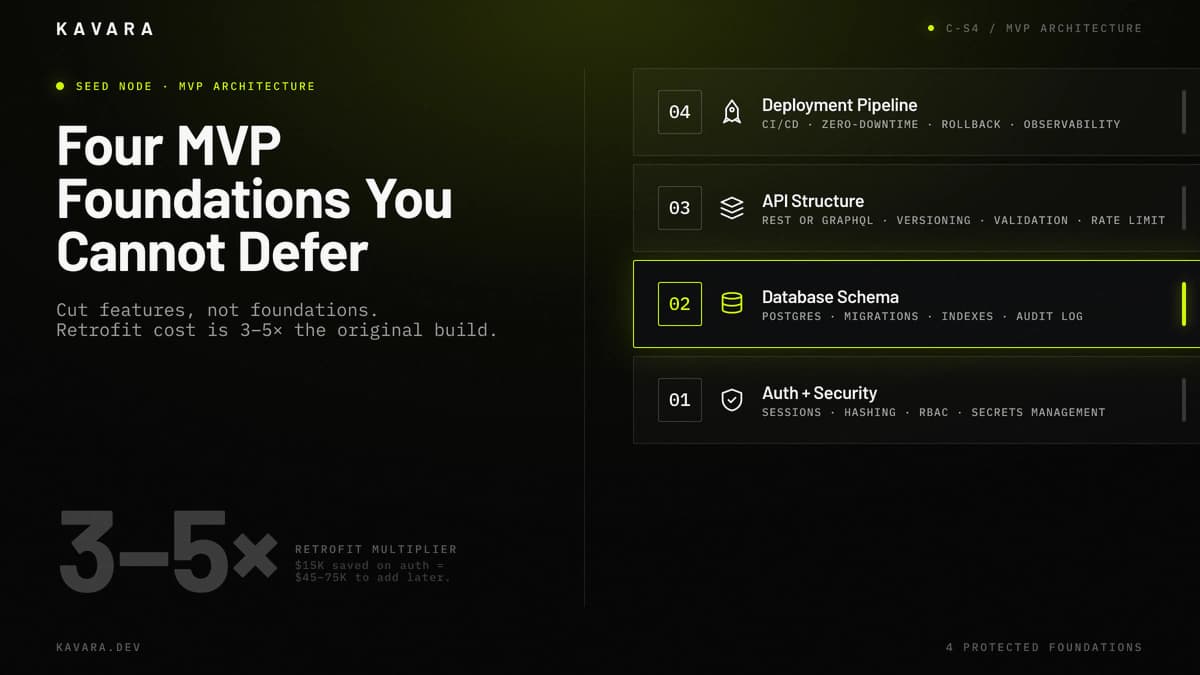
Production-grade MVP architecture starts with non-negotiable foundations. Authentication and authorization protect accounts and permission boundaries; a $15,000 shortcut on authentication can become a $45,000 to $75,000 retrofit once permissions, sessions, and data models depend on the original decision. Clean database schema keeps later migrations manageable. Well-designed API structure is the contract between frontend and backend, so changing it later breaks dependent workflows. Scalable architecture at the MVP stage means preserving these foundations without pretending the first release needs every future feature.
Basic security also belongs in the first MVP release. HTTPS, input validation, SQL injection prevention, secure session management, and sensible access control are not enterprise luxuries. Security failures destroy trust before the product has time to validate. SaaS MVPs require additional foundations — multi-tenant data isolation and basic subscription billing — as our SaaS application development approach details.
MVP architecture can defer scope without deferring foundations. Advanced analytics can wait while basic event tracking proves activation and retention. Admin dashboards can wait while low-volume operations run through controlled database workflows. Integrations, white-labeling, deep customization, complex reporting, and performance optimization can wait until traffic or customer commitments justify the investment.
The technical debt equation is direct: every shortcut taken during MVP development creates a future cost. Deferred features preserve budget and learning speed. Skipped foundations create compounding technical debt because every later feature builds on unstable ground. The architectural foundations every MVP should include — authentication, database design, API structure — follow the same patterns detailed in our MVP web application architecture guide, scoped for validation speed rather than feature completeness.
The technology choices that enable this balance — proven frameworks, mature ecosystems, and deep talent pools — are selected for MVP reliability, not experimentation.
MVP Technology Stack
MVP technology selection optimizes for three criteria: development speed, talent availability, and scalability runway. In custom web application development, the right stack helps the team ship fast, hire or transition efficiently, and scale without re-platforming if validation succeeds.
The stack diagram below shows the six-layer proven MVP stack picked for ramp speed and hireability.
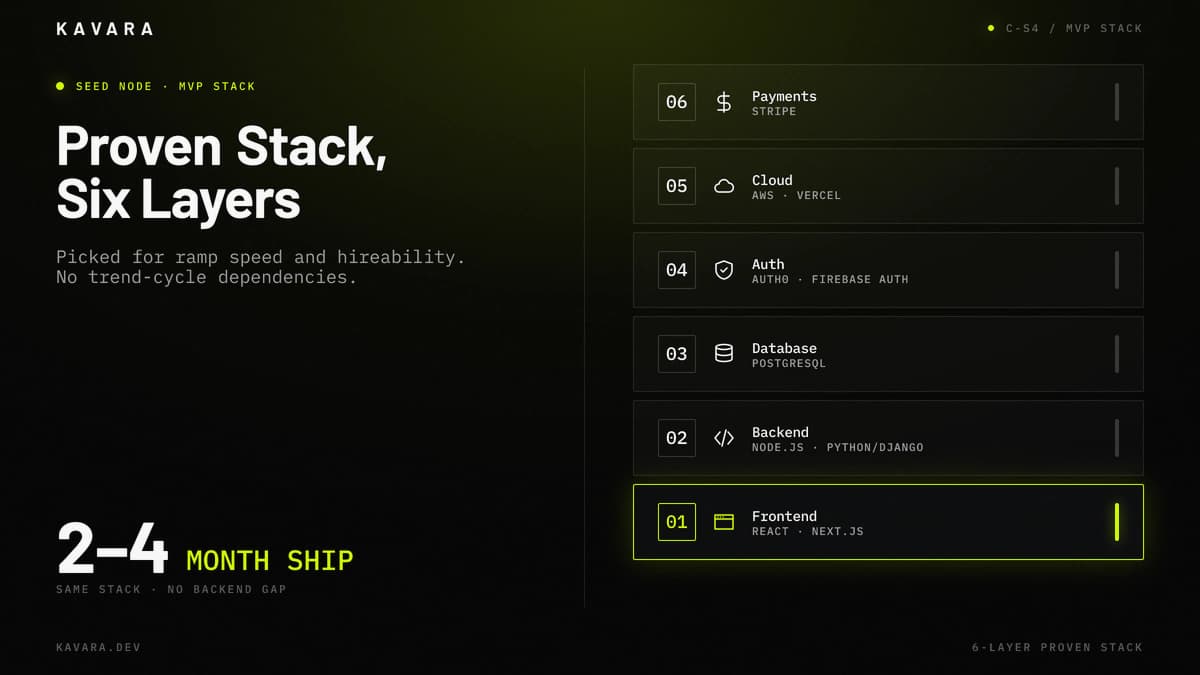
| Layer | Technologies | MVP-Specific Rationale |
|---|---|---|
| Frontend | React, Next.js | Largest ecosystem, fastest hiring, and component reuse that accelerates development |
| Backend | Node.js, Python/Django | Node.js supports real-time features, while Python/Django supports rapid prototyping with built-in admin patterns |
| Database | PostgreSQL | Battle-tested, migration-friendly, and scalable from MVP to enterprise without switching databases |
| Auth | Auth0, Firebase Auth | Pre-built authentication eliminates two to four weeks of development and reduces security risk |
| Cloud | AWS, Vercel | AWS supports production infrastructure, while Vercel accelerates frontend deployment |
| Payments | Stripe | Fast path to accepting payments, subscriptions, invoices, and usage-based billing |
MVP development should use proven technology because the product already carries market risk. Experimental frameworks add technology risk through smaller talent pools, weaker documentation, fewer battle-tested patterns, and higher maintenance uncertainty. When time-to-market determines whether the product survives, technology risk is unacceptable.
Proven technology and constrained feature scope keep MVP development cost predictable — and significantly lower than full product development.
How Much Does MVP Development Cost
MVP development costs between $50,000 and $150,000 depending on feature scope, design requirements, and compliance needs. Validation MVPs with a core hypothesis and basic design typically cost $50,000 to $80,000. Launch-ready MVPs with polished UX, authentication, basic analytics, and production infrastructure typically cost $80,000 to $120,000. Enterprise MVPs with compliance architecture, system integration, SSO, or advanced security typically cost $120,000 to $150,000.
These ranges reflect US-agency web application development services for production-quality MVPs, not offshore prototypes or no-code demos. A validation MVP should still have secure authentication, a stable database, working deployment infrastructure, and enough tracking to measure whether users activate and return. For detailed MVP cost breakdowns by feature scope, phase-by-phase budget allocation, and strategies for controlling cost without cutting architectural quality, see our complete MVP development cost and timeline guide.
MVP cost stays controlled through ruthless feature prioritization, proven technology stacks, design system reuse, and phased development. Cost inflates when scope creep hides behind "just one more feature," when every screen requires custom design, or when the team optimizes for a scale level that has not been validated. For cost comparisons across all application types including SaaS, portals, and dashboards, see our complete application development cost guide.
Cost tells only part of the planning story because MVP development also depends on timeline discipline and the ability to iterate after launch without reworking the foundation.
How Long Does It Take to Build an MVP
MVP development typically takes 2 to 4 months from concept to launch, depending on feature scope, design requirements, and integration complexity. Validation MVPs usually take 2 to 3 months. Launch-ready MVPs usually take 3 to 4 months. Enterprise MVPs with compliance requirements, SSO, or system integration usually take 4 to 5 months.
Feature scope discipline is the primary timeline factor. Every feature added beyond the core hypothesis can add one to two weeks because each feature requires UX, development, QA, deployment, and measurement. The fastest MVPs are not the ones with rushed engineering; the fastest MVPs are the ones with disciplined feature boundaries. That scope discipline also explains why an MVP is different from earlier validation artifacts.
What Is the Difference Between an MVP, a Prototype, and a Proof of Concept
A proof of concept tests whether an idea is technically feasible. A prototype tests whether the user experience works. An MVP tests whether the market will pay.
A POC is a technical experiment with no complete UX and no real user workflow. It answers, "Can we build this?" A prototype is an interactive design model, often built in Figma or another design tool, that tests user flows, screen structure, and interface comprehension. It answers, "Does the experience feel right?" A minimum viable product is real software with real users, real data, and real usage measurement. It answers, "Will people use this enough to justify building more?"
Each artifact answers a different question at a different stage. Some products need all three sequentially. Others can skip directly to MVP development when feasibility and UX are already understood. Once the team chooses MVP development instead of a prototype or POC, the next question is when the validated product deserves full-product investment.
When Should You Move from MVP to Full Product
Move from MVP to full product development when you have validated three conditions: users are consistently engaging with the core functionality, a measurable percentage are willing to pay or already paying, and the most-requested features align with your product vision.
Expansion signals include retention metrics showing users return after initial use, conversion from free to paid exceeding 2% to 3% for SaaS MVPs, feature requests clustering around a coherent product direction, and customer support inquiries showing users pushing against intentional feature boundaries. Stop or pivot signals include sign-ups without repeat usage, active usage without willingness to pay, or feature requests that pull the product away from the original hypothesis.
For a complete framework on when to transition from MVP to full product including risk assessment, validation metrics, and scaling strategies, see our MVP vs full product decision guide. That transition decision depends on which features were intentionally kept inside the MVP scope.
What Features Should an MVP Include
An MVP should include the minimum features required to test your core hypothesis — typically 3 to 7 must-have features identified through MoSCoW prioritization.
Every MVP needs:
- A core workflow that delivers the product's primary value
- User authentication and account management
- Basic onboarding that gets users to value quickly
- Payment or subscription capability when revenue is part of the hypothesis
These features make the minimum viable product real enough to validate behavior instead of opinions.
Common features to defer include:
- Advanced analytics beyond basic event tracking
- Full admin dashboards before operational volume requires them
- Third-party integrations beyond the core value proposition
- Complex notification systems
- Social features, sharing workflows, and collaboration tools
- White-labeling and deep customization
Basic event tracking is enough at first. Database-managed operations are enough at first. Feature prioritization happens during our development process, where stakeholder interviews and user research define the hypothesis and the minimum feature set required to test it.
The discipline is simple: if a feature does not help prove or disprove your market hypothesis, it does not belong in the MVP.
Next Steps
MVP development helps startups and enterprise innovation teams build and launch validation-first products that can scale when the market responds. The key distinction is that MVPs reduce features, not architectural quality. Production-grade foundations such as authentication, database design, API structure, and deployment infrastructure may add 10% to 15% of the MVP budget, but they can save three to five times that cost if the product validates. Explore our full custom web application development services to see how MVPs scale into SaaS platforms, portals, dashboards, and enterprise software. Discuss your project with Kavara to define your hypothesis, prioritize your feature set, and scope your MVP build.