How Much Does MVP Development Cost
MVP development costs between $50,000 and $150,000 depending on feature scope, design requirements, and compliance needs. The difference between a $50,000 MVP and a $150,000 MVP is not arbitrary. A validation MVP testing one market hypothesis and an enterprise MVP with compliance architecture, SSO, audit logging, and system integration are fundamentally different engineering efforts.
Founders building investor pitch decks and enterprise innovation leads building internal business cases both need accurate MVP development cost data before they evaluate proposals or commit budget. Offshore rate cards often mix $10,000 prototypes with production builds, which makes cost planning unreliable. Kavara uses US-agency ranges for production-grade MVP development because a minimum viable product is a deployable application that includes only the features required to test a core business hypothesis; it is not a demo that fails when real users arrive. For Kavara, MVP development sits inside custom web application development: we build web applications that can launch quickly, integrate essential systems, and scale only after validation.
MVP cost is a validation investment, not a full product development expense. It measures how much it costs to learn whether a product should exist before committing full-product budget. CB Insights' recent startup failure analysis attributes 42% of identified failure causes to poor product-market fit, which makes validation speed a budget issue as much as a product issue. This page breaks down MVP development cost by tier, phase allocation, team model, hidden costs, and budgeting method so mid-market teams can build, launch, and validate with realistic numbers.
The diagram below shows the five cost determinants that shape every MVP budget, with feature scope as the largest driver.

What Determines MVP Development Cost
MVP development cost is determined by five factors that shape scope, delivery speed, and architectural quality. These cost drivers matter because an MVP reduces features, not the engineering foundations required to validate with real users.
Feature Scope is the largest development cost driver. A validation MVP with three to five core features costs fundamentally less than a launch-ready MVP with eight to twelve features. Each feature requires product definition, UX, frontend implementation, backend logic, testing, and documentation. Removing three low-priority features can reduce total cost by 20% to 30% without weakening validation if those features do not test the core hypothesis.
Design Requirements determine how much polish the first launch needs. Template-based UI using Tailwind, shadcn/ui, or a proven design system may cost $5,000 to $15,000. A custom design system with bespoke components, interaction states, and visual exploration may cost $15,000 to $30,000. MVPs should use proven design patterns unless design itself is part of the hypothesis.
Technology Stack affects delivery speed and risk. Proven stacks such as React, Next.js, Node.js, Python, and PostgreSQL cost less because common problems already have mature solutions. Experimental frameworks add unpredictable development time. Native mobile with Swift and Kotlin can cost 40% to 60% more than cross-platform React Native for equivalent MVP functionality.
Compliance Requirements increase cost when the MVP operates in healthcare, fintech, education, or enterprise environments. HIPAA, SOC 2, PCI, audit logging, data retention, encryption controls, and SSO can add $20,000 to $40,000. Compliance cannot be deferred when regulated users are part of the validation audience.
Integration Complexity adds cost through external services. Payment processing, transactional email, product analytics, CRM synchronization, and data import workflows each typically add $5,000 to $15,000. Our MVP development services control cost through ruthless feature prioritization and proven technology selection — the same approach that keeps these cost factors within predictable ranges.
These cost factors combine differently at each complexity level, creating three distinct MVP cost tiers with different feature sets, architectural requirements, and investment ranges.
MVP Development Cost by Complexity Tier
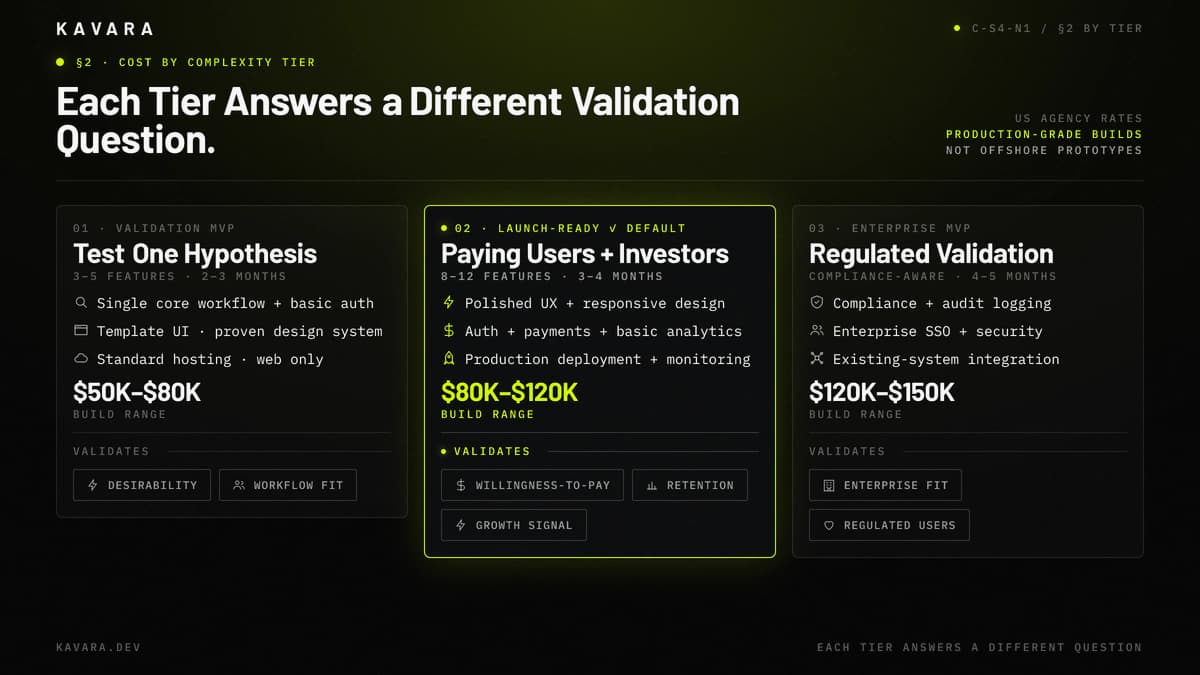
MVP development cost varies by complexity tier because each tier answers a different validation question. The following ranges reflect US-agency rates for production-grade MVP development, not offshore prototypes or no-code experiments.
| Tier | Cost Range | Timeline | Key Characteristics |
|---|---|---|---|
| Validation MVP | $50,000-$80,000 | 2-3 months | 3-5 core features, basic auth, template-based UI, single web platform, standard hosting |
| Launch-Ready MVP | $80,000-$120,000 | 3-4 months | 8-12 features, polished UX, auth and payments, basic analytics, production infrastructure |
| Enterprise MVP | $120,000-$150,000 | 4-5 months | Compliance architecture, enterprise SSO, advanced security, audit logging, system integration |
A validation MVP tests one core hypothesis with minimum spend. It may include login, one core workflow, basic onboarding, and limited analytics. A launch-ready MVP is ready for paying users and investor demos because it adds polished UX, payments, production deployment, and more complete support for the core workflow.
An enterprise MVP validates within organizational constraints. Enterprise MVP cost increases because security, compliance, SSO, audit logs, data controls, and existing-system integration must exist before internal users or regulated customers can participate. The jump from validation to launch-ready is primarily UX polish and payment integration. The jump from launch-ready to enterprise is compliance and security architecture. These jumps reflect real engineering work, not arbitrary pricing, because each tier changes what the minimum viable product must prove and who can safely use it.
Cost tiers tell you what the investment buys; phase allocation tells you where the money goes within each tier.
MVP Development Cost by Development Phase
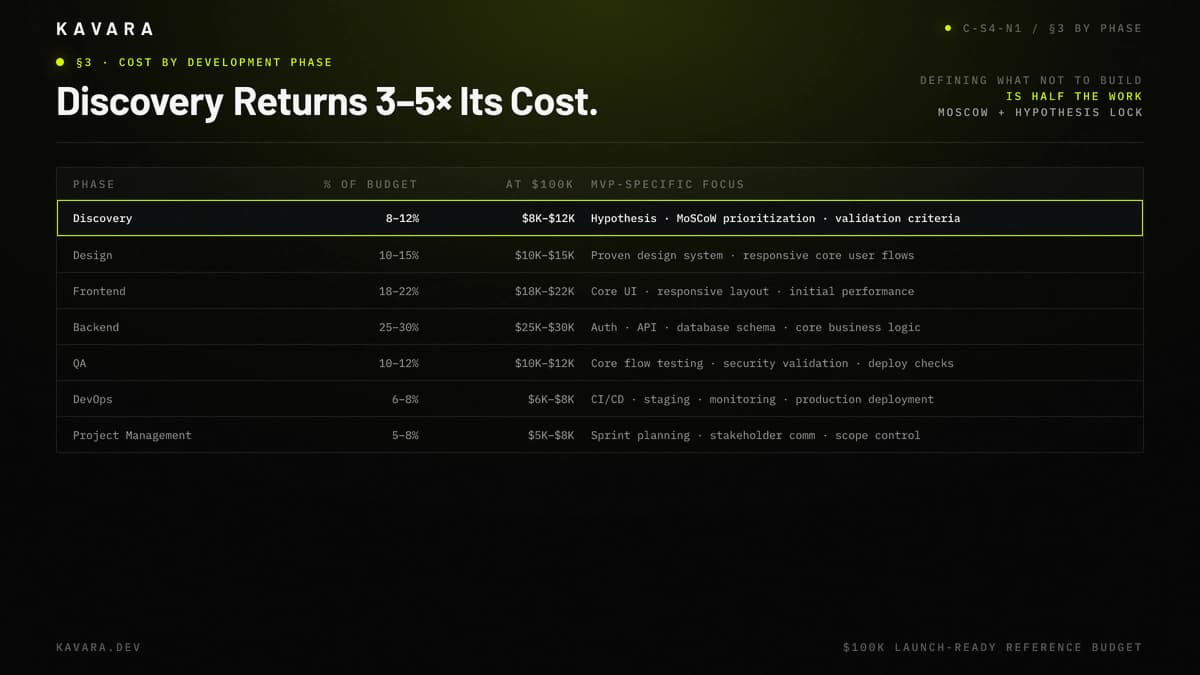
MVP development investment distributes differently than full product development. The following allocation is based on a $100,000 launch-ready MVP, the mid-range tier where most production MVPs fall. Discovery and architecture consume a larger percentage because validation-first projects must define what to build and what to defer before writing code.
| Phase | % of Budget | Estimated Cost at $100K | MVP-Specific Focus |
|---|---|---|---|
| Discovery | 8-12% | $8,000-$12,000 | Hypothesis definition, feature prioritization, competitive validation |
| Design | 10-15% | $10,000-$15,000 | Proven design system, responsive core user flows |
| Frontend | 18-22% | $18,000-$22,000 | Core UI, responsive layout, initial performance |
| Backend | 25-30% | $25,000-$30,000 | Auth, API, database schema, core business logic |
| QA | 10-12% | $10,000-$12,000 | Core flow testing, security validation, deployment checks |
| DevOps | 6-8% | $6,000-$8,000 | CI/CD, staging, monitoring, production deployment |
| PM | 5-8% | $5,000-$8,000 | Sprint planning, stakeholder communication, scope control |
Discovery takes a higher percentage in MVP development than in full product development because defining what not to build is as important as defining what to build. Feature prioritization with MoSCoW, hypothesis definition, and validation criteria prevent teams from spending on speculative features. This phase can return three to five times its cost in avoided rework and scope reduction. Standish Group CHAOS research has reported roughly 31% of software projects as successful, which makes early scope control a risk-reduction expense rather than an administrative phase.
The percentages are approximate and overlapping. A specific project's allocation falls within these bands based on requirements. A validation MVP may spend less on design and more on backend logic if the hypothesis depends on workflow accuracy. An enterprise MVP may spend more on QA and DevOps because security validation and deployment controls are part of the validation environment.
Phase allocation shows where the money goes, but who does the work affects how much each phase costs and how efficiently the budget converts to working software.
How Team Model Affects MVP Development Cost
Team model affects MVP development cost because MVPs need speed, scope discipline, and production judgment at the same time. In a web application development context, the right development agency reduces coordination drag while preserving validation discipline.
| Team Model | Typical Hourly Rate | MVP Suitability | Trade-offs |
|---|---|---|---|
| US Agency (like Kavara) | $150-$250/hr | High — full-stack teams with MVP experience, validation methodology, and accountability | Higher rate, faster delivery, lower total risk |
| Freelancers | $75-$200/hr | Medium — useful for simple MVPs with defined scope | Lower rate, higher management overhead, less accountability |
| Offshore Agency | $30-$80/hr | Low-medium — communication friction can slow MVP iteration | Lower rate, slower feedback loops, quality variance |
| In-House | $180-$300/hr loaded | Low for one-time MVPs — annual salary commitment for a three-month project | Full control, highest fixed cost, recruitment delay |
MVP-specific team requirements differ from general web application work: the team must scope without over-building, resist stakeholder expansion, and protect scalable architecture inside an aggressive timeline. US agencies cost more per hour, but an agency with custom web application development experience compresses management overhead when product, UX, engineering, QA, and DevOps move together. Communication friction in slower engagements can extend MVP timelines by 30% to 50%. A six-month MVP loses half its market-timing value before the first user gives feedback.
The right MVP team should show prior MVP delivery, MoSCoW-level feature prioritization, and scaling-aware architecture decisions. For total cost of ownership analysis across agency, freelancer, offshore, and in-house models — including management overhead, rework rates, timeline impact, and project-type recommendations — read our agency vs freelancer vs in-house comparison.
Team model and phase allocation account for the visible development cost, but MVPs carry additional costs that most estimates miss entirely.
Hidden Costs of MVP Development
Beyond the initial development investment, MVP projects carry costs that most estimates omit, and these costs often determine whether the MVP generates the validation data needed to justify continued investment:

- Post-Launch Iteration — The MVP is not done when it launches. Budget 20% to 40% of the initial build cost for two to three iteration cycles based on real user feedback. A $100,000 MVP needs $20,000 to $40,000 for post-launch refinement.
- Infrastructure Costs — Cloud hosting may cost $200 to $1,000 per month for early-stage usage. Transactional email, logging, monitoring, domains, SSL, and storage can push Year 1 operations to $500 to $1,500 per month.
- Analytics and Tracking — Product analytics tools such as Mixpanel or Amplitude may cost $100 to $500 per month for production-grade tracking. Free tiers exist, but they often lack the event depth needed for validation decisions. Skipping analytics makes the MVP an opinion generator, not a validation instrument.
- Payment Processing Fees — Stripe's standard US online card pricing is 2.9% plus $0.30 per transaction. At $10,000 per month in MVP revenue, fees are roughly $320 per month, or $3,840 per year.
- Legal and Compliance — Privacy policy, terms of service, data protection review, and legal compliance may cost $2,000 to $5,000. Enterprise MVPs in regulated environments may add SOC 2 readiness at $10,000 to $20,000 or HIPAA assessment at $5,000 to $15,000.
- The Cost of Skipping Foundations — Saving $15,000 by not building proper authentication can cost $45,000 to $75,000 to retrofit later. Saving $10,000 on database design can cost $30,000 to $50,000 when the schema must be restructured for scale. Technical debt is not free; it is deferred cost with interest.
Accounting for these hidden costs produces a realistic total budget, and building that budget correctly is the difference between a well-funded validation project and a cost overrun.
How to Budget for an MVP Project
Budgeting for an MVP requires accounting for both the visible development investment and the hidden costs that determine whether the MVP survives long enough to generate validation data:
- Define your tier — Choose validation MVP at $50,000 to $80,000, launch-ready MVP at $80,000 to $120,000, or enterprise MVP at $120,000 to $150,000 based on feature requirements and compliance needs.
- Add 30% to 40% contingency — Contingency covers post-launch iteration, infrastructure, analytics setup, and scope adjustments. An $80,000 MVP should budget $104,000 to $112,000 total.
- Plan for 3 to 6 months of post-launch costs — Budget $500 to $1,500 per month for infrastructure and one iteration cycle at roughly 20% of build cost.
- Define validation criteria before building — Know what metrics will tell you to continue, pivot, or stop. This prevents the most expensive hidden cost: building features nobody wants because success was never defined.
Total Year 1 investment for a $100,000 MVP is approximately $130,000 to $150,000 including development, contingency, post-launch iteration, and six months of operational costs. For cost comparisons across all application types — SaaS, portals, dashboards, and enterprise software — see our complete application development cost guide.
The validation criteria from step four should connect directly to the build plan. Our MVP development process details the phase-by-phase methodology that keeps budgets within these ranges. The broader development process guide explains how buyers should evaluate phase gates, deliverables, and timeline discipline before choosing a development partner.
With a realistic budget established, the remaining questions address how MVP costs compare to full product development and what to expect after launch.
How Does MVP Cost Compare to Full Product Development
MVP development typically costs 25% to 40% of full product development for the same application type. A SaaS product that would cost $200,000 to $400,000 as a complete build may cost $50,000 to $120,000 as an MVP because the MVP tests the hypothesis with 30% to 40% of the features.
The savings come from feature reduction, not quality reduction. Architecture, security, and foundations cost the same; features, polish, and integrations are what scale. For detailed SaaS-specific cost breakdowns including multi-tenancy premiums and billing integration costs, see our SaaS development cost breakdown.
The comparison changes after validation. A successful MVP should become a full product only when usage, payment, retention, or internal adoption data justify the next investment. For a complete decision framework on when to transition from MVP to full product — including validation metrics, risk assessment, and scaling strategies — see our MVP vs full product decision guide.
Can You Build an MVP for Less Than $50,000
With a US-based development agency, a production-grade MVP with proper authentication, database architecture, and deployment infrastructure starts at approximately $50,000. Below this threshold, you are usually working with offshore rates, using no-code or low-code platforms, or cutting architectural foundations that will cost more to add later.
Sub-$50,000 can work for non-technical validation through Bubble, Webflow, or no-code prototypes. It can also work with a freelancer on a single-feature scope with no integrations, or with offshore development when requirements are extremely clear and the buyer can manage delivery. Sub-$50,000 fails when paying users need production-grade architecture, when HIPAA or SOC 2 requirements apply, or when multiple integrations and complex business logic define the core product. The trade-off is not only cost. A cheaper build may validate surface-level interest, but it may not validate whether a real product can launch, process data safely, or support paying users.
What Are the Ongoing Costs After Launching an MVP
Ongoing costs for an MVP typically run $500 to $1,500 per month for infrastructure plus 15% to 25% of initial build cost annually for maintenance and iteration. A $100,000 MVP requires $25,000 to $45,000 in Year 1 post-launch costs to maintain, iterate, and scale.
Cloud hosting usually costs $200 to $1,000 per month depending on user load. Third-party services such as email, analytics, monitoring, and payments may cost $200 to $500 per month. Maintenance and security updates may cost $1,000 to $3,000 per month on a support retainer. Feature iteration should be budgeted separately at 20% to 40% of the initial build for Year 1 development. These ongoing costs keep the MVP alive long enough to gather validation data, fix friction, and decide whether to expand or stop.
How Do Pricing Models Affect MVP Development Cost
Fixed-price engagements work for MVPs with well-defined, locked scope. Time-and-materials works for MVPs where discovery may change priorities. For most MVPs, a hybrid approach — fixed price for discovery and design, time and materials for development — balances budget certainty with iteration flexibility.
Fixed price provides budget certainty but creates scope lock and change orders for adjustments. Time and materials provides flexible scope but requires disciplined budget management. Hybrid pricing lets the team define the product through fixed discovery, then adapt during development without pretending every detail is known upfront. This model fits MVP development because discovery should narrow the hypothesis, while development may surface better ways to validate it. For detailed risk analysis and recommendations by project type, see our fixed price vs time and materials pricing comparison.
Key Takeaways
MVP development costs $50,000 to $150,000 for US-agency production-grade builds, with complexity tier and compliance requirements as primary cost drivers. Hidden costs add 30% to 40% to initial development estimates, so budget for post-launch iteration, infrastructure, and analytics before launch. The cost of a minimum viable product is not the cost of a complete product; it is the cost of learning whether a product should exist. Explore our full web application services to see how validated MVPs scale into production SaaS platforms, portals, and enterprise software. talk to Kavara to scope your MVP build, define validation criteria, and launch with a realistic budget.