How Much Does SaaS Development Cost
SaaS application development costs between $150,000 and $400,000 or more for production-grade platforms, with enterprise SaaS exceeding $400,000 depending on multi-tenancy complexity, integration scope, and compliance requirements. Basic SaaS platforms cost $150,000 to $200,000. Mid-complexity SaaS platforms cost $200,000 to $300,000. Complex SaaS platforms with enterprise security, advanced billing, white-labeling, and regulated data requirements cost $300,000 to $400,000 or more.
SaaS development cost runs higher than equivalent standard web application development because SaaS platforms require infrastructure that single-organization applications do not carry. Multi-tenancy infrastructure, subscription billing, tenant provisioning, cross-tenant testing, and zero-downtime deployment add roughly 25 to 40 percent to baseline web application development cost. That premium is not overhead. That premium builds the architecture required to serve multiple customers, isolate tenant data, process recurring revenue, launch safely, and scale without re-engineering the product after customer growth begins.
That premium is exactly what CTOs, founders, and VPs evaluating SaaS development investment need explained, not broad ranges that hide the engineering work. Accurate SaaS budgeting requires cost analysis by complexity tier, development phase, team model, hidden operating costs, and post-launch investment before teams invest in build work.
The tier overview below positions the three SaaS complexity bands — basic, mid-complexity, and enterprise — on a shared budget scale.

What Determines SaaS Application Development Cost
SaaS development cost is determined by six factors — four shared with standard web applications and two unique to SaaS platforms that add 25 to 40 percent to baseline development investment. Our SaaS application development services are structured to manage these cost factors through phased delivery and architectural decisions that optimize investment.
Application complexity determines how many user roles, data models, business logic rules, and operational workflows the platform must support. SaaS adds tenant-level complexity to that baseline because every feature must work across multiple customer environments without exposing one tenant's data to another tenant. A feature that looks simple in a single-company application becomes more expensive when it needs tenant settings, tenant permissions, and tenant-specific reporting.
Feature scope affects cost because every feature requires design, frontend implementation, backend logic, testing, documentation, and release management. SaaS adds isolation logic to each feature because each capability must be tenant-scoped. User management, reporting, notifications, file storage, and admin controls all require tenant-aware data access and permission checks.
Technology stack affects cost through development speed, talent availability, and operational complexity. SaaS stacks often include Stripe for subscription billing, SAML or OAuth for enterprise authentication, PostgreSQL or similar databases for tenant-aware data models, Redis for caching, and containerized deployment for horizontal scaling. These choices increase early architecture work but reduce scaling risk after launch.
Team composition changes SaaS development cost because senior architecture decisions determine whether the platform can scale. SaaS projects need engineers who understand billing workflows, tenant isolation, API design, and deployment automation. A lower hourly rate does not reduce total cost if the team learns multi-tenancy on the project.
Multi-tenancy infrastructure is the defining SaaS cost factor. Database isolation model selection, tenant provisioning automation, tenant-level configuration, and horizontal scaling architecture account for roughly 15 to 25 percent of total SaaS development cost. The multi-tenant SaaS architecture model selected during architecture is the single largest cost determinant because shared schema, separate schema, and separate database strategies create different isolation guarantees and operating costs.
Subscription billing complexity adds another SaaS-specific cost layer. Simple Stripe subscription billing with monthly plans may add $15,000 to $25,000. Complex usage-based billing with metering, proration, plan upgrades, dunning workflows, invoice generation, and enterprise contract logic can add $30,000 to $60,000.
These six factors combine differently depending on the complexity tier of the SaaS platform being built.
SaaS Development Cost by Complexity Tier
SaaS development cost varies by complexity tier because each tier carries different assumptions about multi-tenant architecture, billing logic, security, integrations, and customer scale. The following ranges reflect US-based agency rates for production-grade SaaS application development.
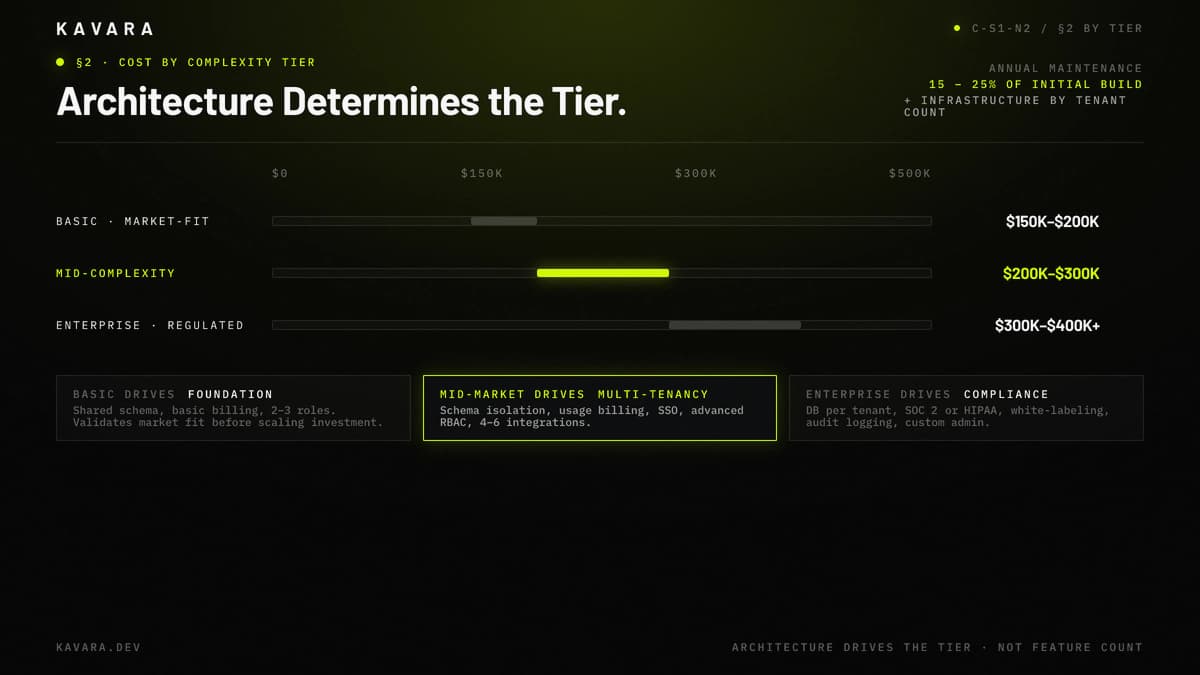
| Complexity Tier | Typical Cost Range | Timeline | Key Characteristics |
|---|---|---|---|
| Basic SaaS | $150,000-$200,000 | 4-6 months | Single-tenant or shared schema, limited integrations, standard billing, basic RBAC |
| Mid-Complexity SaaS | $200,000-$300,000 | 6-8 months | Multi-tenant with schema isolation, Stripe billing with usage metering, third-party API integrations, SSO, advanced RBAC |
| Complex/Enterprise SaaS | $300,000-$400,000+ | 8-10+ months | Separate database per tenant, complex billing, SOC 2 or HIPAA compliance, white-labeling, advanced analytics |
Basic SaaS platforms fit early-stage products testing market fit with a focused feature set. Basic SaaS usually uses shared-schema multi-tenancy or a single-tenant architecture that can later move toward tenant isolation if the market validates. Standard subscription billing, two or three user roles, basic dashboards, and limited integrations keep the budget between $150,000 and $200,000. Simple project management tools, basic CRM platforms, and lightweight workflow products often fit this tier when compliance demands are low.
Mid-complexity SaaS is the common mid-market build range. Mid-complexity platforms use proper multi-tenant architecture, schema-level isolation or strong tenant-scoped access controls, usage-based billing with metering, enterprise SSO, advanced role-based access control, and four to six third-party integrations. HR platforms, analytics dashboards, logistics workflow systems, and industry-specific operations tools often land in the $200,000 to $300,000 range because the platform must serve multiple customer organizations from launch.
Complex or enterprise SaaS platforms serve regulated industries, enterprise customers, or high-scale business models where tenant isolation and compliance requirements are strict. Complex SaaS may require separate databases per tenant, billing that combines subscription tiers with usage charges and enterprise contracts, SOC 2 or HIPAA architecture, white-label capability, audit logging, advanced analytics, and custom admin controls. Healthcare platforms, fintech applications, and enterprise compliance tools often exceed $400,000 because the SaaS platform must satisfy security, integration, and customer-specific configuration requirements before it can launch.
The tier boundary is determined by architecture, not by the number of screens alone. A small SaaS product with HIPAA requirements, enterprise SSO, and separate tenant databases can cost more than a larger visual interface with fewer compliance obligations. Companies that build SaaS applications should classify the project by tenant isolation, billing complexity, compliance burden, and integration depth before using feature count to estimate cost.
These ranges should not be compared to offshore rate cards that quote $25,000 SaaS builds. Those budgets may produce prototypes, but they do not cover production-grade SaaS application development with tenant isolation, billing accuracy, cross-tenant testing, and deployment architecture built to scale. Kavara prices SaaS tiers around the architecture needed to launch safely, not around the lowest possible feature checklist. That architecture cost concentrates in specific development phases.
SaaS Development Cost by Development Phase
SaaS development cost concentrates in the backend, multi-tenancy, billing, and QA phases because those phases carry the SaaS-specific architecture premium. The following allocation shows a typical mid-complexity SaaS platform with an estimated $250,000 total budget.

| Phase | % of Budget | Estimated Cost | SaaS-Specific Premium |
|---|---|---|---|
| Discovery & SaaS Strategy | 6-8% | $15,000-$20,000 | Subscription model design, compliance scoping |
| UX/UI Design | 10-12% | $25,000-$30,000 | Tenant-level customization, billing portal, onboarding flows |
| Frontend Development | 18-22% | $45,000-$55,000 | Tenant-scoped UI, white-labeling architecture |
| Backend + Multi-Tenancy | 28-35% | $70,000-$87,500 | Tenant isolation, billing integration, provisioning automation |
| QA & Testing | 8-12% | $20,000-$30,000 | Cross-tenant security testing, billing accuracy verification |
| DevOps & Infrastructure | 6-8% | $15,000-$20,000 | Auto-scaling, zero-downtime deployment, per-tenant monitoring |
| Project Management | 5-8% | $12,500-$20,000 | SaaS milestone tracking, tenant onboarding coordination |
Backend and multi-tenancy consume the largest share because that phase includes tenant isolation, billing infrastructure, API architecture, provisioning automation, and integration work. A standard web application's backend might consume 25 to 30 percent of the budget, while SaaS adds multi-tenancy and billing layers on top. Each phase has specific SaaS deliverables and milestones; our SaaS development process guide details the engineering work, timeline, and stakeholder involvement at every stage.
Discovery appears small at 6 to 8 percent, but skipping discovery rarely saves money in SaaS application development. Project Management Institute requirements management research found that inaccurate requirements are the primary cause of unsuccessful project outcomes almost half of the time, at 47 percent. SaaS discovery defines tenant roles, pricing model logic, compliance requirements, integration inventory, and billing scenarios before development begins, which reduces rework during architecture and QA.
These phase percentages are directional rather than additive at their extremes. A specific SaaS project centers around 100 percent, with allocation shifting based on requirements. Phase allocation tells you where the money goes; team model determines how much each hour costs.
How Team Model Affects SaaS Development Cost
Team model affects SaaS development cost because multi-tenancy architecture, subscription billing, compliance design, and zero-downtime deployment require specialized production experience. SaaS projects have stricter team requirements than general web applications: the team must know how to isolate tenant data, design billing lifecycle workflows, implement enterprise SSO, test cross-tenant access boundaries, and deploy updates without taking all customers offline. A team that learns multi-tenancy on your budget will produce architecture mistakes that surface after the second or third tenant signs — and those mistakes are expensive to fix at scale.
| Team Model | Hourly Rate (US) | SaaS Suitability | Trade-offs |
|---|---|---|---|
| US Agency | $150-$250/hr | High - production multi-tenancy, billing, and compliance experience | Higher rate, lower total risk, SaaS-specific delivery process |
| Freelancers | $75-$200/hr | Low to medium - few freelancers have production multi-tenant experience | Lower rate, higher architecture risk, limited process infrastructure |
| Offshore Agency | $30-$80/hr | Medium - some teams have SaaS experience, with communication and quality variance | Lowest rate, higher rework risk for complex SaaS platforms |
| In-House Team | $180-$300/hr loaded | High if SaaS-experienced hires are available | Highest control, highest fixed cost, 3-6 month hiring timeline |
For SaaS-specific evaluation, the right vendor should show production experience with multi-tenant architecture, Stripe-style subscription billing in production, SOC 2 or HIPAA architecture if compliance applies, and zero-downtime deployment patterns. For total cost of ownership analysis across agency, freelancer, offshore, and in-house team models — including management overhead, rework rates, and project-type recommendations — read our SaaS team model comparison.
Team model and phase allocation account for visible costs, but SaaS platforms carry hidden costs that most estimates miss entirely.
Hidden Costs of SaaS Development
Beyond development investment, SaaS platforms carry operational costs that standard web applications do not. The image below highlights the five hidden-cost categories buyers most often underestimate; the full seven-part budget list also includes onboarding/support and churn-prevention investment.

- Payment Processing Fees — Stripe's published US pricing lists 2.9 percent plus $0.30 per successful online card transaction. On a SaaS platform processing $50,000 per month in subscription revenue, the payment processing fee is approximately $1,480 per month, or $17,760 per year, before refunds, international cards, currency conversion, and failed-payment recovery costs. Usage-based billing with metered charges can add additional event-tracking and invoice logic costs.
- Per-Tenant Infrastructure Scaling — Cloud costs increase as tenant count, data volume, file storage, and background job load grow. Database compute, object storage, CDN bandwidth, queues, observability, and monitoring costs all expand with usage. Production SaaS infrastructure often requires $500 to $5,000 or more per month depending on tenant count, data volume, and uptime expectations.
- Compliance Costs Per Customer Segment — Risk Publishing's 2026 SOC 2 audit cost breakdown places startup all-in first-time Type I programs at $20,000 to $40,000 and Type II programs at $30,000 to $60,000, which makes $20,000 to $50,000 a practical annual planning range when audit readiness, auditor fees, monitoring tools, and policy management are included. Aptible's HIPAA guidance for digital health startups places one-time policy, documentation, and legal-review setup at $10,000 to $30,000, supporting a $15,000 to $30,000 initial planning range once implementation work is included. Enterprise customers may also require security questionnaires, penetration tests, or compliance evidence specific to their procurement process.
- Ongoing Maintenance — Bug fixes, dependency updates, security patches, browser compatibility updates, infrastructure management, and monitoring typically require 15 to 25 percent of the initial build cost annually. Adevs' 2026 software maintenance pricing guide uses the same 15 to 25 percent annual planning rule for active applications. SaaS maintenance is higher than standard web app maintenance because updates must deploy across all tenants without downtime or cross-tenant regressions.
- Feature Iteration — SaaS products need post-launch development driven by tenant feedback, sales objections, competitive pressure, and usage analytics. Budget 20 to 40 percent of the initial build for Year 1 feature iteration. SaaS products that stop improving after launch lose tenants to competitors that keep shipping.
- Tenant Onboarding and Support — Customer success tooling, onboarding flows, product documentation, API documentation, integration guides, in-app help, support operations, and admin training add operational cost. These costs scale with tenant count and become more important as the product moves from early adopters to enterprise customers.
- Churn-Prevention Investment — Analytics tooling, health scoring, lifecycle emails, feature adoption tracking, customer success programs, and retention-focused product work protect recurring revenue. Harvard Business Review's retention economics analysis notes that acquiring a new customer can cost five to 25 times more than retaining an existing one, which makes churn prevention a direct SaaS cost category.
Budget for 30 to 50 percent above initial development cost to cover Year 1 SaaS-specific operational costs. This buffer protects the launch, supports tenant growth, and prevents the platform from becoming underfunded immediately after the first version ships, which is why a SaaS budget has to be built as a deliberate framework instead of a single number.
How to Budget for a SaaS Development Project
SaaS budgeting starts with six practical steps that connect scope, architecture, team model, and post-launch operating cost:
- Define the complexity tier — Basic SaaS costs $150,000 to $200,000, mid-complexity SaaS costs $200,000 to $300,000, and enterprise SaaS costs $300,000 to $400,000 or more. Accurate SaaS budgeting starts with documented requirements: scope definition should capture user roles, tenant rules, billing states, integrations, and acceptance criteria before estimates are treated as reliable.
- Select the team model — Validate SaaS-specific expertise in multi-tenancy, billing, compliance, and zero-downtime deployment before comparing hourly rates.
- Calculate the base range — Combine the complexity tier with team model assumptions to create the initial budget range.
- Add contingency — Add 30 to 50 percent for SaaS-specific hidden costs, operational setup, and requirement changes revealed during discovery.
- Plan annual costs — Budget 15 to 25 percent of the initial build annually for maintenance, infrastructure, security, and iteration.
- Use phase gates — Approve discovery and design first, refine estimates from actual requirements, then authorize development with clearer architecture assumptions.
SaaS budgets must account for post-launch costs from day one because a SaaS platform is never finished in the same way a project-based web application can be finished. Maintenance, scaling, feature iteration, and customer success investment are part of the business model.
How Does SaaS Development Cost Compare to Other Application Types
Within custom web application development, SaaS development costs 25 to 40 percent more than equivalent-complexity standard web applications due to multi-tenancy infrastructure, subscription billing, tenant provisioning, and cross-tenant testing requirements. Teams that build web applications for a single organization usually price a standard portal, dashboard, or internal operations web application with similar feature scope at $100,000 to $250,000, while a SaaS platform with the same visible features typically costs $150,000 to $400,000.
The premium is an investment, not waste. General web application development services can stop at one organization's workflow; SaaS platforms generate recurring subscription revenue, serve multiple customer organizations, and scale across tenants in a way that internal web applications do not. A portal usually serves one company and its stakeholders. A SaaS platform must serve many customer companies with isolated data, separate billing states, and repeatable onboarding. That recurring-revenue model justifies additional architecture investment when the product is meant to become a sellable platform. For cost comparisons across all application types — SaaS, portals, dashboards, MVPs, and enterprise software — see our complete web application development cost guide.
Should You Start with a SaaS MVP to Control Cost
Starting with a SaaS MVP reduces initial investment to $50,000 to $80,000 for a validation-ready product, but the MVP must include multi-tenant foundations to avoid costly re-architecture when scaling. A SaaS MVP can cut non-essential features, advanced analytics, white-labeling, complex admin dashboards, and low-priority integrations.
A SaaS MVP cannot cut tenant isolation architecture, basic subscription billing, authentication, authorization, data security, or deployment quality. The common mistake is building a single-tenant "MVP" that requires complete re-architecture for the second customer. The savings from cutting multi-tenancy foundations are often consumed several times over during the inevitable rebuild. The better cost-control move is narrowing feature scope while preserving SaaS architecture quality. That approach lets founders validate pricing, onboarding, and core workflow assumptions without creating platform debt or delaying future enterprise sales. Our MVP development services build validation-ready SaaS products with multi-tenant foundations that scale without re-architecture.
What Are the Ongoing Costs After Launching a SaaS Platform
Ongoing SaaS platform costs typically run 15 to 25 percent of the initial development investment annually, plus infrastructure costs that scale with tenant count and usage volume. A $250,000 SaaS platform usually needs $37,500 to $62,500 per year in baseline maintenance before new feature development.
Maintenance and updates often run $3,000 to $10,000 per month for security patches, dependency updates, bug fixes, and operational support. Cloud infrastructure may cost $500 to $5,000 or more per month depending on tenant count and data volume. Payment processing follows provider pricing, with Stripe's standard US online card pricing at 2.9 percent plus $0.30 per successful transaction. Compliance costs include annual audit renewals, penetration testing, and security reviews that often add $5,000 to $15,000 or more per year. Feature iteration is separate from maintenance and should be planned as a product roadmap budget, not treated as support.
How Do Pricing Models Affect Total SaaS Development Cost
Fixed price works best for SaaS projects with well-defined scope and a clear complexity tier. Fixed pricing creates budget predictability, but scope lock can limit adaptation when multi-tenancy complexity changes during architecture.
Time and materials works best for SaaS projects where billing logic, integration behavior, or tenant isolation requirements may evolve after discovery. Time and materials preserves flexibility, but budget control requires disciplined sprint planning and scope governance.
Retainer pricing works best for post-launch SaaS development. Retainers create predictable monthly investment while allowing the roadmap to shift based on tenant feedback, support data, and customer growth. Compared with fixed price, time and materials fits architecture volatility better; compared with time and materials, fixed price fits scope certainty better. SaaS projects often start fixed-price through discovery and design, then move to time and materials during development where architecture adjustments may be required. A fixed price vs time and materials comparison should weigh scope certainty, architecture volatility, and contract governance before the project commits to one pricing model.
Key Takeaways
SaaS application development costs $150,000 to $400,000 or more for production-grade platforms, with enterprise SaaS exceeding $400,000 when compliance, integrations, or complex tenant isolation are required. Multi-tenancy and subscription billing infrastructure account for the 25 to 40 percent SaaS premium over standard web applications, while hidden costs add 30 to 50 percent when SaaS-specific operations are included. SaaS budgets must plan for post-launch maintenance, scaling, feature iteration, and the custom web application development work buyers cannot see on screen: tenant-safe data access, billing event handling, release automation, observability, and recovery planning. Explore our full custom web application development practice including SaaS, portal, dashboard, and enterprise software development. discuss your project with Kavara to scope your SaaS build with phase-by-phase pricing.