How to Choose a Web Application Development Company
Choosing a web application development company is a decision that affects your project's budget, timeline, and long-term technology trajectory. The difference between a successful partnership and a costly failure comes down to evaluation: asking the right questions, recognizing warning signs, and comparing proposals on criteria that predict project outcomes rather than sales presentation quality.
This page provides a five-criteria evaluation framework for selecting a development partner, with interview questions, what to listen for in answers, red flags, due diligence steps, proposal comparison methods, and contract considerations. It is written for CTOs, VPs of Technology, founders, and operations leaders at mid-market companies with $5M to $100M in revenue who are ready to hire for custom web application development.
The evaluation process matters because software projects fail for reasons that are often visible before contract signature. Standish Group CHAOS research has reported roughly 31% of software projects as successful, which makes vendor evaluation a project-risk control rather than a procurement formality. Weak requirements, unclear communication, missing decision ownership, and vague post-launch support surface when buyers ask for evidence instead of reassurance.
A strong evaluation process exposes those risks before development starts. It tests technical expertise, verifies relevant experience, inspects the development process, confirms the actual team, and validates post-launch support. A weak evaluation process chooses the best pitch rather than the best development company.
The goal is not to find a vendor that says yes to every requirement. The goal is to select a development partner that can build, launch, scale, integrate, and support production software without hiding complexity until it becomes expensive.
For mid-market teams, the best evaluation process starts by defining the project category before talking to vendors. A SaaS platform, enterprise portal, dashboard, MVP, mobile app, and internal operations platform each require different evidence. A company that claims custom web application development experience should explain the architecture, delivery risks, and support model for the specific application type you are buying.
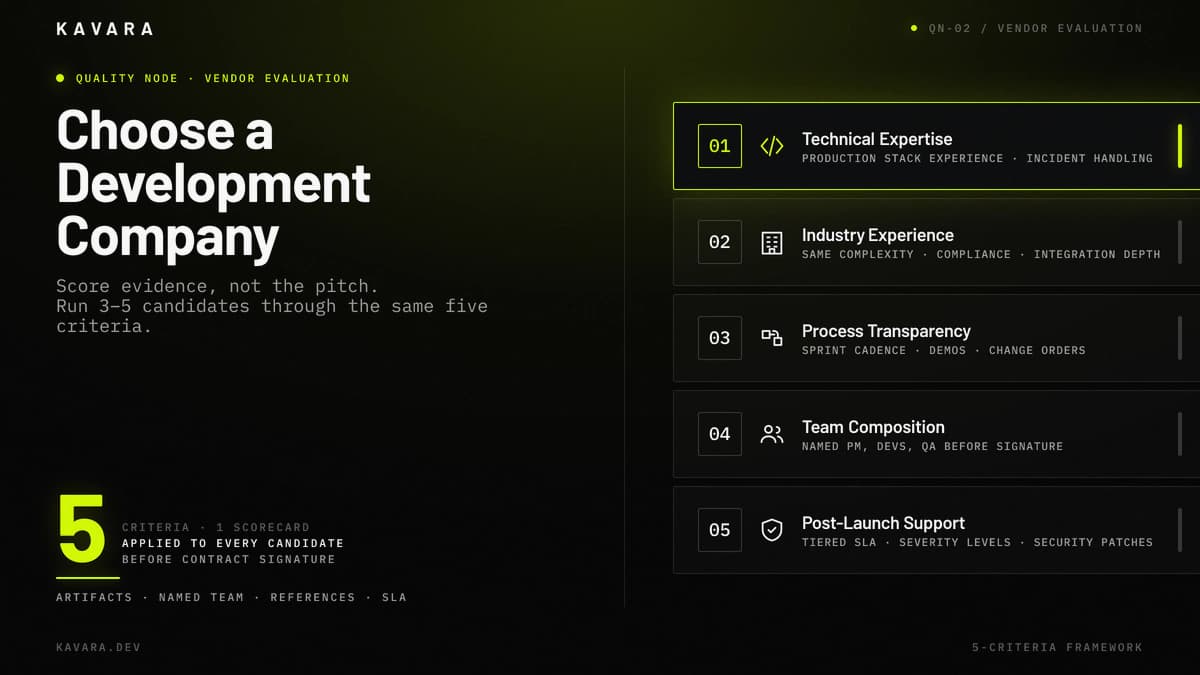
The diagram below shows the five-criteria scorecard applied across three to five candidates with the same questions and the same evidence threshold.
What Makes a Development Company Evaluation Effective
Most development company evaluations fail because they measure the wrong things. Portfolio aesthetics, sales presentation polish, and client logo lists tell very little about how the company will perform on a specific project. What predicts project success is different from what impresses in a pitch.
PMI's 2026 Pulse of the Profession report found that 31% of complex projects fail to achieve the full scope of intended benefits, more than twice the 13% failure rate for projects overall. That is why an effective evaluation tests how a development company handles complexity before the contract creates dependency.
An effective evaluation uses five criteria that are more reliable than subjective impressions:
- Technical expertise and technology stack depth - The company must have production experience with the technologies, architecture patterns, and integrations the application requires.
- Industry experience and relevant case studies - The company must understand projects with similar complexity, compliance exposure, scale, and operational constraints.
- Development process transparency and communication structure - The company must show how progress, scope, risk, and decisions are managed during delivery.
- Team composition and retention - The company must identify who will work on the project and whether the team has the seniority to make durable engineering decisions.
- Post-launch support and maintenance commitment - The company must support the application after deployment through bug fixes, security updates, performance work, and iteration.
These evaluation criteria should be applied consistently across 3 to 5 candidate companies. Each company should answer the same questions, provide comparable evidence, and explain how its process reduces risk. The strongest development partner will welcome structured evaluation because evidence helps separate engineering depth from sales positioning.
With the framework established, each criterion requires specific evaluation, starting with the one that matters most.
Five Criteria That Predict Project Success
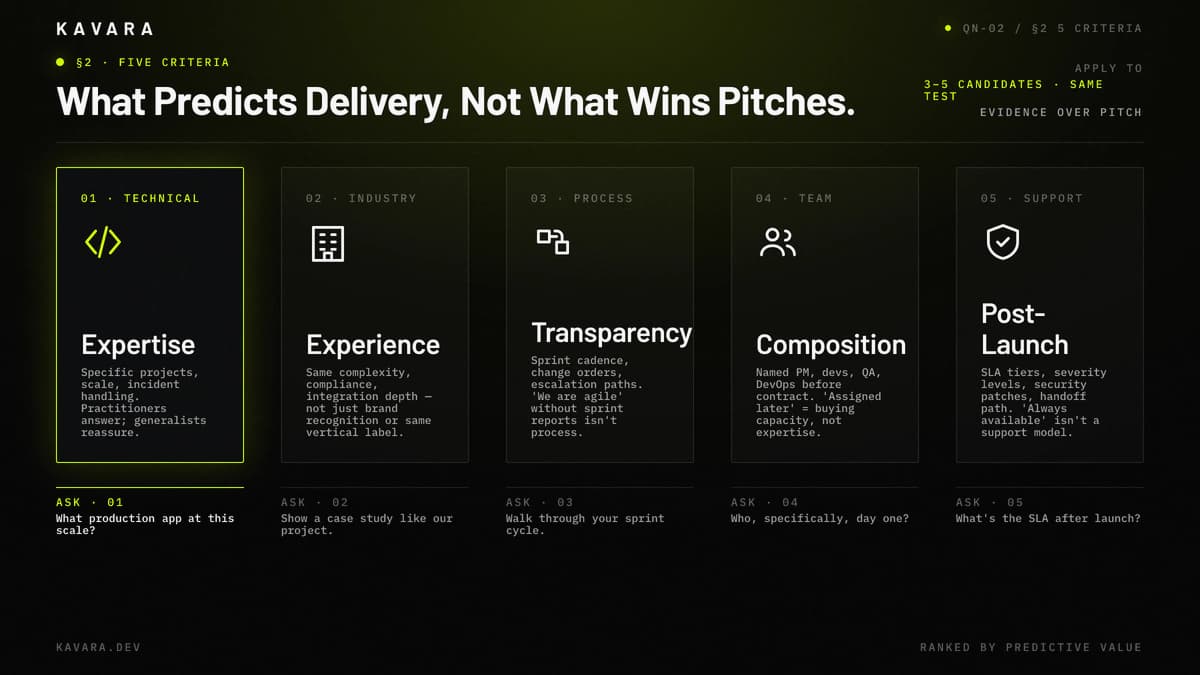
The five criteria that predict project success are technical expertise, industry experience, process transparency, team composition, and post-launch support. Each criterion should be evaluated with direct questions and evidence-based follow-up. A development company that performs well across all five criteria is more likely to deliver production software than a company that excels in only one area.
The criteria are ranked by predictive value. Technical expertise comes first because weak architecture and poor engineering decisions create expensive downstream problems. Industry experience, process transparency, team composition, and post-launch support then show whether the development company can apply that expertise to the project context.
The diagram below ranks the five evaluation criteria by predictive value, with technical expertise leading.
1. Technical Expertise and Technology Stack Depth
Technical expertise means production experience with the specific technologies your project requires, not general familiarity with logos on a website.
Ask these questions:
- What production applications have you built with the required technology stack?
- How many concurrent users or transactions does your most complex application support?
- When a production issue occurs at 2 a.m., who on your team handles it?
Strong answers include project examples, deployment details, scale context, and measurable outcomes. Weak answers rely on broad claims such as "we work with most technologies" or "our developers can learn any stack."
Evaluating technical depth also requires understanding good architecture. The web application architecture guide explains monolithic vs microservices decisions, backend/API patterns, database architecture, and infrastructure choices that indicate genuine engineering competence.
Test failure scenarios: API rate limits, slow database queries, failed deployments, or vulnerable dependencies. Practitioners answer with incident handling, monitoring, rollback, and escalation details.
IBM's 2025 Cost of a Data Breach Report placed the global average breach cost at $4.4 million, so security scenarios should produce concrete answers about access control, dependency patching, and incident response.
2. Industry Experience and Relevant Case Studies
Industry experience means experience with similar complexity, scale, compliance requirements, and operational workflows, not only the same industry label. A wellness app does not prove HIPAA workflow depth, and a payment landing page does not prove PCI DSS architecture or transaction reconciliation.
Ask these questions:
- Show a case study for a project with similar complexity.
- What compliance requirements did the project include?
- What was the biggest technical challenge, and how did the team solve it?
Strong answers describe the problem, constraints, architecture decision, result, and post-launch outcome. Weak answers describe visual design, brand names, and broad business goals without technical detail.
For a structured methodology to evaluate development portfolios beyond surface-level aesthetics, assess code quality signals, architecture decisions, performance, and business outcomes.
3. Development Process Transparency and Communication
Development process transparency means the company can explain how work is planned, demonstrated, reviewed, changed, and escalated. The process determines whether stakeholders see progress weekly or discover problems at milestone reviews.
Ask these questions:
- Walk through your sprint cycle from planning to demo.
- How will we see progress between sprint reviews?
- What happens when requirements change mid-sprint?
- How do you handle disagreements about scope?
Strong answers include tools, sprint cadence, demo structure, backlog management, change-order rules, decision ownership, and risk escalation. Weak answers use "we are agile" as a substitute for process detail.
PMI's 2020 Pulse of the Profession report found that 11.4% of investment is wasted because of poor project performance. A transparent structured development process makes scope and risk visible through defined phases, deliverables, review points, and communication cadences.
A candidate company should be able to show an anonymized sprint report, demo agenda, or status report from a previous project. If the company cannot show how it communicates, communication is probably not operationalized.
4. Team Composition and Retention
Team composition means the specific people who will work on the project, their role, and whether they are likely to stay from discovery through launch. Developer turnover mid-project causes rework, knowledge loss, and quality problems.
The U.S. Bureau of Labor Statistics reported a May 2024 median annual wage of $133,080 for software developers, while Gallup estimates replacement cost at one-half to two times annual salary. When a vendor swaps senior engineers after signature, the buyer inherits knowledge-transfer risk and replacement pressure.
Ask these questions:
- Who specifically will work on the project?
- What is each person's experience level and role?
- How long has each person been at the company?
- Will these same people remain assigned through launch?
- What is your annual developer retention rate?
Strong answers name the project manager, lead developer, frontend developer, backend developer, QA engineer, and DevOps support when applicable. Strong answers also explain seniority, availability, and escalation paths. Weak answers say the company will assign the right people after signature, which means the buyer is purchasing a promise rather than evaluating a team.
5. Post-Launch Support and Maintenance Commitment
Post-launch support means the company has a structured model for bug fixes, security patches, dependency updates, monitoring, performance work, and feature iteration. A production application without support degrades as browsers, dependencies, vulnerabilities, and users change.
CISQ's 2022 Cost of Poor Software Quality report estimated poor software quality at $2.41 trillion in the United States and accumulated software technical debt at approximately $1.52 trillion. Post-launch support prevents small defects, stale dependencies, and undocumented workarounds from becoming compounding debt.
Ask these questions:
- What does your post-launch support include?
- What is the SLA for critical bug response?
- How do you handle security vulnerabilities?
- What does ongoing support cost?
- How do you transfer knowledge if we bring support in-house later?
Strong answers define support tiers, response times, severity levels, maintenance cadence, ownership boundaries, and handoff processes. Weak answers say "we are always available" without an enforceable SLA. Availability is not a support model.
Post-launch support should include a path to independence: deployment notes, architecture documentation, credentials, third-party services, and runbooks another qualified team can use.
The strongest development partnerships score well across all five criteria. A beautiful portfolio cannot compensate for weak architecture, poor communication, or missing post-launch support.
These criteria tell you what to evaluate. Interview questions reveal the answers. But some signals indicate problems that questions alone cannot surface.
Red Flags When Evaluating Development Companies
Red flags during evaluation predict red flags during development. If a web application development company exhibits warning signs before the contract is signed, the problems usually multiply after project kickoff.
PMI's 2020 Pulse research reported that organizations undervaluing project management as a strategic competency had 67% more projects fail outright. Repeated ambiguity during sales is therefore not a communication style; it is an early indicator of delivery risk.
The side-by-side comparison below contrasts strong evaluation signals with their corresponding red flags.
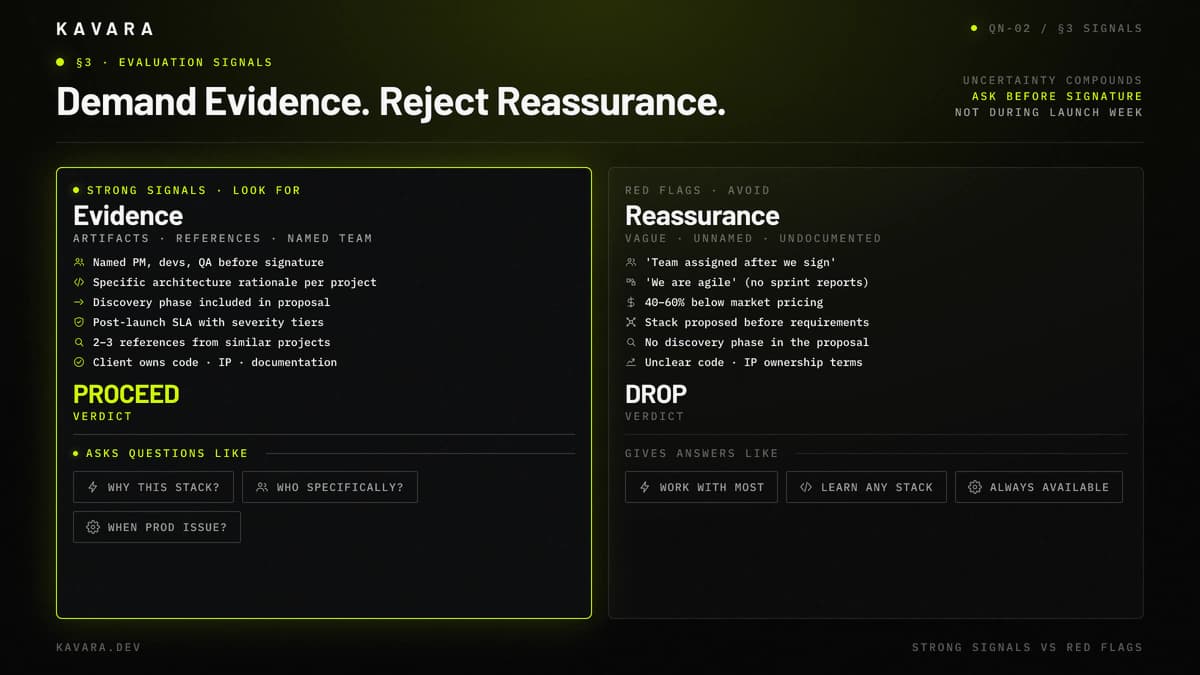
- No fixed team assigned before contract - "We will assemble the right team after we understand the project" means the buyer cannot evaluate who will build the application. If the company cannot name the team before signature, the buyer is purchasing capacity rather than expertise.
- Vague or undocumented process - "We are agile" without sprint reports, demo schedules, defined deliverables, or change-management rules is not enough. Real agile has structure. Agile without documentation often means the team figures things out as it goes.
- Significantly below-market pricing - If an estimate is 40% to 60% below competitors, the team is usually junior, offshore without disclosure, or misunderstanding the scope. Cheap estimates can become expensive projects when rework, delays, and missing requirements appear.
- No post-launch support offering - A company that builds and walks away leaves the buyer responsible for vulnerabilities, dependency changes, bugs, infrastructure issues, and browser updates. A production application needs an operating model after launch.
- No references for similar projects - Confidentiality can limit details, but reputable companies can usually provide 2 to 3 references willing to speak privately. If every reference is unavailable, the references may not support the sales story.
- Technology stack chosen before requirements are understood - Proposing React, microservices, MongoDB, or any stack in the first meeting can signal a one-size-fits-all delivery model. Architecture should follow requirements, not preference.
- No discovery phase in the proposal - Moving from sales call to fixed development estimate without discovery means the estimate is guesswork. Discovery is where scope, risk, integrations, and cost assumptions become real.
- Unclear code ownership - If the contract does not state that the client owns the code, designs, documentation, and deliverables, the client may be licensing rather than owning the application.
- No technical stakeholder in the sales process - If every conversation happens with sales or account management, technical assumptions may be untested. A senior engineer or architect should participate before estimate approval.
- No questions about business goals - A company that only asks for a feature list may miss the outcome the application must produce. Strong development partners ask about revenue, operations, risk, users, adoption, and support because software exists to change a business result.
These red flags should be weighted by severity. One unclear answer may require follow-up. Repeated ambiguity across team, process, pricing, and ownership should remove the development company from consideration because uncertainty compounds after the contract starts.
Recognizing red flags prevents bad partnerships. Due diligence confirms good ones.
Due Diligence and Contract Considerations
Before signing, verify three things: the company is who it claims to be, the contract protects your interests, and the engagement structure matches the project needs. Due diligence turns sales claims into evidence.
PMI's 2020 project outcome highlights reported that 35% of projects experienced scope creep and 13% were deemed failures. Due diligence reduces those odds by verifying scope assumptions, decision authority, and commercial terms before the team starts building.
Due diligence should include:
- Reference calls - Speak with 2 to 3 past clients from similar projects. Ask whether the project finished on time and budget, how communication worked, whether the client would hire the company again, and what surprised them.
- Portfolio verification - Ask to see live applications, not only screenshots. Review performance, mobile responsiveness, error states, workflow completeness, and interaction quality.
- Team verification - Look up proposed team members on LinkedIn. Confirm that their background matches the role and experience described in the proposal.
Contract review should include:
- IP ownership - The client should own all code, designs, documentation, and deliverables. This is non-negotiable for custom web application development.
- Payment structure - Milestone-based payments should be tied to deliverables, not calendar dates. Avoid large upfront payments for unknown teams.
- Change-order process - Scope changes should require written cost and timeline impact before implementation.
- Termination clause - If the engagement ends, the client should receive code written to date, documentation, credentials, and repository access.
- Post-launch SLA - The contract should define response times for critical bugs, security vulnerabilities, and infrastructure issues.
- Repository access - The client should have access to GitHub, GitLab, or equivalent repositories throughout development, not only at delivery.
The pricing model affects both cost predictability and scope flexibility. Fixed-price contracts need tightly defined scope, while time-and-materials contracts need strong budget governance and change approval because each model shifts risk differently between buyer and vendor.
Due diligence should also verify incentives. A milestone contract should reward completed deliverables, not hours spent in meetings. A support contract should reward fast resolution and clear communication, not vague availability. A discovery agreement should produce assets the client can use even if the build contract goes elsewhere.
The strongest due diligence process creates a paper trail before signature. Save reference notes, proposal assumptions, ownership clauses, support terms, and change-order language in one comparison document so the final decision is auditable.
Due diligence validates the company. Proposal comparison validates the investment.
How to Compare Development Proposals and Estimates
When comparing proposals from 3 to 5 development companies, evaluate beyond price. The cheapest proposal is rarely the cheapest project because missing scope, weak staffing, and skipped discovery usually become change orders later.
The framework table below normalizes seven proposal factors so candidates can be compared on the same axes before price.
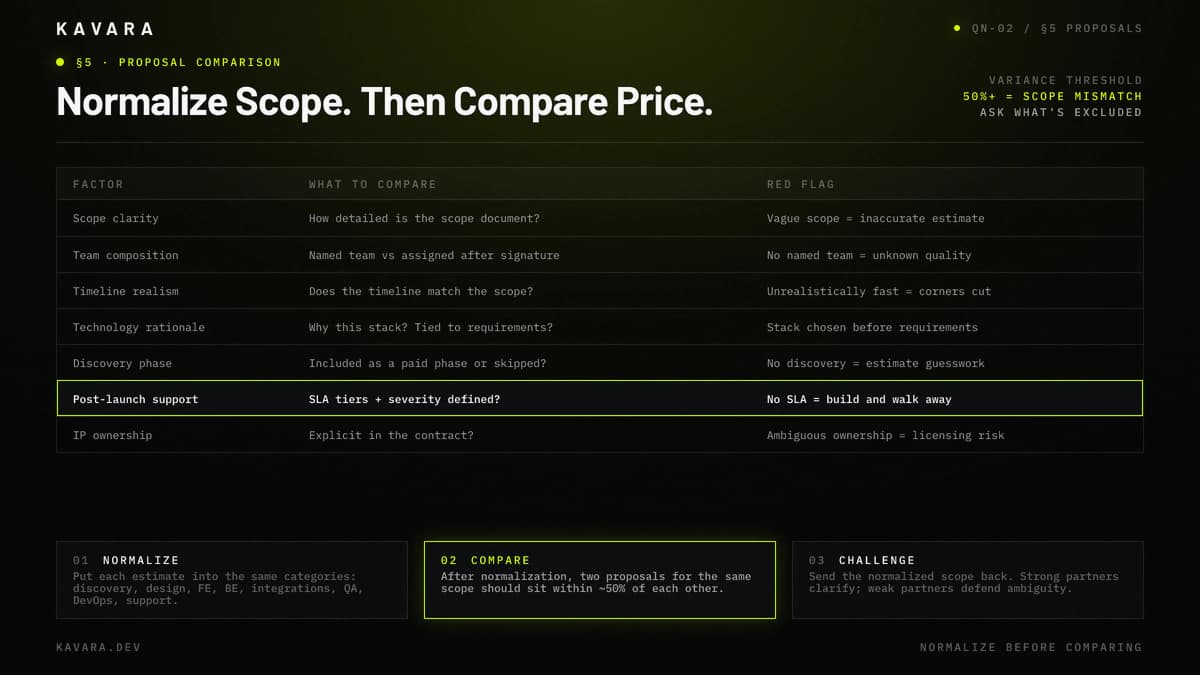
| Factor | What to Compare | Red Flag |
|---|---|---|
| Scope clarity | How detailed is the scope document? | Vague scope means inaccurate estimate |
| Team composition | Named team vs assigned later | No named team means unknown quality |
| Timeline realism | Does timeline match scope? | Unrealistically fast means corners cut |
| Technology rationale | Why this stack? | Stack chosen before requirements |
| Discovery phase | Included or skipped? | No discovery means estimate guesswork |
| Post-launch support | SLA included? | No SLA means build and walk away |
| IP ownership | Explicit in contract? | Ambiguous ownership creates risk |
Proposals that differ by 50% or more for the same project almost certainly define the scope differently. Ask each web application development company to explain what is included, what is excluded, which assumptions drive the estimate, and what could change the price.
Normalize proposals before comparing them. Put each estimate into the same categories: discovery, UX/UI design, frontend, backend, integrations, QA, DevOps, project management, launch, and support. A proposal that appears cheaper may exclude QA, production monitoring, data migration, or post-launch support. Normalization exposes whether price differences reflect efficiency or missing work.
Ask every candidate to revise the proposal against the same normalized scope. The best development company will clarify assumptions instead of defending ambiguity. Use the same scorecard after the first proposal revision because strong partners improve clarity when challenged, while weak partners defend ambiguity.
For realistic cost ranges by application type that help evaluate whether proposals are within expected bounds, see the web application development cost guide.
Proposal comparison narrows the field. The next supplementary questions clarify team model, budget, support, and technical diligence.
Should You Hire an Agency, Freelancer, or In-House Team
The team model decision — agency, freelancer, or in-house — should be made before evaluating specific companies because each model carries a different cost structure, management burden, and risk profile.
An agency is usually best for mid-market companies that need production quality, process accountability, and a complete team for a defined project. A freelancer is best for simple projects, isolated skill gaps, or narrow scopes where the buyer can manage requirements and QA directly. An in-house team is best when continuous product development is a core business capability and the company can support recruiting, management, tooling, and long-term engineering leadership.
After the model is selected, evaluate specific companies inside that model with the same five criteria. For total cost of ownership analysis, hidden cost identification, and project-type recommendations across all three models, read the agency vs freelancer vs in-house comparison. The model decision also sets the budget range you are working within.
How Much Should You Budget for Custom Development
Custom web application development costs between $50,000 and $500,000+ depending on application type, complexity, and team model. MVPs typically cost $50,000 to $150,000, SaaS platforms typically cost $150,000 to $400,000, enterprise portals typically cost $100,000 to $300,000, and enterprise software can exceed $500,000 when integrations, compliance, and scale requirements are significant.
If a proposal falls significantly below these ranges, the scope is likely different from what was described or the team composition is not what was presented. For phase-level allocation and hidden costs, see the detailed web application development pricing guide.
Budget should also include post-launch support, hosting, monitoring, security updates, analytics, training, and feature iteration. A development company that excludes those costs may look cheaper during proposal review while pushing required expenses into the first year after launch, which is why support questions belong in the next pass.
What Questions Should You Ask About Post-Launch Support
Post-launch support questions should test whether the development company can operate the application after deployment, not only build it. Ask these five questions:
- What is included in the standard support retainer?
- What is the SLA for critical bug response?
- How are security vulnerabilities monitored, patched, and communicated?
- What does feature iteration look like after launch?
- What happens if support moves in-house or to another provider?
Strong support answers include bug fixes, security patches, dependency updates, monitoring, performance work, documented handoff, and clear severity levels.
Support questions should be asked before contract signature, not during launch week. The support model affects architecture, documentation, access control, monitoring, and release planning during development.
The buyer should also ask who handles support. A separate support team may respond quickly but lack project context. The original build team may have context but limited availability. The best answer defines both ownership and escalation.
Support answers reveal how the company operates the application; technical questions reveal whether the team can build the application correctly in the first place.
How to Evaluate a Development Company's Technical Expertise
Technical expertise is best evaluated through specific questions about production experience, not through capability lists or technology logos on a website. Ask for a live application demo rather than screenshots or slides.
Ask architecture questions that require reasoning. A practitioner can explain why a project used monolithic architecture instead of microservices, why PostgreSQL was selected instead of MongoDB, and how the application handles 10x traffic. A generalist repeats definitions.
Request a technical reference from a CTO, VP Engineering, or technical stakeholder at a past client. Evaluating technical expertise starts with understanding what production-grade Kavara custom web application development services look like: engineering standards, architecture patterns, and quality benchmarks that separate practitioners from generalists.
Choosing a development company is an evaluation process, not a selection process. The five criteria, technical expertise, industry experience, process transparency, team composition, and post-launch support, predict project outcomes more reliably than portfolio aesthetics or sales presentations.
Apply the framework consistently across 3 to 5 candidates before contract signature. The right partner will welcome rigorous evaluation because evidence makes the decision stronger. Apply the same standard to Kavara: review our custom web application development service model, ask the same technical and process questions, and judge whether our team can build and launch the application under your constraints. Contact Kavara about your project with the evaluation criteria in hand.