SaaS Application Development Services
SaaS application development is the process of designing, building, and deploying multi-tenant software platforms that deliver functionality to end users through subscription-based cloud access. Unlike standard web applications that serve a single organization, SaaS platforms must support multiple customers on shared infrastructure with logically isolated data, automated tenant provisioning, subscription billing, and the ability to scale horizontally as the customer base grows.
Kavara builds production-grade SaaS applications for mid-market companies creating subscription-based software products. We architect multi-tenant systems, integrate subscription billing infrastructure, design tenant isolation strategies, and deploy to cloud environments configured for zero-downtime updates and horizontal scaling. Every SaaS platform we deliver launches with the architectural foundations required to support growth from first customer to thousands of tenants without re-engineering the core system.
The SaaS market reflects why companies invest in building custom platforms rather than adapting off-the-shelf tools. According to Fortune Business Insights, the global SaaS market is projected to reach $375.57 billion in 2026, growing at an 18.7% compound annual growth rate through 2034. This growth is driven by organizations across every industry moving from installed software to cloud-delivered subscription models. Companies building those platforms need SaaS development services that deliver multi-tenant architecture, not generic web application development relabeled for the SaaS market.
Custom web application development for SaaS requires engineering decisions at every layer that standard projects do not encounter: database isolation strategies, subscription lifecycle management, usage metering, tenant-scoped permissions, and infrastructure that scales with demand rather than capacity planning.
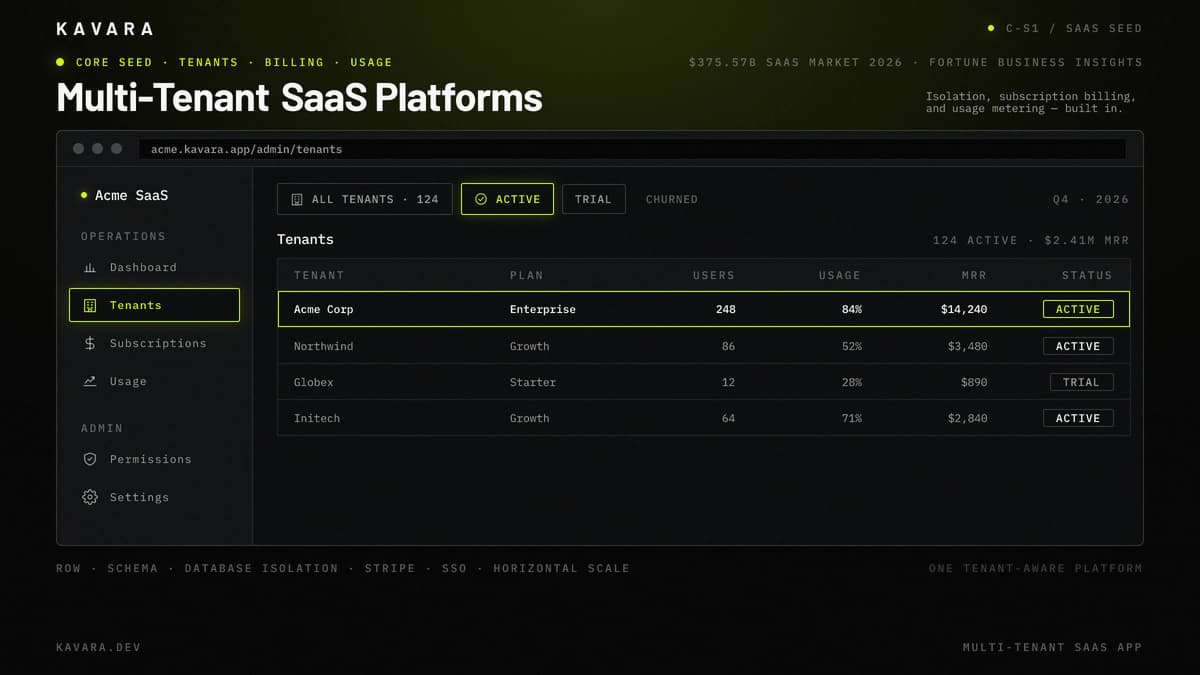
The mockup below shows a multi-tenant SaaS admin app with tenants, plans, usage, MRR, and subscription status in one tenant-aware interface.
What Is SaaS Application Development
SaaS application development is the specialized practice of building cloud-hosted software platforms that serve multiple customers through shared infrastructure while maintaining data isolation, subscription-based access, and continuous deployment capabilities. SaaS development differs from standard web application development in fundamental architectural ways that affect every layer of the technology stack.
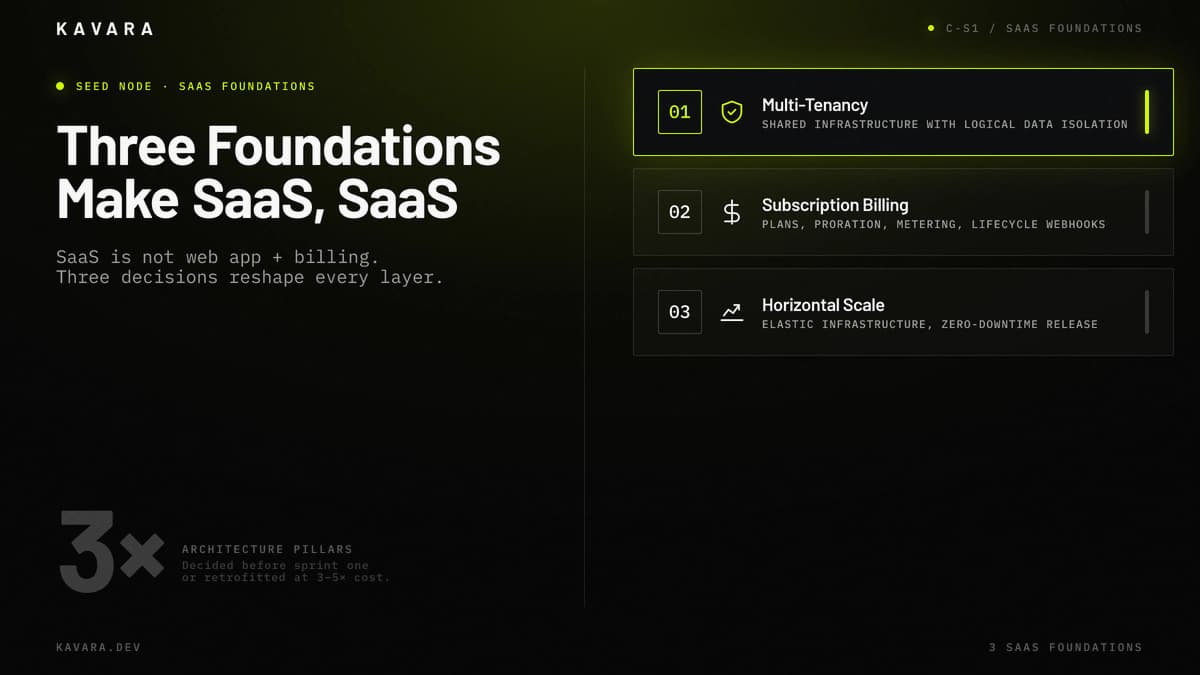
The diagram below maps the three architectural foundations — multi-tenancy, subscription billing, and horizontal scale — that make SaaS structurally different from standard web applications.
Traditional software is installed on a customer's infrastructure, licensed per copy, and updated through manual release cycles. Standard web applications serve a single organization through a dedicated deployment. SaaS platforms serve dozens, hundreds, or thousands of organizations simultaneously from shared infrastructure. This multi-tenant requirement changes every architectural decision from database schema design to authentication to deployment strategy.
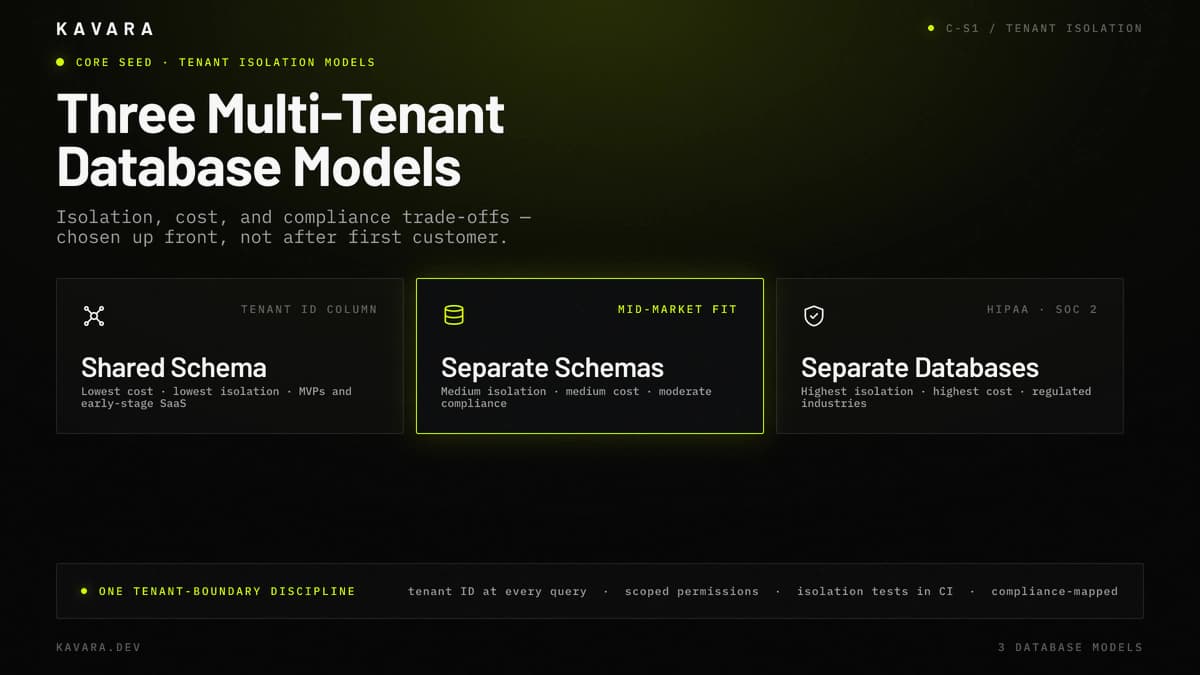
Multi-tenant architecture is the defining characteristic of SaaS. In practice, multi-tenancy means multiple customers share compute, storage, and application infrastructure while each customer's data remains logically isolated from every other customer's data. Three primary database strategies support this isolation. Shared database with tenant ID columns provides the lowest cost and complexity but offers limited isolation — suitable for MVPs and early-stage SaaS products. Separate schemas within a shared database provide medium isolation with moderate cost — appropriate for mid-market SaaS with moderate compliance requirements. Separate databases per tenant provide the highest isolation at the highest cost — required for enterprise SaaS serving regulated industries where complete data separation is mandatory.
The SaaS business model also distinguishes this development category. The application is the revenue engine. Subscription billing, usage-based pricing, freemium tiers, plan upgrades, and proration are architecture requirements built into the platform from day one — not business features bolted on after the core application is complete.
SaaS application development falls within the broader category of custom web app development, which also encompasses enterprise portals, dashboards, enterprise software, and mobile applications. Within that category, SaaS carries the highest architectural complexity because multi-tenancy, billing, and scaling requirements compound at every layer.
This is why SaaS should be evaluated as a specialized branch of web application development services rather than a standard app with a subscription page. A SaaS development partner must design tenant boundaries, plan billing events, model account ownership, and define deployment operations before the visible feature list is complete. Custom web application development for SaaS also needs commercial awareness because onboarding, plan limits, expansion paths, and support workflows shape the architecture. Kavara treats SaaS development as product infrastructure: our team must build web applications as repeatable customer-facing products, not only launch one internal tool.
That repeatable delivery model is what turns SaaS development services into a long-term product investment rather than a one-time application build.
Understanding what SaaS architecture requires is the first step — the next is understanding why companies choose to build custom SaaS platforms rather than adapting off-the-shelf tools.
Why Companies Build Custom SaaS Platforms
Companies build custom SaaS platforms for two primary reasons: they are creating a software product as a business, or they are converting an internal capability into a market-ready product. Both paths require production-grade multi-tenant architecture that off-the-shelf tools cannot provide.
Revenue-Generating Software Products — When the application is the business, architecture is not a supporting function — it is the product itself. Companies building project management tools, HR platforms, analytics suites, or industry-specific workflow applications need multi-tenant architecture that supports subscription billing, tenant management, and horizontal scaling from day one. The platform must onboard new customers without manual provisioning, isolate each customer's data without exception, and handle billing lifecycle events — upgrades, downgrades, cancellations, proration — as automated processes, not manual interventions.
Internal-to-External Product Conversion — Companies with proprietary processes, datasets, or tools that could serve an external market face a specific engineering challenge: converting internal software into a multi-tenant SaaS platform. This conversion requires the same rigorous engineering approach as any custom software development project, with additional multi-tenancy and billing requirements layered on top. User management, tenant provisioning, subscription lifecycle, and data isolation must be re-architected from single-organization assumptions to multi-organization reality.
Custom SaaS platforms also provide competitive advantages that horizontal tools cannot replicate. Competitive Differentiation Through Vertical SaaS — Vertical SaaS is software built for one industry's workflows rather than a broad, general-purpose market. Generic SaaS tools like Salesforce, HubSpot, and Monday.com serve broad markets with general-purpose features; custom SaaS serves specific verticals with capabilities no horizontal platform provides. According to the 2024 SaaS Benchmarks Report by High Alpha and OpenView, which surveyed over 800 SaaS companies, vertical SaaS companies grew at 31% compared to 28% for horizontal SaaS companies in growth rates above $1 million ARR. Vertical SaaS platforms increasingly differentiate through embedded intelligence — our AI integration services integrate predictive analytics and automation directly into SaaS product architectures.
Data Ownership and Control — Companies processing sensitive data under HIPAA, SOC 2, or PCI requirements need SaaS platforms they own and control, where data governance follows their policies rather than depending on a third-party vendor's compliance posture.
Unit Economics at Scale — Own-built SaaS eliminates per-seat licensing costs. As the customer base grows, marginal infrastructure cost decreases while subscription revenue scales — creating the unit economics that make SaaS businesses valuable.
But how do these business drivers translate into actual engineering requirements? Multi-tenancy, subscription billing, and horizontal scaling are not optional features layered on at the end — they are foundational architecture decisions that shape every layer of the platform from database to deployment.
SaaS Architecture and Multi-Tenancy
Multi-tenant architecture is the defining technical characteristic of SaaS application development. Every architecture decision — database design, authentication, caching, deployment — must account for tenant isolation, data security, and the ability to scale horizontally as the customer base grows. AWS's SaaS Lens treats tenant isolation as an architecture-wide requirement, not a database-only concern, because each tenant's resources must remain effectively isolated across the system.
The multi-tenancy model a SaaS platform uses determines its isolation guarantees, cost structure, and operational complexity:
| Model | Data Isolation | Cost | Complexity | Best For |
|---|---|---|---|---|
| Shared Database, Shared Schema | Low — tenant ID column | Lowest | Lowest | MVPs, early-stage SaaS |
| Shared Database, Separate Schemas | Medium — schema-level isolation | Medium | Medium | Mid-market SaaS, moderate compliance |
| Separate Databases | Highest — complete isolation | Highest | Highest | Enterprise SaaS, regulated industries |
Kavara selects the right multi-tenancy model based on compliance requirements, expected scale, and cost constraints — not by defaulting to the simplest option. Migration paths between models should be planned before scale or compliance forces re-architecture.
Beyond database isolation, production-grade SaaS platforms also need subscription billing infrastructure (Stripe-style integration with metering, plan management, proration, and invoice generation), tenant-scoped authentication and authorization (SSO via SAML or OAuth with tenant-level RBAC), horizontal scaling architecture, and zero-downtime deployment patterns. These layers are SaaS-specific because they exist to serve multiple customers from shared infrastructure without exposing one tenant to another. For broader API design patterns, frontend rendering models, database selection, and infrastructure decisions that apply across all web application types, see our web application architecture guide.
Building this architecture requires a development process specifically adapted to SaaS requirements at every phase — from discovery through deployment and scaling.
Our SaaS Development Process
We build SaaS platforms through a structured development process adapted for the specific requirements of multi-tenant, subscription-based software:
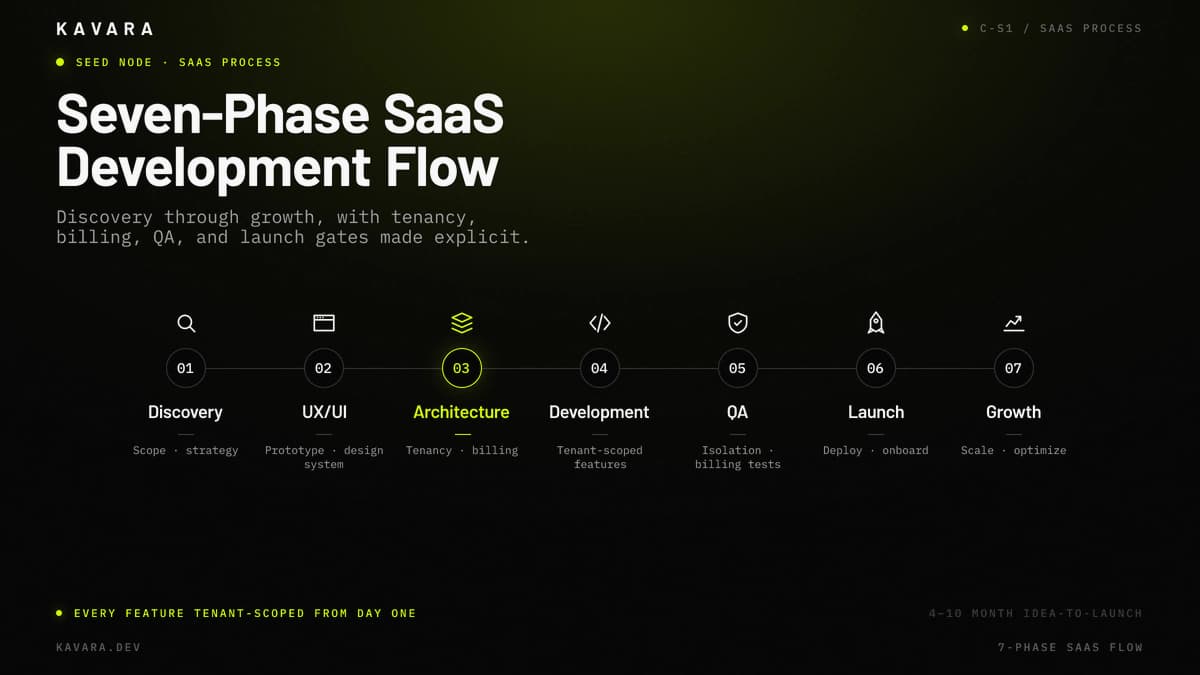
- Discovery and SaaS Strategy — Discovery validates the subscription model, customer profile, compliance requirements, and multi-tenancy strategy before scope is locked. For migrations, this phase also identifies which workflows, data models, and user roles must be redesigned for multiple customer organizations. Deliverables include a SaaS product requirements document, architecture recommendations, and subscription model proposal.
- UX and UI Design — SaaS interface design covers onboarding flows, tenant-level customization, admin dashboards, user management, plan limits, and billing portal interactions. Deliverables include a clickable prototype and design system patterns that support repeatable tenant onboarding.
- Architecture and Infrastructure — Architecture selects the multi-tenancy model, database structure, API boundaries, authentication strategy, billing integration, and CI/CD approach. Deliverables include an architecture document, infrastructure plan, tenant isolation model, and deployment strategy.
- Development — Development runs in agile sprints with SaaS-specific milestones: tenant management, subscription billing, user provisioning, role-based access, and core product features. Two-week sprint cycles produce working software increments and stakeholder demos.
- Quality Assurance — QA verifies cross-tenant isolation, billing accuracy, role permissions, load behavior under concurrent tenants, and regression risk across shared infrastructure. OWASP's Cloud Tenant Isolation project frames cross-tenant vulnerabilities as a specific SaaS/PaaS risk, which is why isolation testing belongs inside the process rather than after launch.
- Launch and Tenant Onboarding — Launch includes staging validation, production deployment, monitoring setup, billing system go-live, first-tenant onboarding, and support handoff. The goal is not only to deploy the application, but to prove that tenant provisioning, billing events, and monitoring work in production.
- Growth and Scaling — Post-launch work tracks tenant growth, usage analytics, infrastructure scaling, feature iteration, and performance optimization. Deliverables include monitoring reports, backlog priorities, scaling recommendations, and product roadmap updates.
The seven-phase flow below shows how SaaS development moves from strategy through growth while keeping tenant provisioning, billing, and isolation visible through the build.
For phase-by-phase deliverables, sprint sequencing, SaaS-specific QA dimensions, and tenant onboarding methodology, see our detailed SaaS development process guide.
Each phase of SaaS development relies on technology choices specifically selected for multi-tenancy, scaling, and subscription management.
SaaS Technology Stack
Technology selection for SaaS platforms is driven by multi-tenancy requirements, scaling demands, and ecosystem maturity — not by developer preference or trend cycles. Our SaaS architecture and technology stack guide covers the multi-tenancy models and the rationale behind each layer in depth.
The diagram below shows the six layers of a production SaaS stack chosen for multi-tenancy and scale.
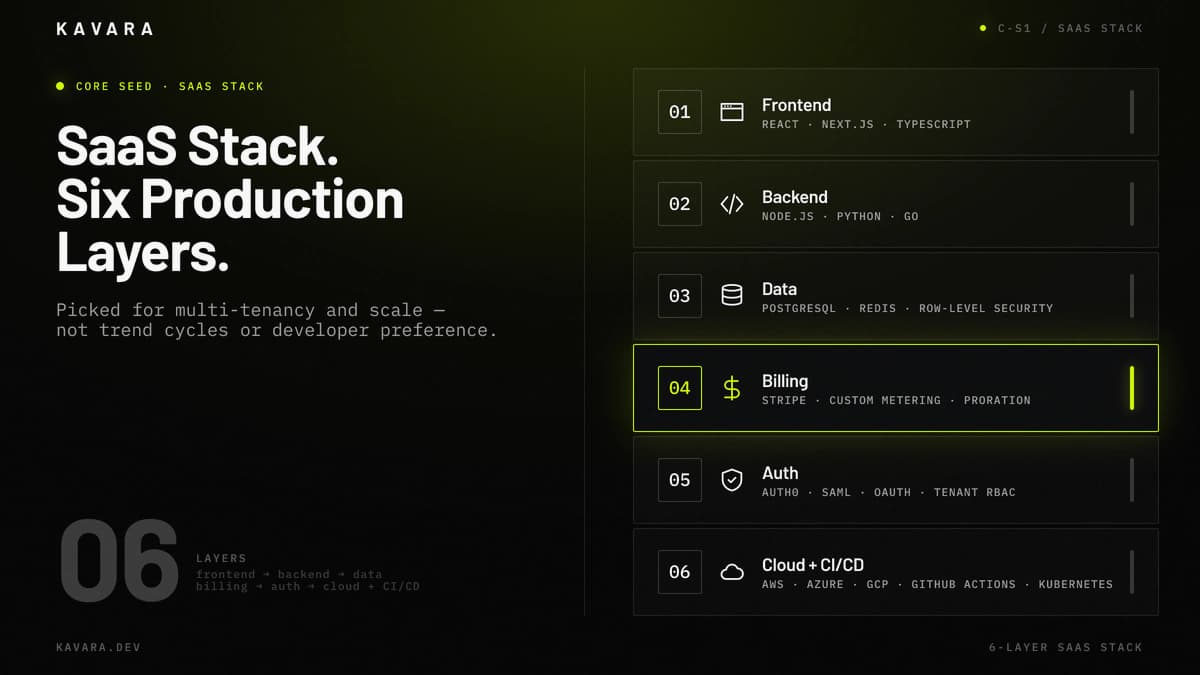
| Layer | Technologies | SaaS-Specific Rationale |
|---|---|---|
| Frontend | React, Next.js, TypeScript | Component-based architecture supports tenant-level theming and white-labeling |
| Backend | Node.js, Python, Go | Node.js for real-time features, Python for AI/data pipelines, Go for high-throughput services |
| Database | PostgreSQL, Redis | PostgreSQL with row-level security for multi-tenancy, Redis for session and cache management |
| Billing | Stripe, custom metering | Stripe for subscription management, custom usage metering for consumption-based pricing |
| Auth | Auth0, custom SSO | SAML/OAuth for enterprise SSO, tenant-scoped role-based access control |
| Cloud and CI/CD | AWS, Azure, GCP, GitHub Actions, Docker, Kubernetes | Cloud services, containers, and deployment automation provide environment parity and horizontal scaling |
SaaS technology stacks require more infrastructure tooling than standard web applications because billing, authentication, monitoring, and tenant management are core platform infrastructure — not optional add-ons. Stripe Billing documentation describes subscription tooling as handling trials, renewals, recurring payments, invoices, and billing-period logic; in SaaS architecture, those flows become part of the product state machine. A scalable architecture without tenant-scoped monitoring cannot diagnose performance issues affecting individual customers. These decision frameworks should be documented inside the architecture workstream before implementation begins.
These technology and architecture decisions — multi-tenancy model, billing integration, cloud infrastructure, CI/CD pipeline — directly affect the total cost of SaaS development.
How Much Does SaaS Development Cost
SaaS application development costs between $150,000 and $400,000 for mid-complexity platforms, with enterprise-grade SaaS products exceeding $400,000 depending on multi-tenancy requirements, integration scope, and compliance needs.
Cost varies by complexity tier. Basic SaaS applications with single-tenant architecture, limited integrations, and standard feature sets require $150,000 to $200,000. Mid-complexity SaaS platforms with multi-tenant architecture, subscription billing integration, role-based access control, and third-party API connections range from $200,000 to $300,000. Complex SaaS products with enterprise features, advanced security, complex data models, and white-label capabilities cost $300,000 to $400,000 or more.
SaaS development costs more than equivalent standard web applications because multi-tenancy infrastructure, subscription billing systems, tenant provisioning automation, and horizontal scaling architecture are foundational requirements that do not exist in single-organization applications. These layers add engineering effort across every development phase — from architecture design through QA testing. For feature-level pricing, phase-by-phase budget allocation, and hidden costs specific to SaaS projects, read our detailed SaaS development cost breakdown.
Ongoing costs for SaaS platforms typically add 15 to 25 percent of the initial build cost annually, covering cloud hosting, infrastructure scaling, maintenance, security updates, and feature iteration. SaaS hosting costs tend to be higher than standard web applications because multi-tenant infrastructure requires monitoring per tenant, database scaling for growing data volumes, and compute capacity that adjusts to variable demand patterns.
For cost comparisons across all application types — SaaS, portals, dashboards, MVPs — see our complete web application development cost guide.
What Is the Difference Between SaaS and Traditional Software
Traditional software is installed locally, licensed per copy, and updated through manual release cycles. SaaS is hosted in the cloud, delivered through subscription, and updated continuously without user intervention. The distinction shapes every aspect of how SaaS platforms are built.
Delivery differs fundamentally: traditional software requires installation on customer hardware, while SaaS runs in cloud infrastructure managed by the provider. Pricing shifts from one-time license fees to recurring subscription revenue with usage-based components. Updates move from manual release cycles requiring customer action to continuous deployment pipelines that deliver improvements without downtime. Infrastructure responsibility transfers from the customer's IT team to the SaaS provider's operations team. Access expands from desktop or local network limitations to any browser, anywhere, on any device.
We build SaaS applications — cloud-native, continuously deployed, subscription-driven platforms designed to serve multiple customers from shared infrastructure with isolated data, automated billing, and scalable architecture.
How Long Does It Take to Build a SaaS Application
Building a SaaS application typically takes 4 to 10 months from discovery to launch, depending on multi-tenancy complexity, feature scope, and integration requirements.
Basic SaaS applications with limited features and single-tenant architecture require 4 to 6 months. Mid-complexity SaaS platforms with multi-tenant architecture, subscription billing, and third-party integrations take 6 to 8 months. Complex SaaS products with enterprise features, compliance requirements, and advanced architecture require 8 to 10 months or more.
SaaS timelines are longer than equivalent web applications because multi-tenancy, billing infrastructure, and tenant provisioning are foundational systems — not features added later. Skipping or compressing these phases creates technical debt that blocks scaling when the platform gains traction. Understanding our SaaS development process helps set realistic timeline expectations by showing what each phase delivers.
Should You Start with a SaaS MVP or Build the Full Product
Start with a SaaS MVP when you need to validate market demand before committing full budget. Build the full product when you have validated demand, defined requirements, and enterprise customers waiting for production-ready features.
MVP-first makes sense when the market is unvalidated, initial budget is limited, or the founding team needs user feedback to refine the feature set. Full-build makes sense when market demand is proven, compliance requirements apply from day one, or enterprise clients require production stability before signing contracts.
A critical distinction separates SaaS MVPs from standard MVPs: a SaaS MVP still requires multi-tenant architecture foundations. Cutting corners on data isolation, billing infrastructure, or tenant provisioning creates technical debt that blocks scaling when the product finds market fit. The MVP scope reduces features, not architectural quality. Our SaaS development services pair with MVP methodology to build your SaaS MVP with validation-first architecture that controls cost without creating the technical debt that blocks scaling.
What Industries Use Custom SaaS Applications
Custom SaaS platforms serve industries where off-the-shelf tools cannot accommodate specialized workflows, compliance requirements, or data models:
- Healthcare builds HIPAA-compliant patient management platforms, telehealth systems, and clinical workflow SaaS that integrates with EHR systems.
- Financial services builds SOC 2 and PCI-compliant payment platforms, lending management systems, and regulatory compliance monitoring tools.
- Education builds LMS platforms, assessment tools, and student management systems with FERPA compliance and LTI integration.
- Real estate builds property management platforms, listing aggregation systems, and transaction management SaaS with MLS data integration.
- HR and recruiting builds applicant tracking systems, employee management platforms, and benefits administration SaaS.
- Logistics builds fleet management platforms, shipment tracking systems, and route optimization SaaS with real-time IoT data processing.
That pattern matches the High Alpha and OpenView benchmark cited above: industry-specific vertical SaaS companies grew faster than horizontal SaaS companies in the surveyed group. Companies that build SaaS applications serving a defined vertical create competitive moats that broad-market tools cannot replicate. Many of these industry-specific platforms serve business customers rather than consumers, which introduces its own set of architectural requirements.
What Makes B2B SaaS Development Different from B2C
B2B SaaS development requires enterprise-grade features — SSO integration, advanced role-based permissions, audit logging, SLA guarantees, and white-labeling capabilities — that B2C SaaS products rarely need.
B2B SaaS serves fewer customers at higher revenue per customer with complex onboarding processes, deep enterprise system integrations, and industry-specific compliance requirements. B2C SaaS serves high user volumes through self-serve onboarding, freemium acquisition models, and consumer-grade UX expectations.
Architecture decisions differ accordingly. B2B SaaS often requires separate database per tenant for compliance and enterprise isolation guarantees, while B2C SaaS typically uses shared-schema multi-tenancy for cost efficiency at scale. B2B platforms need API access for enterprise integrations, while B2C platforms prioritize mobile-first experiences and viral growth features. Enterprise feature requirements, integration patterns, and compliance architecture should be scoped before B2B SaaS platform decisions are locked.
How to Choose a SaaS Development Company
When evaluating a SaaS development partner, assess these SaaS-specific capabilities beyond general development competence:
- Multi-tenant architecture experience — Ask for examples of tenant isolation strategies they have implemented in production, not just theoretical knowledge of multi-tenancy patterns.
- Subscription billing integration — Verify they have built and deployed production billing systems with Stripe or equivalent providers, including usage tracking, plan management, and proration.
- Scaling track record — Ask how applications they built handle growth from 10 to 1,000 or more tenants without re-architecture or performance degradation.
- SaaS-specific QA — Cross-tenant security testing, billing accuracy verification, and load testing under multi-tenant conditions require testing practices that standard web application QA does not cover.
- Post-launch SaaS operations — Infrastructure monitoring, scaling support, feature iteration, and tenant growth management are ongoing requirements that extend well beyond initial deployment.
Choosing the right partner for production-grade SaaS development services determines whether the platform scales with demand or requires re-engineering under pressure. For comprehensive evaluation frameworks, interview questions, and red flags applicable across all project types, read our complete guide to choosing a web application development company.
Next Steps
SaaS application development demands architecture that most web application development projects never encounter — multi-tenant data isolation, subscription billing infrastructure, and scalable cloud deployment are not optional features but the foundation of every SaaS platform Kavara builds. We build, launch, and scale production-grade SaaS applications for mid-market companies creating subscription-based software products.
Explore our full SaaS and web application development services to see how we build across SaaS, portal, dashboard, and enterprise software categories. Schedule a project discussion to discuss your SaaS application requirements, evaluate multi-tenancy strategy, and receive a scoped estimate with architecture recommendations.