AI Implementation and Integration Services
AI implementation is the practice of embedding machine learning models, large language models, predictive analytics, and intelligent automation into production business applications - not building isolated proof-of-concept demos that never reach the users who need them. Business AI creates value only when the model connects to real workflows, real data, authenticated users, monitoring, and measurable outcomes.
The implementation problem is not the model alone. Gartner found in 2026 that by the end of 2025 at least 50% of generative AI projects were abandoned after proof of concept. The causes were poor data quality, inadequate risk controls, escalating costs, or unclear business value. RAND's 2024 report made the same practical point from interviews with 65 experienced AI engineers and data scientists: AI projects fail when teams misunderstand the problem, lack usable data, chase technology, or cannot deploy models into production infrastructure.
Kavara approaches AI implementation from a production engineering perspective. We start with data readiness, then select the model approach, then integrate AI into custom web application development work across SaaS platforms, enterprise portals, analytics dashboards, workflow systems, and custom enterprise software. AI is a capability we implement inside software, not a science experiment.
These AI implementation services serve mid-market companies at $5M-$100M revenue that need AI to solve specific business problems. Those problems include reducing processing, predicting churn, routing support requests, automating classification, extracting knowledge, and surfacing anomalies before they become operational issues. Kavara builds, launches, and implements AI features where users can adopt them and where the business can measure whether the implementation works.
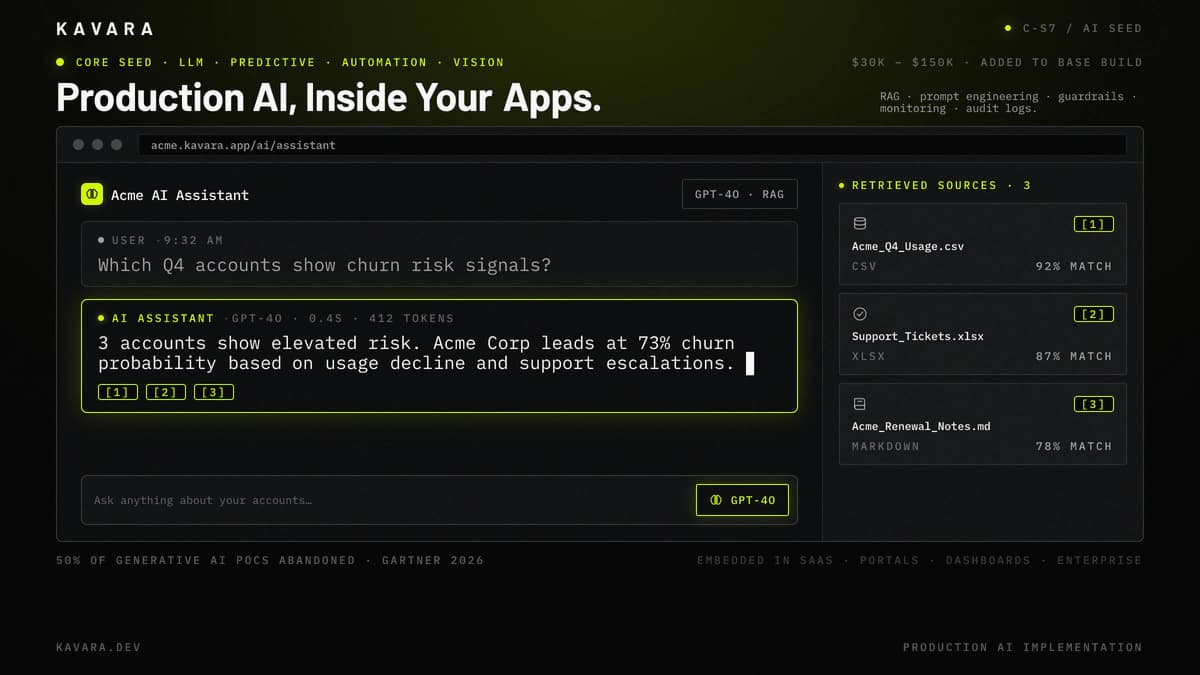
The mockup below shows a production AI assistant inside a SaaS application, with RAG-retrieved citations and audit-logged sources.
What Is AI Implementation for Business
AI implementation for business is the engineering discipline that integrates machine learning, large language models, and intelligent automation into production-grade web applications where real users, real data, and business outcomes depend on the system. AI implementation differs from AI research because the goal is not to prove that a model can work in a controlled environment. The goal is to make AI work reliably inside the business application people use.
AI strategy is a plan for where artificial intelligence might create value. AI development is the work of building, training, fine-tuning, or configuring a model. AI implementation is the work of putting that model into production-grade web applications with authentication, permissions, error handling, fallback behavior, monitoring, cost management, and response-time constraints. Implementation is where the engineering challenge lives because the model must operate inside the same production standards as the rest of the application.
Building a model that works on clean test data is relatively straightforward compared with integrating that model into messy business operations. A production AI feature must handle missing fields, malformed documents, stale records, unexpected user prompts, low-confidence predictions, API outages, and changing usage volume. AI implementation at Kavara operates within our broader Kavara application development practice. These web application development services embed AI capabilities into the SaaS platforms, portals, dashboards, and enterprise software we build.
Kavara scopes AI as a capability within business applications, not as an isolated product. A contract review model belongs inside a document workflow. A churn prediction model belongs inside a customer success dashboard. A support classification model belongs inside the service desk workflow. AI implementation shares the engineering discipline of all custom software development practice, with additional requirements for data pipeline architecture, model serving infrastructure, inference cost management, and accuracy monitoring.
Understanding what custom web application development with AI requires in practice clarifies which capabilities deliver measurable business value and which remain experimental.
AI Capabilities We Implement
We implement four AI capability categories:
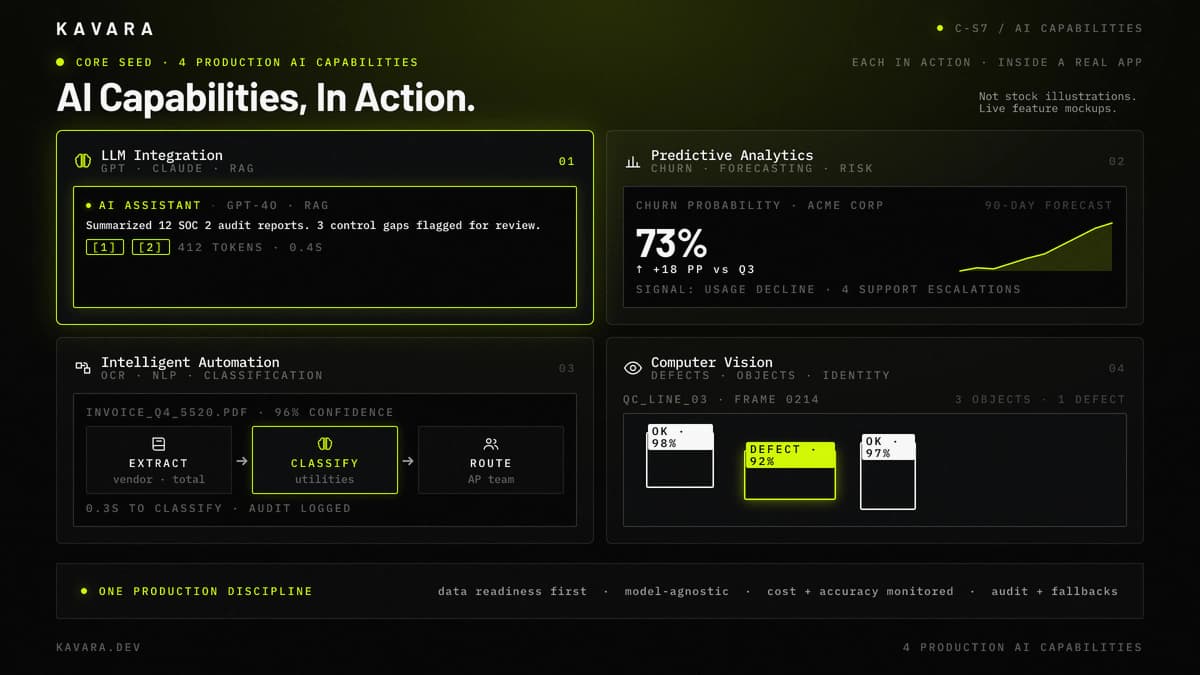
- Large Language Model (LLM) Integration - Large language model integration embeds GPT, Claude, or open-source LLMs into applications for document summarization, intelligent search, conversational interfaces, and knowledge extraction. Enterprise LLM implementation often requires retrieval-augmented generation, or RAG, which retrieves company-specific context before asking the model to generate an answer. Prompt engineering, guardrails, access control, audit logging, and token-cost management determine whether LLM integration is usable in production. Our LLM and ChatGPT integration services cover RAG architecture, prompt engineering, guardrails, and enterprise deployment for production applications.
- Predictive Analytics and Forecasting - Predictive analytics uses machine learning models to forecast business outcomes from historical data. These models support demand forecasting, churn prediction, risk scoring, anomaly detection, resource optimization, and operational planning. Predictive AI turns historical records into forward-looking intelligence embedded directly into operational dashboards and decision workflows. Our AI-powered analytics and predictive intelligence services embed forecasting and anomaly detection directly into operational dashboards.
- Intelligent Automation - Intelligent automation combines AI models with workflow logic to reduce repetitive manual work. Common implementations include document processing with OCR and natural language processing for invoice extraction, contract analysis, form processing, email routing, support ticket categorization, and decision support systems. The automation should classify routine cases while escalating exceptions to human review when confidence is low or the decision carries meaningful risk. Our AI automation for business processes covers document processing, classification systems, and decision support for mid-market operations.
- Computer Vision - Computer vision is image and video analysis that identifies objects, extracts visual information, verifies identities, or detects quality issues. In mid-market applications, computer vision commonly supports document digitization, product catalog tagging, inventory counting, quality inspection, visual search, and manufacturing defect detection. Computer vision implementations require training data pipelines, model optimization for inference speed, and integration with camera hardware or image upload workflows. The capability becomes useful only when the visual output triggers a workflow, updates a record, or informs a user decision.
These AI capabilities serve different application types. LLMs fit portals, knowledge bases, and enterprise software. Predictive analytics fits dashboards and reporting. Intelligent automation fits workflow systems. Computer vision fits mobile, IoT, manufacturing, and document-heavy applications. Implementing these capabilities into production requires a methodology that addresses the main reason AI projects fail: data readiness.
Our AI Implementation Methodology
Most AI projects fail not because the model is wrong but because the data is not ready, the business objective is unclear, or the integration architecture is not planned. Our methodology addresses these failure modes before model selection begins.
The diagram below pairs the five most common AI project failure modes with the five methodology phases that prevent each.
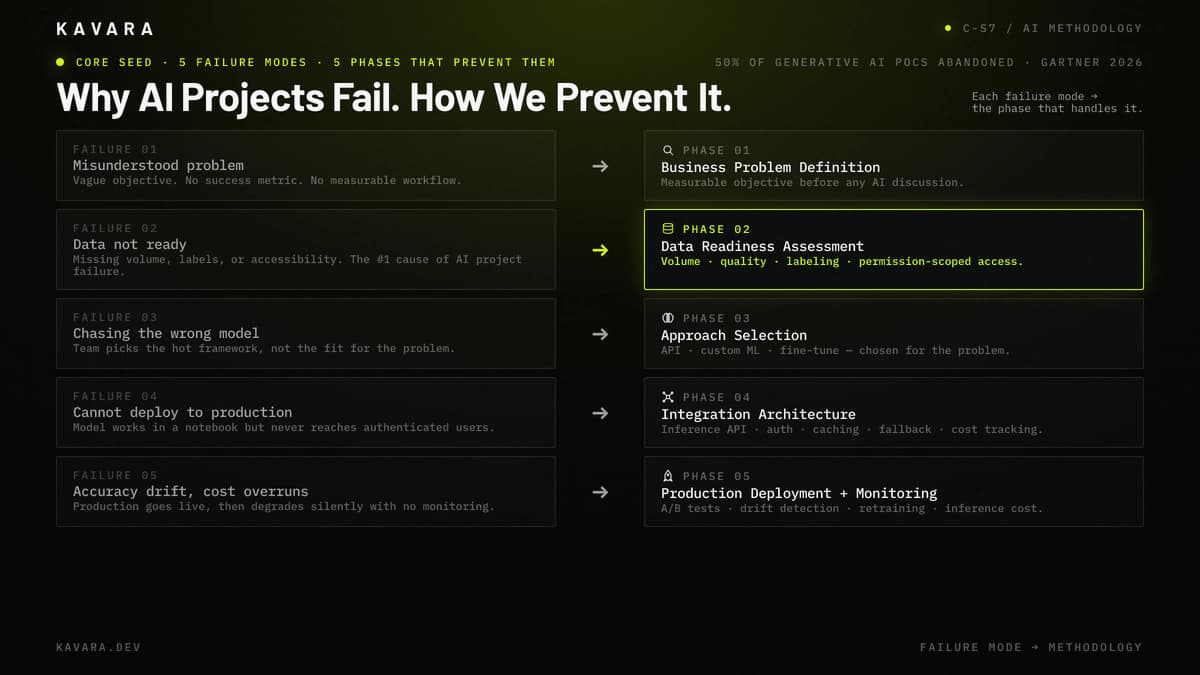
- Business Problem Definition - Business problem definition happens before any AI discussion. "Make our operations more efficient" is not measurable. "Reduce manual document processing from 40 hours per week to 4 hours per week" is measurable because the AI implementation can prove whether the workflow improved. RAND's 2024 AI failure report identified misunderstanding the problem as a leading cause of failed AI projects.
- Data Readiness Assessment - Data readiness assessment determines whether the data exists, whether it is clean, whether there is enough of it, whether it is labeled, and whether the application can access it. A supervised machine learning model needs labeled examples. A RAG-based LLM feature needs source documents that can be chunked, embedded, retrieved, and permission-scoped. Data readiness prevents building AI around data that is unavailable, inconsistent, or locked in systems without usable APIs.
- Approach Selection - Approach selection matches the problem and data to the right AI pattern. API-based AI, including OpenAI, Anthropic, and Google models, fits natural language and content workflows. Custom machine learning models fit domain-specific prediction when proprietary data drives the result. Fine-tuned models fit specialized classification when baseline behavior is close but not accurate enough. The selection depends on accuracy, explainability, latency, data volume, and inference cost at production scale.
- Integration Architecture - Integration architecture defines how the model connects to the application. The architecture covers inference API design, response caching, authentication, permission filtering, fallback behavior, accuracy drift monitoring, and cost tracking. Our AI implementation methodology operates within a structured delivery process, with data readiness assessment during discovery and integration architecture during the architecture phase.
- Production Deployment and Monitoring - Production deployment moves the model into infrastructure that can serve real users. Deployment includes model serving, A/B testing, accuracy monitoring, prompt or model versioning, retraining triggers, and inference cost monitoring. AI implementation continues after launch because model performance can degrade when data patterns, usage volume, or business rules change.
This methodology connects AI capabilities to existing applications through integration patterns designed for reliability and cost efficiency.
AI Architecture and Integration Patterns
AI implementation is an architecture problem, not a model problem. The model produces a prediction, classification, extraction, or generated response. The architecture determines whether that output reaches users reliably, handles errors gracefully, and operates within cost constraints at production scale.
McKinsey's 2025 State of AI survey found that AI high performers are nearly three times as likely as others to fundamentally redesign workflows during deployment, which is why AI integration architecture has to reach the user's actual work surface.
The diagram below shows how data sources, pipeline work, inference APIs, application logic, and user workflows connect in production AI architecture.
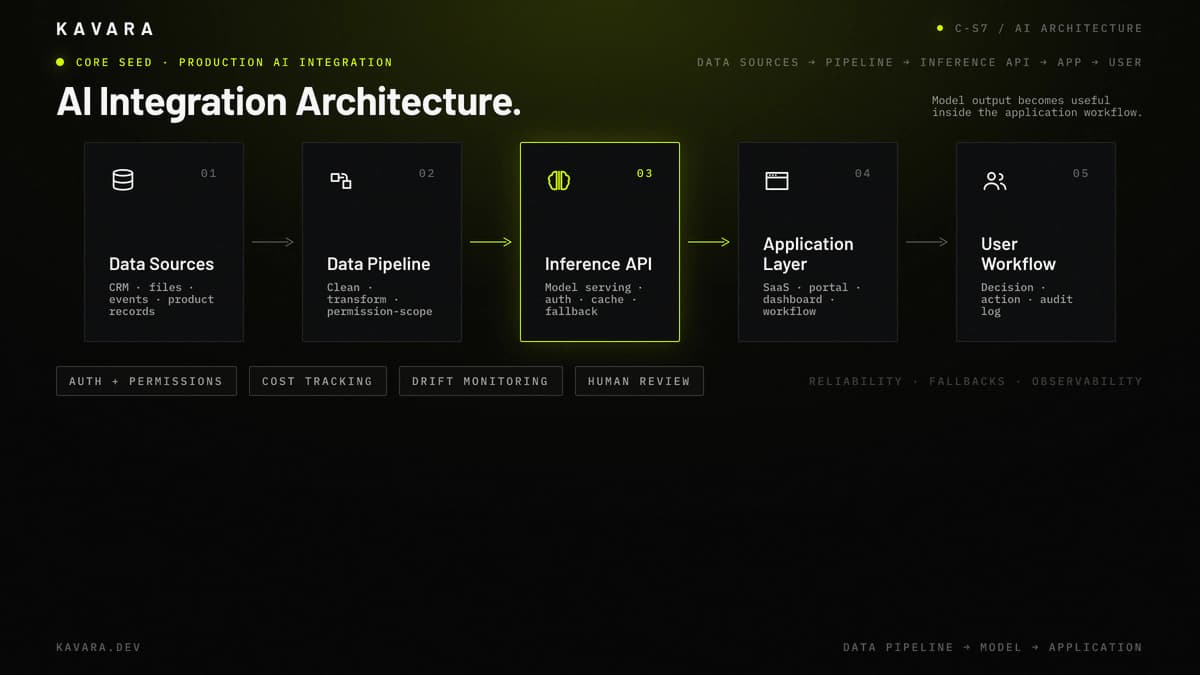
Inference API design determines how the AI model serves results to the application. AI models usually expose predictions through APIs that manage latency, concurrency, retries, authentication, and request payload structure. Real-time workflows need low-latency inference, while batch workflows can process records asynchronously. For LLM features, streaming responses improve user experience when generation takes several seconds.
Data pipeline integration determines whether the model receives the right inputs at the right time. AI models need historical data for training, current data for inference, and transformed features that match the model's expected format. The data pipeline connects databases, APIs, file storage, and event streams through cleaning and feature engineering. Dashboard applications already depend on data pipelines, and AI implementation extends those pipelines to serve model inputs.
Cost management is a production architecture concern because API-based AI charges per token, request, image, or inference event. A production application processing 10,000 AI requests per day at $0.01 to $0.03 per request can generate $100 to $300 per day in inference cost. Caching, request batching, prompt compression, model routing, and smaller-model selection directly control operational cost.
Fallback and error handling make production AI safer and more predictable. AI models are probabilistic, so they can produce incorrect, inconsistent, incomplete, or inappropriate outputs. Production AI requires default responses when the model fails, confidence thresholds that reject low-confidence predictions, human review for high-risk decisions, and audit logs when outputs affect customers, money, compliance, or safety.
The application architecture that AI integrates into follows the patterns detailed in our web application architecture guide, with additional layers for model serving, inference APIs, and data pipeline management. The technology choices that power these integration patterns evolve rapidly, but reliability, cost management, and graceful degradation remain constant.
AI Technology Stack
AI technology selection splits into two layers: the model layer, which handles intelligence, and the integration layer, which connects the model to production applications.
| Layer | Technologies | AI-Specific Rationale |
|---|---|---|
| LLM / NLP | OpenAI GPT models, Anthropic Claude, Llama, Mistral | Hosted models for production NLP, open-source models for on-premise or cost-sensitive workloads |
| ML Framework | Python, scikit-learn, TensorFlow, PyTorch | Python ecosystem for custom model training, evaluation, and experimentation |
| Data Pipeline | Apache Airflow, AWS Glue, custom ETL | Airflow for orchestration, AWS Glue for serverless data transformation |
| Vector Database | Pinecone, Weaviate, pgvector | RAG architecture for storing and retrieving embeddings for LLM context |
| Model Serving | AWS SageMaker, custom inference APIs | SageMaker for managed ML, custom APIs for LLM integration and application-specific control |
| Monitoring | Weights & Biases, custom dashboards | Model accuracy tracking, inference cost monitoring, drift detection |
AI technology evolves faster than almost any other layer in the application stack. The 2026 Stanford AI Index reported that industry produced over 90% of notable frontier models in 2025 and that SWE-bench Verified performance rose from 60% to near 100% in one year. A model selected today may be replaced in 12 months when a faster, cheaper, or more accurate model becomes available. Production AI architecture should therefore remain model-agnostic. The application should be able to swap model providers, update prompts, change embedding models, or route simpler tasks to smaller models without re-engineering the entire product.
The integration layer matters more than the model layer because the integration layer protects the business from model churn. AI technology cost is primarily driven by model complexity, data pipeline requirements, and ongoing inference expenses, which makes AI implementation cost different from standard web application development.
How Much Does AI Implementation Cost
AI implementation typically adds $30,000 to $150,000 to the base cost of the application it integrates with. The range depends on AI capability, data pipeline complexity, and whether the solution uses API-based or custom-trained models.
The chart below positions each AI capability on a shared $0K to $150K scale, with computer vision carrying the widest range.
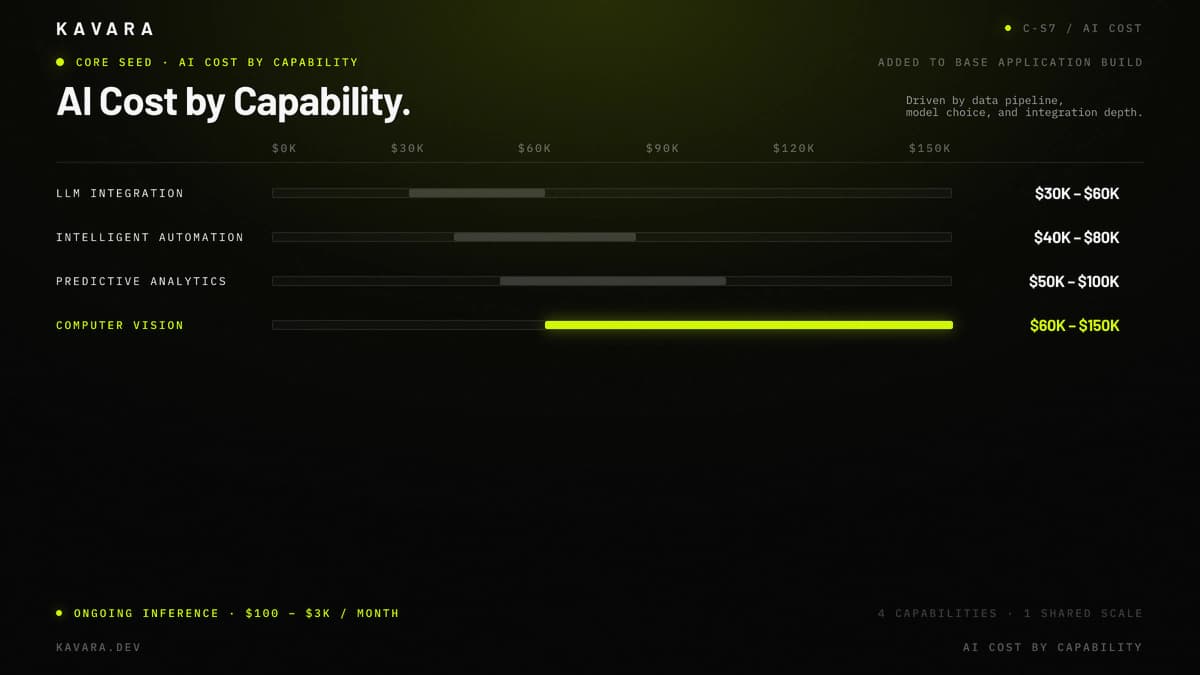
LLM integration with RAG architecture, prompt engineering, guardrails, and enterprise deployment typically adds $30,000 to $60,000. Predictive analytics with custom machine learning model training and integration typically adds $50,000 to $100,000.
Intelligent automation for document processing, classification, and decision support typically adds $40,000 to $80,000. Computer vision with custom model training, image pipeline engineering, and production integration typically adds $60,000 to $150,000. These ranges reflect AI-specific engineering on top of discovery, UX, application development, QA, deployment, and support.
Ongoing AI costs include API-based inference, model monitoring, retraining, data pipeline maintenance, and prompt or model version management. API-based inference may cost $100 to $3,000 per month depending on usage volume, token count, model selection, and caching strategy. Retraining may run annually or when model accuracy degrades.
AI implementation costs are additive to base application development. AI-ready SaaS platforms that cost $200,000 to $400,000 to build may add $50,000 to $100,000 for production AI features.
For detailed cost ranges across SaaS, portal, dashboard, and enterprise software categories, see our web application cost guide.
What Data Do You Need Before Implementing AI
Before implementing AI, you need enough clean, accessible data.
- Sufficient volume - Supervised learning needs hundreds to thousands of labeled examples, RAG needs a reliable knowledge base, and predictive models need historical data spanning multiple business cycles.
- Data quality - Data needs to be clean, consistent, labeled when necessary, and structured enough for the AI approach selected. In production AI integration work, preparation often consumes more effort than model selection because the application must inventory source systems, normalize records, preserve permissions, label examples, and test whether outputs can be trusted.
- Data accessibility - Data must be reachable through APIs, database connections, file storage, or controlled extraction workflows. Data locked in PDFs, spreadsheets, email inboxes, or legacy systems requires extraction engineering before AI can use it.
If usable data does not exist yet, the first AI implementation step is data collection and governance rather than model deployment.
How Long Does AI Implementation Take
AI implementation typically adds 4 to 12 weeks to the development timeline of the application it integrates with, depending on data readiness, model complexity, and integration depth. LLM integration with existing data usually adds 4 to 6 weeks. Custom machine learning model training and integration usually adds 6 to 10 weeks. Computer vision with custom model training and image pipeline work usually adds 8 to 12 weeks.
Data preparation is the primary timeline factor. If data is clean and accessible, model integration proceeds quickly. If data must be collected, cleaned, labeled, transformed, or migrated from legacy systems, the data engineering phase can double the AI timeline. Timeline risk decreases when the project starts with a narrow business objective and a defined production workflow.
What Is the Difference Between Custom AI and Off-the-Shelf AI Tools
Off-the-shelf AI tools, including ChatGPT, Copilot, Jasper, and pre-built analytics platforms, provide general-purpose AI through a subscription. Custom AI implementation embeds AI trained, configured, or integrated for your specific data, workflows, permissions, and business rules into your production applications.
Off-the-shelf AI works when the task is general: writing assistance, basic summarization, standard chatbot behavior, broad research, or simple analysis that does not require proprietary data. Off-the-shelf AI also works when subscription cost is predictable and the workflow can stay outside the core system.
Custom AI implementation wins when the AI must access proprietary company data, follow role-based permissions, produce predictions specific to your business, or operate inside existing workflows. Churn prediction, demand forecasting, compliance review, contract analysis, and customer-specific knowledge retrieval usually require custom AI integration because generic tools cannot understand your data model, business rules, or operational context.
What Industries Benefit Most from AI Implementation
AI implementation delivers the highest ROI in industries with high data volume, repetitive processes, or complex prediction requirements:
- Healthcare - Clinical decision support, medical document processing, patient outcome prediction, and intake automation can reduce administrative load when implemented with HIPAA-aware architecture. Our healthcare web application development practice implements AI with compliant architecture for clinical workflows.
- Financial services - Fraud detection, credit risk scoring, compliance automation, and portfolio analytics support faster decisions when models operate with audit logs and access control.
- Logistics - Demand forecasting, route optimization, carrier exception detection, and predictive maintenance help operations teams reduce delay, fuel cost, and service failures.
- Manufacturing - Computer vision quality inspection, predictive maintenance, production optimization, and anomaly detection help teams identify defects and equipment risk earlier.
- Professional services - Document analysis, contract review, knowledge management, and matter classification reduce repetitive review work.
AI-powered predictive analytics integrate naturally into dashboard and analytics development, embedding forecasting and anomaly detection into the visualization layer decision-makers already use. Industry use cases matter, but the pattern remains the same: define the problem, verify the data, design the integration, and launch inside the workflow.
Next Steps
AI implementation helps mid-market companies build, launch, and implement production AI capabilities such as LLM integration, predictive analytics, intelligent automation, and computer vision inside the applications their teams already use. Data readiness comes first, integration architecture second, and model selection third. Explore our full custom application development services to see how AI capabilities integrate into SaaS platforms, portals, dashboards, and enterprise software. To assess data readiness, define your AI use case, and scope implementation from discovery through launch, schedule a project discussion.