SaaS Development Process: From Idea to Launch
Building a SaaS platform requires a development process that goes beyond standard web application development - every phase must account for multi-tenancy, subscription billing, tenant isolation, and the operational demands of serving multiple customers from shared infrastructure. Standard applications usually serve one organization. SaaS applications must serve many tenants, isolate customer data, process recurring revenue, deploy updates without downtime, and scale as customer count grows.
The SaaS development process changes each phase of the build. Discovery validates recurring revenue, not just user interest. Architecture defines multi-tenant architecture, database isolation, billing workflows, and infrastructure before product features are built. Design covers tenant onboarding, admin dashboards, billing portals, and role-based user flows. Development sequences tenant provisioning before feature work. QA verifies cross-tenant security and billing accuracy. Launch includes first-tenant onboarding and production monitoring.
Kavara builds SaaS platforms through this process for mid-market companies that need production-grade SaaS application development from idea validation through first-tenant launch. It is a practitioner view of how to build SaaS applications without creating rework, billing defects, tenant data exposure, or scaling constraints that surface after the first customers arrive.
The diagram below maps the five structural differences from standard web development that shape every SaaS phase.
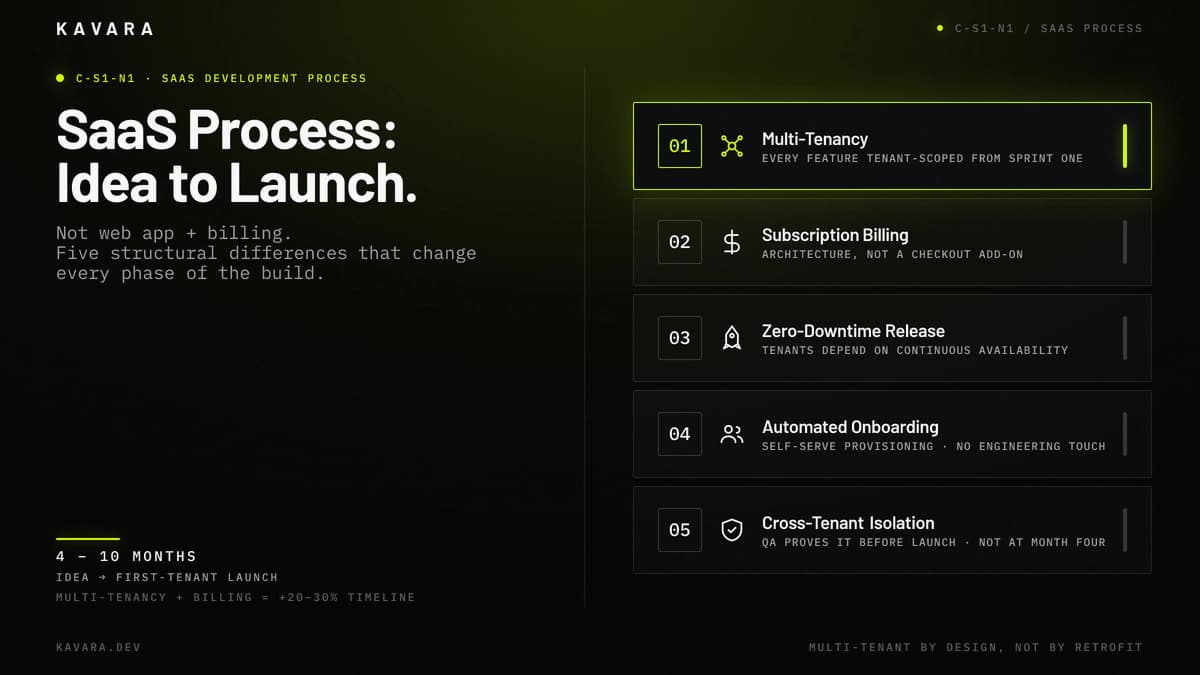
How SaaS Development Differs from Standard Web Application Development
Standard web application development produces software for one organization. SaaS development produces software for many organizations at once, so every architecture, design, deployment, and support decision must account for tenant isolation and recurring revenue. In practice, SaaS development differs from standard web application development at every layer, and that difference separates generic teams that build web applications from teams building subscription platforms.
Multi-tenancy is the defining design constraint because every feature must be tenant-scoped from the first sprint. Subscription billing is foundational architecture, not a checkout add-on, because plan logic affects database schema, API behavior, and permission models. Deployment must be zero-downtime. Scaling must be horizontal because tenant count, usage, and data growth are unpredictable after launch. Onboarding must shift from custom implementation to automated provisioning so new customers can activate without engineering work.
For the broader definition of SaaS application development, multi-tenant architecture model selection, and custom SaaS platform categories inside a custom web application development practice, see our SaaS application development services page. The rest of this guide focuses on how those SaaS-specific requirements change each phase of the development process.
These differences shape every phase of the SaaS development process, starting with how the idea is validated and the product strategy is defined.
Idea Validation and SaaS Product Strategy
SaaS idea validation goes beyond confirming that people want the software - it must confirm that they will pay for it on a recurring basis, that the market supports a multi-tenant delivery model, and that the unit economics work at scale. A SaaS product that earns one trial sign-up but fails to retain paid users has not validated the business model.
Market validation therefore tests willingness to pay monthly or annually, not only interest in the feature set. Subscription model design also starts during discovery because pricing tiers, freemium access, usage-based billing, per-seat billing, and enterprise contracts affect database schema, API behavior, user roles, and billing events. High Alpha and OpenView's 2024 SaaS Benchmarks Report surveyed 800+ SaaS companies and found 37% target enterprise buyers, making pricing, roles, SSO, and procurement readiness discovery inputs. Billing logic is architecture, not a checkout add-on.
Competitive analysis matters because SaaS competitors are one click away. Switching costs must come from workflow depth, integrations, data history, and operational usefulness rather than from sales promises. Compliance scoping also starts here because healthcare, fintech, and enterprise SaaS buyers expect HIPAA, SOC 2, PCI, SSO, audit logging, or data residency requirements before procurement approves the platform.
CB Insights' report The Top 20 Reasons Startups Fail analyzed 101 startup post-mortems and found that building for no market need was cited in 42% of failures. For SaaS, this failure mode is amplified because subscription revenue requires ongoing value delivery, not just an initial purchase. A SaaS development process that skips validation may still build software, but it has not proven that the recurring workflow is valuable enough for customers to renew.
With a validated idea and defined subscription model, the next phase translates these business decisions into multi-tenant architecture.
Multi-Tenant Architecture and Infrastructure Design
Multi-tenant architecture is the decision that defines a SaaS platform's cost structure, security posture, compliance capability, and scaling path - and it must be made correctly before development begins. The tenancy model determines how every later feature stores, queries, secures, and exposes customer data.
The comparison below positions the three multi-tenancy models on a single cost-versus-isolation axis.
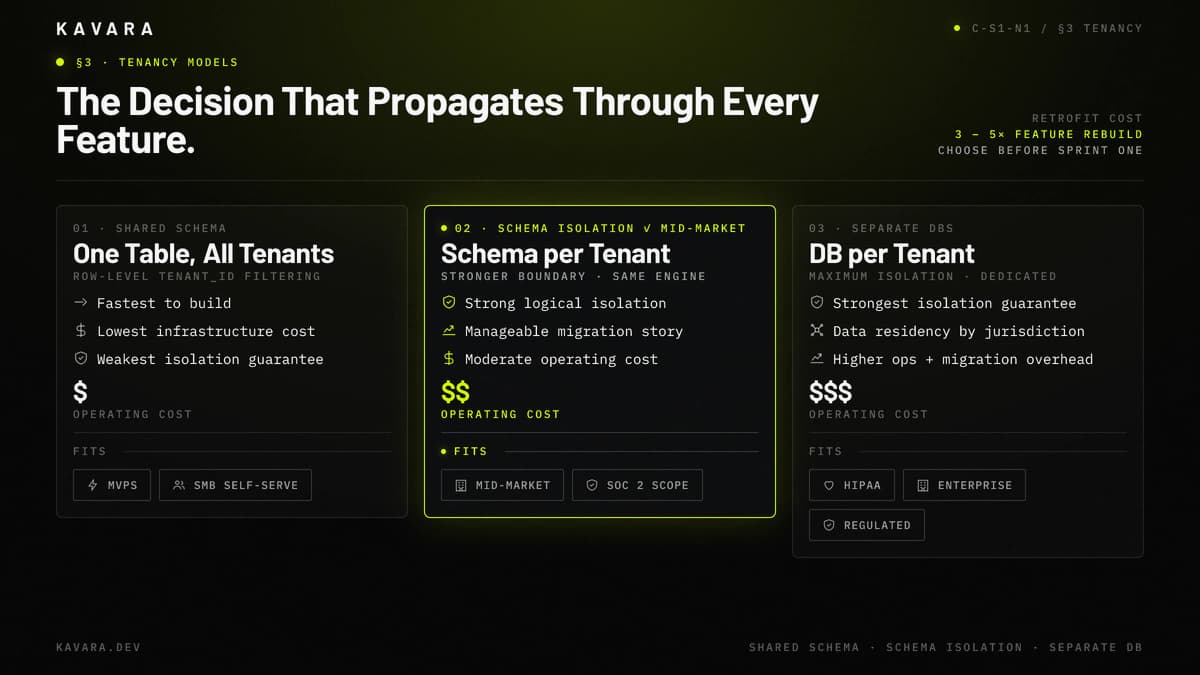
Tenancy model selection usually starts with three options: shared database and shared schema for the fastest build and lowest infrastructure cost, shared database with separate schemas for stronger isolation, or separate databases for maximum isolation and the highest operating cost. Selection depends on compliance requirements, expected tenant count, data sensitivity, and enterprise sales expectations. Deeper architecture work covers tenant management patterns and migration paths between isolation models; this page focuses on when that decision is made and how it affects later work.
Database architecture then makes tenant-scoped access enforceable. Schema design must propagate tenant IDs through the application, row-level security policies must prevent cross-tenant reads, and API queries must preserve tenant context from authentication through response generation. These decisions affect the development timeline because retrofitting tenant isolation after features exist is expensive and risky.
Subscription billing architecture is defined in the same phase. Stripe or custom billing integration, usage metering, plan management, proration, invoice generation, payment failure handling, and billing event webhooks must align with the product's pricing model. Authentication and authorization also become tenant-scoped through SAML, OAuth, role-based access control, and admin permission hierarchies. Infrastructure design completes the phase with cloud selection, containerization, auto-scaling, CDN strategy, and monitoring boundaries.
With architecture defined, product design creates the user experience layer that tenants and their end users interact with.
SaaS Product Development and Sprint Methodology
SaaS development runs in two-week agile sprints with milestones structured around SaaS-specific infrastructure - tenant management, subscription billing, and core product features are built in a deliberate sequence, not in parallel. Design considerations are embedded inside these agile sprints rather than handled as a detached phase because tenant-level theming, onboarding flows, admin dashboards, and billing portal design must evolve with the systems they control.
The timeline below shows the four ordered build milestones — tenant provisioning, billing, core features, and admin dashboards.
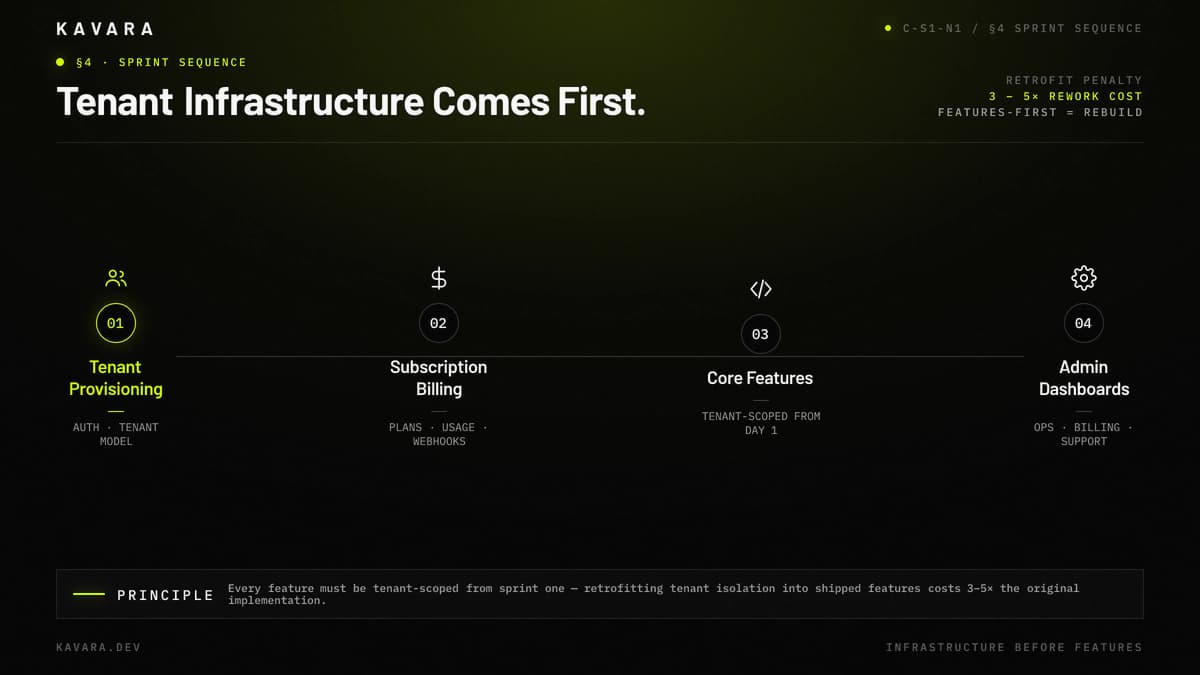
Sprint sequence matters. Tenant provisioning and authentication come first because every feature depends on knowing which tenant owns the user, data, and permissions. Subscription billing comes second because plan limits, payment states, usage events, and subscription lifecycle rules affect what users can access. Technology choices - frontend framework, database engine, billing layer - must stay visible in sprint planning because each affects tenant isolation, billing behavior, and deployment risk.
Core product features come third because every feature must be tenant-scoped from the start. Building product features before tenant infrastructure creates rework; retrofitting tenant isolation into existing features costs three to five times more than building the correct boundaries during the first implementation. Admin dashboards and tenant management follow because internal operations need controlled visibility into tenant health, billing state, and support actions.
Agile communication cadence keeps stakeholders close to working software. Biweekly sprint demos show tenant provisioning, billing flows, onboarding screens, and product features in action rather than slide summaries. This sprint methodology follows our structured web application development process, adapted for the specific milestones and infrastructure requirements of SaaS platforms.
Every feature built in a sprint passes through SaaS-specific quality assurance before reaching production.
SaaS-Specific Quality Assurance and Compliance Testing
SaaS quality assurance requires testing dimensions that single-tenant applications never encounter - cross-tenant data isolation verification, billing accuracy under concurrent usage, and compliance validation against industry-specific regulatory frameworks. QA must prove the platform is safe for multiple customers before launch.
The matrix below shows the four SaaS-specific QA dimensions that single-tenant applications never test.

Cross-tenant isolation testing verifies that Tenant A cannot access Tenant B's records through any API endpoint, query path, file URL, export, search result, or UI state. Automated isolation tests run against every tenant-scoped endpoint because a single missed permission check can expose customer data across the platform.
Billing accuracy testing validates subscription creation, plan upgrades and downgrades, proration calculations, usage metering, invoice generation, failed-payment handling, and account state changes. Billing bugs are not minor SaaS defects. Billing bugs affect revenue recognition, customer trust, and support burden.
Multi-tenant performance testing simulates concurrent tenants so one tenant's heavy usage does not degrade performance for others. Compliance validation checks HIPAA, SOC 2, PCI DSS, audit logging, retention, encryption, and access control requirements based on the target industry. Zero-downtime deployment testing verifies that releases, database migrations, and feature flags can execute without interrupting active tenants. Bessemer's 2025 Cloud 100 Benchmarks case study of Intercom's Fin cites backtesting, simulated users, and large-scale A/B tests before scaled deployment - the same evidence-first launch discipline SaaS platforms need.
When QA confirms tenant isolation, billing accuracy, and performance under multi-tenant load, the platform is ready for its first production tenants.
Launch, Tenant Onboarding, and Post-Launch Iteration
Launching a SaaS platform is not a single deployment event - it is the transition from building the product to operating a service that tenants depend on. Launch begins with staging validation using test tenants, production deployment, monitoring configuration, uptime checks, error tracking, and response-time visibility by tenant.
First-tenant onboarding is intentionally guided. Early tenants often need data migration assistance, integration setup, billing activation, admin training, and support while the team validates onboarding friction. After initial tenants, onboarding must become self-serve through automated account creation, environment provisioning, billing activation, and role setup.
Post-launch iteration uses tenant-level usage analytics and feature data to prioritize the roadmap. Infrastructure scaling, feature iteration, and ongoing maintenance affect total SaaS development cost - see our detailed SaaS development cost breakdown for phase-by-phase investment expectations. SaaS platforms scale through continuous improvement after first-tenant launch, not through a single release. The launch phase therefore measures both product adoption and operational readiness: support load, onboarding friction, billing errors, and infrastructure behavior under real tenant usage.
The first practical questions about this lifecycle are timeline and the most common SaaS development mistakes.
How Long Does the SaaS Development Process Take
SaaS development typically takes 4 to 10 months from idea validation to first-tenant launch, depending on multi-tenancy complexity, feature scope, and compliance requirements. Basic SaaS platforms with shared-schema architecture and limited features take 4 to 6 months. Mid-complexity SaaS platforms with multi-tenancy, billing, and integrations take 6 to 8 months. Complex SaaS platforms with enterprise compliance and advanced architecture take 8 to 10 months or more.
Multi-tenancy and billing infrastructure account for 20% to 30% of the total SaaS development process timeline, which is time that standard web applications do not require. Timeline also depends on how quickly the team can confirm tenant roles, pricing logic, compliance requirements, and integration scope during discovery.
What Are the Most Common SaaS Development Mistakes
The most costly SaaS development mistakes involve deferring infrastructure decisions that should be made before writing product code:
- Building features before tenant infrastructure - This forces teams to retrofit tenant isolation into every existing feature.
- Treating billing as a feature instead of architecture - Subscription logic affects database schema, API design, permissions, and user management.
- Choosing single-tenant architecture to keep it simple - This creates a complete re-architecture requirement when the second customer arrives.
- Skipping cross-tenant security testing - A single data leak between tenants destroys trust for the entire platform.
- Launching without automated tenant provisioning - Manual onboarding creates an operational bottleneck that limits growth.
These mistakes explain why the SaaS development process must be specialized from discovery through launch. Teams that build SaaS applications with a generic web application process usually discover the missing SaaS infrastructure after the cost of change has already multiplied.
Should You Start with a SaaS MVP or Build the Full Platform
Start with a SaaS MVP when the market, pricing model, or onboarding motion still needs evidence. Build the full platform when customer commitments, compliance obligations, or enterprise procurement requirements already demand production breadth. The key is that a SaaS MVP can reduce features, but it cannot remove tenant isolation, authentication, billing foundations, or deployment quality. Custom web application development for SaaS should preserve the platform architecture that lets the product scale after validation, even when the first release includes only the core workflow. Our MVP development services focus on validation-first scope control without cutting the architecture quality that SaaS products need after launch.
Next Steps
SaaS development is not standard web application development with a billing page added. It is a different engineering challenge requiring multi-tenancy, subscription billing, tenant isolation, and launch operations at every layer. Kavara builds SaaS platforms for mid-market companies from idea validation through first-tenant launch and scaling, preserving phase order so teams validate demand, choose tenancy, build billing, and prove QA before customers arrive. Explore our full web application development services to see how we build across SaaS, portal, dashboard, and enterprise software categories. Start a project conversation to validate your SaaS concept, define your tenancy strategy, and scope the build.