Product Discovery and Requirements Process
We run product discovery as a two-to-four-week phase before we write any application code — not because methodology demands it, but because the data is unambiguous. According to the Project Management Institute's research on requirements management, 47% of unsuccessful projects fail to meet their goals because of inaccurate requirements management — and discovery is the cheapest way we have found to prevent the most expensive mistakes. That single statistic shapes how we treat the discovery phase across every custom web application development engagement we run.
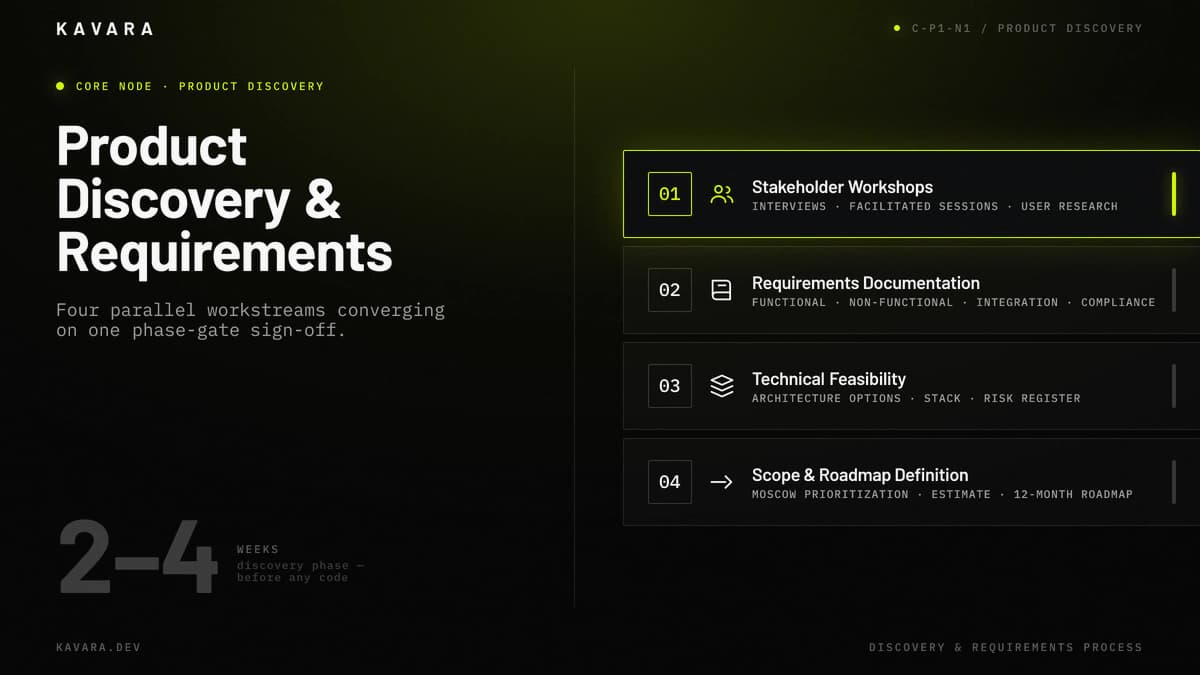
Product discovery is the structured phase where we work with stakeholders to define what the application needs to do, document those requirements, validate the technical feasibility of what is being asked, and produce the scope, architecture recommendations, and project estimate that every downstream phase depends on. Discovery is four parallel workstreams — stakeholder workshops, requirements documentation, technical feasibility, and scope and roadmap definition — running over two to four weeks and converging into a phase-gate sign-off that authorizes development.
Our discovery process is informed by hundreds of completed projects for mid-market companies — discovery is where we discover, document, and scope before we build web applications, so that what we deliver matches what the business needs at production-grade scale.
What We Mean by Product Discovery
In every Kavara engagement, product discovery is the phase where we translate business intent into a documented, scoped, and feasibility-validated build plan — before we commit a single developer hour to writing code. Product discovery is the structured phase where stakeholders define what the application needs to do, requirements get documented in detail, technical feasibility is validated, and the scope, architecture recommendations, and project estimate are produced.
That definition is narrower than how the term is sometimes used, and the distinction matters. Product discovery — the phase we run before custom builds — is not the same as continuous discovery, the ongoing user research practice that happens after launch on a different cadence. Discovery workshops are the facilitated sessions inside the discovery phase, not the phase itself. Requirements gathering is the artifact-producing workstream within discovery, not the whole engagement.
Three things our discovery is not. Discovery is not a sales activity — we run it to define engagements, not to qualify them, and discovery starts only after the engagement is signed. Discovery is not a brainstorm — brainstorming may happen inside workshops, but the output is structured documentation. Discovery is not optional — we have built applications without it in the past, and the results are consistent with what the requirements-management research describes. That framing — discovery as definition, not exploration — is what makes the case for treating it as mandatory.
For the full seven-phase web application development process Kavara runs that discovery feeds into, see our complete development process page.
Why We Don't Skip Discovery — Even on Tight Timelines
Every CTO we work with eventually asks whether discovery can be compressed or skipped to accelerate the timeline. Our answer, across hundreds of custom web application development engagements, is the same: time saved by skipping discovery is lost multiple times over fixing what should have been defined upfront.
According to the Project Management Institute's research on requirements management, 47% of unsuccessful projects fail to meet their goals because of inaccurate requirements management. Wellingtone's State of Project Management research tells the same story — 66% of organizations report frequent delays caused by unclear requirements. The requirements process is where projects become buildable or remain ambiguous, and ambiguous projects do not get cheaper as development progresses.
The structural reason is simple: defects caught in requirements are far cheaper to fix than defects found in testing or production. Discovery is the cheapest hour in the project. For how requirements quality affects total cost, see our guide to web application development cost.
Agile does not eliminate the need for discovery — it changes when continuous discovery happens after launch. The initial discovery phase before we start building is what gives the agile sprints a coherent product to iterate on. Agile without discovery is expensive guessing in sprint vocabulary.
We have built applications without discovery in the past — usually under pressure from clients with a fixed launch date or who had done their own discovery internally. In nearly every case, we spent more time during development reconstructing requirements than discovery would have taken. That is why discovery is the first phase of our web application development services, not an optional add-on — we treat it as a phase-gated commitment, not a negotiable preparation step.
How We Run Discovery: Four Workstreams Over Two to Four Weeks
We structure every discovery phase as four parallel workstreams that converge into a single phase-gate sign-off — and the duration we commit to (two to four weeks) is determined by application complexity and stakeholder availability, not by an arbitrary template. The four-workstream structure is what we have arrived at because it produces complete coverage without redundancy across the projects we run for mid-market companies.
| Workstream | What We Do | Timeline | Primary Deliverable |
|---|---|---|---|
| Stakeholder Interviews and Workshops | Structured interviews with business, operations, and technical stakeholders; facilitated discovery workshops; user research with end users where applicable | Weeks 1–2 | Interview synthesis, user journey maps, stakeholder alignment summary |
| Requirements Documentation | Functional and non-functional requirements capture; user stories with acceptance criteria; integration requirements; compliance requirements | Weeks 1–3 | Requirements document |
| Technical Feasibility | Architecture options analysis; technology stack assessment; integration feasibility validation; risk identification | Weeks 2–3 | Architecture recommendations, risk register, technology rationale |
| Scope and Roadmap Definition | Feature prioritization with MoSCoW, scope statement, phase-by-phase project estimate, product roadmap for the first twelve months | Weeks 3–4 | Scope statement, project estimate, product roadmap |
The workstreams overlap deliberately. Interviews surface requirements that documentation captures; documentation surfaces edge cases that the feasibility assessment stress-tests; the feasibility assessment surfaces constraints that scope definition incorporates. Running them sequentially rather than in parallel would extend discovery to six to eight weeks without improving the output.
The two-to-four-week range exists because complexity varies, and we commit to a specific duration inside that range in each proposal. Two weeks is what we plan for well-scoped MVPs, single-application projects with limited integrations, and engagements where the client has done substantial internal discovery. Three weeks is most common — mid-market SaaS, enterprise portals, and dashboards with typical integration scope and stakeholder count. Four weeks is what we plan for complex enterprise applications, projects requiring extensive user research, and regulated industries (healthcare, financial services) where compliance scoping adds depth that cannot be compressed.
The first workstream — stakeholder interviews and discovery workshops — sets the foundation the other three depend on, and it is where we make the largest demand on the client's time.
Stakeholder Interviews and Discovery Workshops We Run
We run stakeholder interviews and discovery workshops in week one and week two — structured conversations and facilitated sessions that surface what the application needs to do, who it needs to serve, and what constraints we have to work within. Everything we document in the requirements process traces back to something a stakeholder said in an interview, a workshop, or a follow-up review.
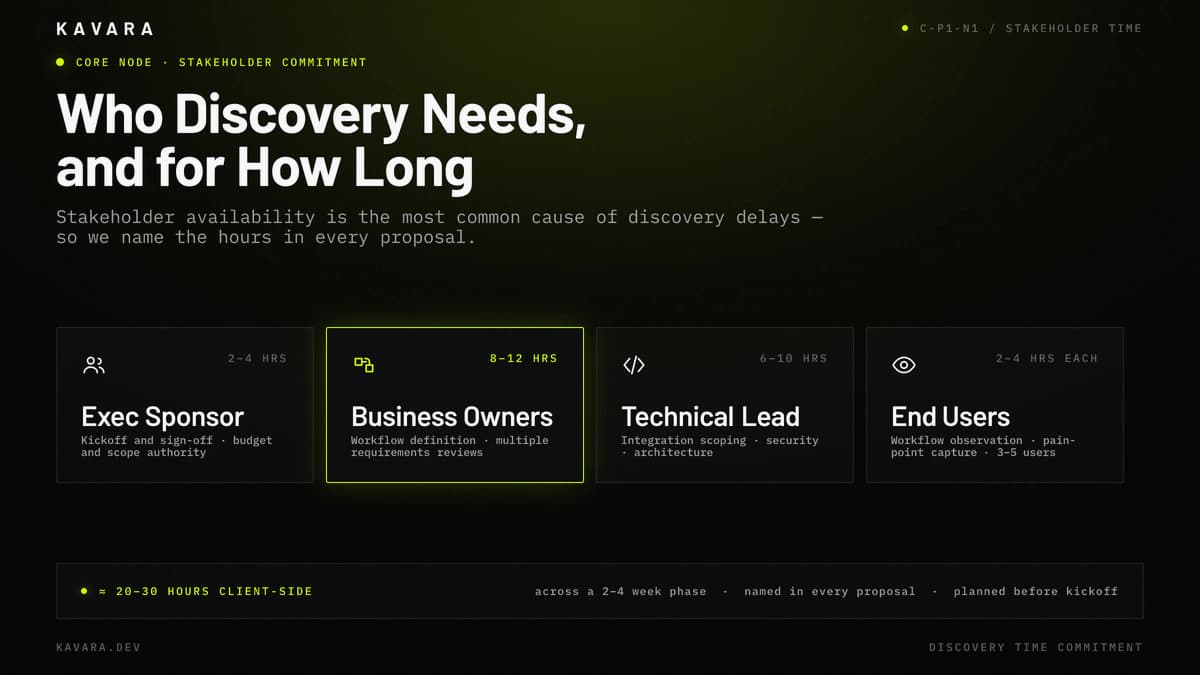
The stakeholder roles we engage with, and the time we ask of each, are specific. We name these commitments in proposals because the most common cause of discovery delays is not our process — it is stakeholder availability the client did not anticipate.
The executive sponsor commits 2–4 hours across kickoff, a mid-discovery progress check, and the sign-off session — providing business outcome clarity, budget confirmation, and a clear chain of decision-making authority.
The business owners and domain experts commit 8–12 hours — the largest single time commitment. These are the people who understand the workflows the application has to support, and they participate in multiple interview and workshop sessions plus requirements reviews.
The technical lead or CTO commits 6–10 hours across integration scoping, security and compliance, system landscape walkthrough, and architecture feasibility sessions.
End users commit 2–4 hours each for internal applications (typically three to five users) — direct interviews surfacing workflow pain points, manual workarounds, and the user reality the application has to fit. For customer-facing applications, we substitute behavioral data, analytics, and proxy interviews with customer-facing staff.
Total client-side time is approximately 20–30 hours over two to four weeks. We name that number because the alternative — vague "we'll need some of your time" — is what causes calendars to slip.
The workshops follow a structured rhythm. The kickoff discovery workshop (week 1, day 1, 3–4 hours) establishes business outcomes, success criteria, and constraints. Each domain discovery workshop (weeks 1–2, multiple 2-hour sessions) works through current-state and future-state with business owners by functional area. The feasibility synthesis (week 2–3) brings the technical lead together with our architecture team to validate the realism of what business owners have requested. The discovery readout (end of phase, 90 minutes) presents findings, requirements summary, architecture recommendations, scope, and estimate — and leads into the phase-gate sign-off.
We document every workshop with structured notes that feed the requirements document — we do not rely on the client to take notes.
Requirements Documentation We Produce in Discovery
The requirements document we produce in discovery is the central artifact of the phase — the source of truth that architecture, design, development, and quality assurance all reference, and the document that determines whether the project we estimated is the project that gets built.
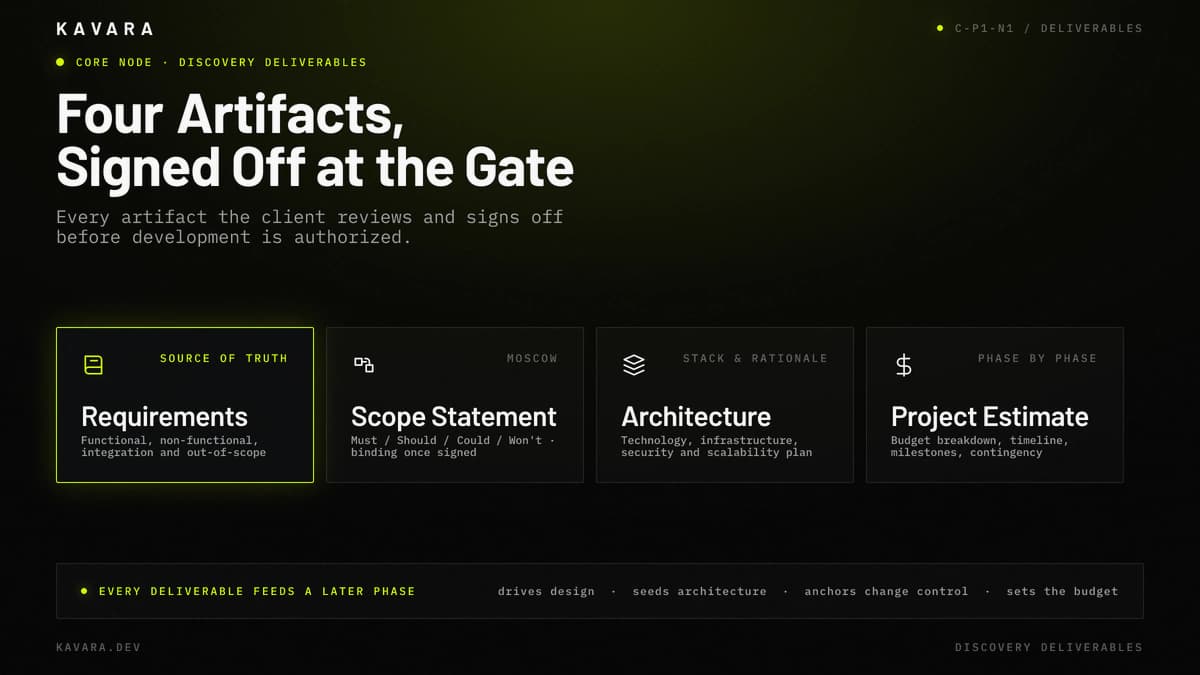
The requirements document has a consistent named structure.
Functional requirements capture what the application does as user stories with acceptance criteria — the format development sprints work from — organized by user role and functional area. Every functional requirement is traceable to a stakeholder interview, workshop output, or compliance source.
Non-functional requirements capture how the application must behave under load and over time. Performance requirements specify concurrent users, response time targets, and data volumes. Security requirements name the authentication model, data protection approach, and audit logging. Compliance requirements identify which standards apply (SOC 2, HIPAA, PCI DSS, GDPR). Scalability requirements capture growth projections the architecture must accommodate. These directly inform the architecture recommendations we deliver and the broader patterns covered in our guide to web application architecture.
Integration requirements catalog every external system the application must connect to — named systems, integration patterns (REST API, file transfer, database sync, message queue), data direction, volume estimates, and latency. Vague references get resolved into specific systems with specific connection mechanics.
User stories with acceptance criteria decompose every functional requirement into the stories the development team works from in sprints. Acceptance criteria are written in Gherkin (Given/When/Then) format where appropriate, with estimation tags applied so stories can be sized for sprint planning the moment design begins.
Out-of-scope items explicitly document what was discussed and excluded. The section is often the most contested during sign-off — and it is what prevents scope creep three months later by making the boundary visible before development.
Alongside the requirements document, we produce a scope statement with MoSCoW prioritization — Must Have, Should Have, Could Have, Won't Have — negotiable during scope definition and binding once signed. The scope statement gives us a defensible answer when someone asks during development whether a new request is in scope.
We use a structured requirements document template refined across hundreds of engagements — a checklist anchored with example sections from previous projects.
Every requirement is traceable to one of three sources: a stakeholder interview, a workshop output, or a compliance source. Assumptions from our own analysis go in a separate section, flagged for stakeholder validation before sign-off.
What Discovery Produces: Deliverables, Decisions, and the Phase-Gate Sign-Off
Discovery ends with a phase-gate sign-off — a formal decision point where the client reviews everything we have produced, signs off on requirements, scope, architecture, and estimate, and authorizes development. The sign-off is what distinguishes our discovery practice from "preparation" approaches that drift into development without a baseline.
The client receives four deliverables at the discovery readout, each signed off explicitly.
The requirements document (covered above) — functional and non-functional requirements, user stories with acceptance criteria, integration requirements, and the explicit out-of-scope list. It is the artifact every other phase references.
The scope statement — MoSCoW-prioritized feature list, phase-by-phase delivery plan, and the explicit dependencies and assumptions the plan rests on. It is what change control will measure against during development.
Architecture recommendations — proposed technology stack with rationale, infrastructure plan, integration architecture, security architecture, and scalability approach. These become commitments only after the architecture phase confirms them, but they are sufficiently detailed for the project estimate to be reliable.
The project estimate — phase-by-phase budget breakdown rather than a single number, with timeline, milestones, team composition by phase, and risk-adjusted contingency. The estimate is built from cost frameworks for web application development documented in our complete cost coverage.
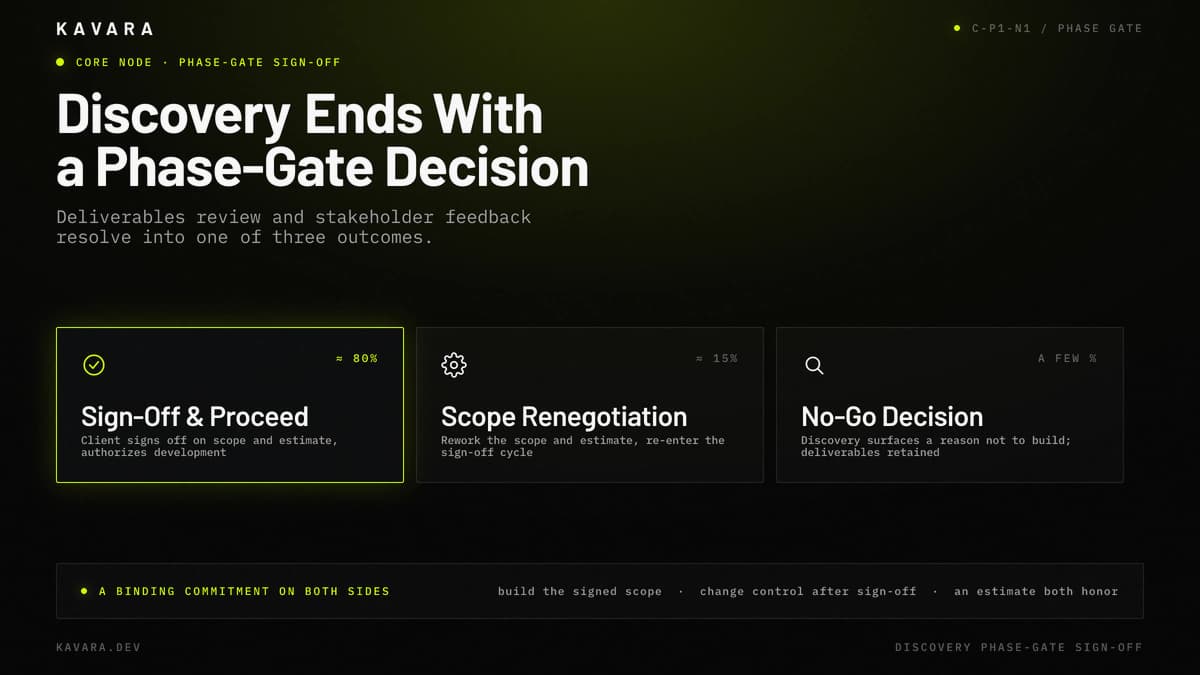
The phase-gate review has three possible outcomes, and we tell clients about all three before discovery begins.
Sign-off and proceed to development is the most common — roughly 80% of our discovery engagements. The client reviews the deliverables, requests refinements where needed, signs off on scope and estimate, and authorizes design and architecture.
Scope renegotiation is the second outcome — roughly 15%. Discovery surfaces scope or budget mismatches the client wants to address before authorizing development. We rework the scope statement and estimate and re-enter the sign-off cycle. Renegotiation is built into the process, not a failure mode.
No-go decision is the third outcome — a few percent. Discovery surfaces something that changes the client's calculation, and the client chooses not to proceed. The engagement is complete, the client has the deliverables, and the relationship continues on the deliverables alone.
The phase-gate sign-off is a binding commitment on both sides. We commit to building what is in the signed scope; the client commits to not changing it without going through change control. That mutual commitment is what makes accurate estimation possible.
From sign-off, deliverables flow into every subsequent phase: the requirements document drives design, architecture recommendations seed the architecture phase, the scope statement is the source of truth for development priorities, and the project estimate is the financial commitment we both honor.
How Discovery Adapts to Different Application Types
The four-workstream structure of our discovery process stays consistent across every project we run — what changes by application type is the emphasis within each workstream, the duration of specific workshops, and the specialized deliverables we add to the standard set.
SaaS platforms require extended technical feasibility on multi-tenancy strategy, subscription billing architecture, and tenant isolation. We add a tenant data model recommendation to the standard deliverables. SaaS discovery typically runs at the longer end (three to four weeks) because the architectural decisions made now compound across the customer base — the multi-tenancy and subscription billing decisions discovery surfaces flow directly into our SaaS platform development services, where the architecture decisions are built.
Enterprise portals require heavier stakeholder workshops because portals serve multiple user types — employees, partners, vendors, customers. Role-based access design starts in discovery, not later. Portal discovery often surfaces internal political alignment work that has to be done before scope can be locked.
MVP builds get compressed discovery — two weeks is typical — but not skipped. We focus on the validation hypothesis the MVP is designed to test, the minimum feature set that tests it, and the architecture decisions that keep the MVP from becoming a re-architecture liability later. Validation-first scoping is the defining concern of our MVP development engagements.
Dashboards and analytics applications require extended feasibility on data pipeline architecture, data freshness, and query performance under realistic data volumes. We add a data architecture recommendation alongside the application architecture recommendation.
AI and LLM-integrated applications require extended feasibility on data privacy, model selection, retrieval architecture, and operating cost. We add an AI architecture recommendation with cost-per-interaction projections. AI discovery often runs four weeks because the cost-per-interaction math determines whether the application is viable as proposed.
The variations exist because the applications are different — but the underlying discipline is constant.
How Long Does Product Discovery Take?
Product discovery in our engagements takes two to four weeks, with three weeks being the most common duration for mid-market SaaS, portal, and dashboard projects. The discovery phase duration is determined by application complexity, stakeholder availability, and the depth of internal discovery the client has already done. We commit to a specific duration in the discovery proposal — we do not run open-ended engagements.
Two weeks is what we plan for well-scoped MVPs, single-application projects with limited integrations, and engagements where the client has done substantial internal discovery. Three weeks is most common — mid-market SaaS, enterprise portals, and dashboards with typical integration scope. Four weeks is what we plan for complex enterprise applications, extensive user research, and regulated industries where compliance scoping adds depth.
The duration commitment we make is binding the same way the scope commitment is binding. We do not extend discovery without a documented scope change.
What Stakeholders Need to Be Available During Discovery?
In our engagements, the stakeholders we need available during discovery are the executive sponsor, business owners or domain experts, the technical lead, and (for internal applications) a small number of end users — approximately 20–30 hours of client-side time across all roles over two to four weeks. Stakeholder availability is the most common cause of discovery delays, and we name the time commitment in proposals so clients can plan calendar availability before discovery starts.
The executive sponsor commits 2–4 hours across kickoff, mid-discovery check, and sign-off — with decision-making authority for budget and scope. Business owners or domain experts commit 8–12 hours across interviews and workshops. The technical lead commits 6–10 hours for integration scoping, security and compliance, and architecture feasibility. End users (for internal applications) commit 2–4 hours each, typically three to five users, for workflow observation and pain-point capture.
For customer-facing applications, we substitute behavioral data and analytics for direct end-user interviews where end-user access is not feasible.
What Happens When Discovery Surfaces a No-Go?
In rare cases — a few percent of our discovery engagements — discovery surfaces something that changes the client's calculation and the answer is not to proceed. We treat that as a valid outcome, not a failure.
Three common no-go triggers. A feasibility constraint — discovery surfaces a technical or integration constraint that makes the original scope unachievable within the original budget or timeline. A cost surprise — the project estimate exceeds what the client had budgeted, and reducing scope to fit would compromise the business outcome the application was meant to enable. An internal business reason — strategic shifts, deprioritization, or business changes during discovery.
In all three cases, the engagement is complete, the client has the deliverables, and the relationship continues on the deliverables alone. Discovery as risk-elimination includes the possibility that the answer is "don't build this" — and we would rather discover that during a four-week phase than during a six-month build.
What Are the Most Common Discovery Mistakes?
The product discovery mistakes we see most often in engagements we inherit from previous vendors: skipping discovery under timeline pressure, treating discovery as a sales activity instead of a deliverable engagement, capturing requirements without traceability, and ending discovery without a binding phase-gate sign-off.
Skipping discovery under timeline pressure is the most common and most expensive — the PMI 47% data tells the story, and the rescue engagements we run confirm it. Treating discovery as sales qualification is the second — vendors run discovery to qualify the engagement rather than define it; the client ends up with no usable deliverables when development should begin. Requirements without traceability is the third — requirements appear in the document with no source citation, and three months in no one can answer where a requirement came from. Soft transitions instead of phase-gate sign-off is the fourth — development "starts" without formal sign-off, scope and estimate remain effectively negotiable, and change control becomes impossible because there is no baseline.
Each of these is reversible, but the reversal costs more than discovery would have. For the broader pattern of how to evaluate any vendor before signing, see our guide to evaluating any web application development process.
Product discovery is the phase where we define what we are going to build, and we treat it as a mandatory two-to-four-week phase backed by a phase-gate sign-off because the alternative is the requirements-driven failure mode the PMI data describes. We structure discovery as four parallel workstreams — stakeholder interviews and workshops, requirements documentation, technical feasibility, and scope and roadmap definition — and deliver four artifacts at sign-off: requirements document, scope statement with MoSCoW prioritization, architecture recommendations, and a phase-by-phase estimate. We commit to roughly 20–30 hours of stakeholder time and a specific duration in every proposal. The sign-off authorizes development only after the client reviews the deliverables and approves scope, architecture direction, and estimate — and it can also result in scope renegotiation or a no-go — so what we discover, document, and scope here is what makes a predictable, production-grade build and launch possible.
Every Kavara engagement begins with a free discovery conversation; the discovery engagement itself is scoped and priced. Explore the full range of custom web application development we deliver to see the applications discovery enables us to build, and contact our team to schedule a discovery conversation and scope your engagement.