SaaS Architecture and Technology Stack for Multi-Tenant Platforms
We build production SaaS platforms for mid-market companies, and the architecture and technology stack decisions we make in the first weeks of every engagement determine whether the platform scales smoothly to 10,000 tenants or hits a costly re-architecture wall at 1,000. SaaS architecture is the integrated design of multi-tenant software — how tenants share or isolate resources, how subscription lifecycles shape the data model, and how the technology stack composes to serve many customers from a single application instance.
In SaaS work, architecture decisions and technology choices cannot be separated. Choosing PostgreSQL with row-level security is both an architecture decision and a technology decision, and we treat them as one integrated practice — the same discipline we apply across our custom web application development work, sharpened for the multi-tenant case because a model that fits a hundred tenants can become a liability at ten thousand. This page reflects how we architect SaaS application development through the three multi-tenancy models we build with, the six-layer SaaS technology stack we deploy, subscription billing as architecture rather than feature, tenant context propagation through authentication, production scaling patterns, and the way we choose the right architecture for each product inside our broader custom web application development practice.
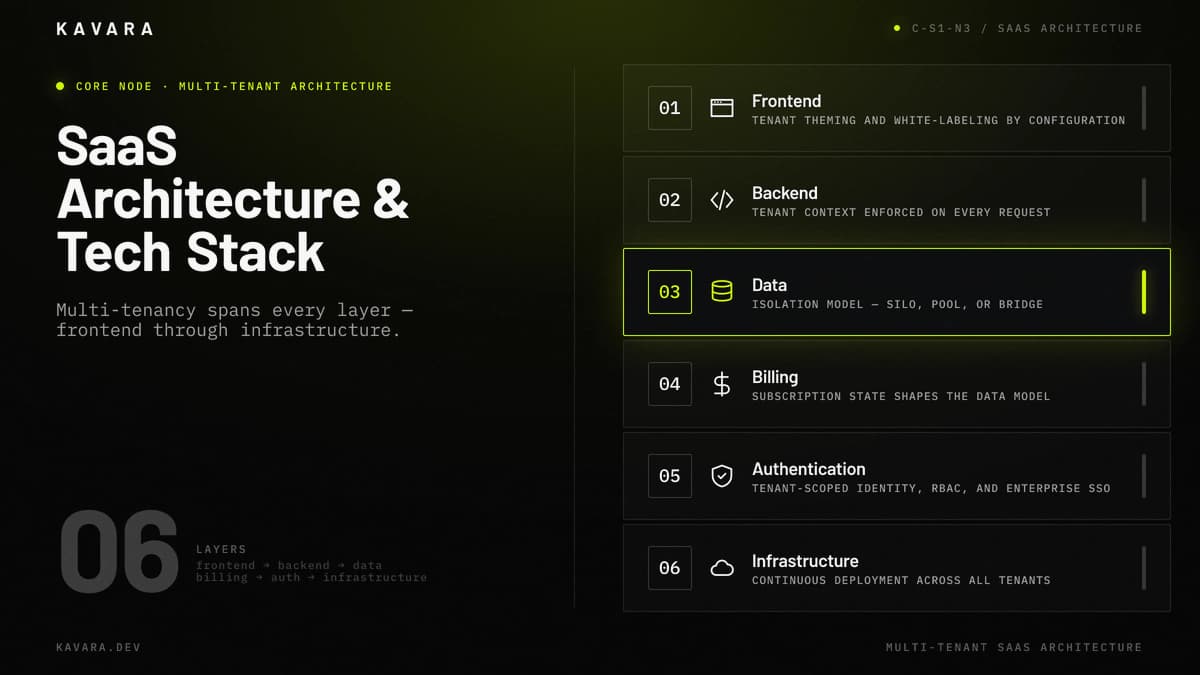
What SaaS Architecture Has to Solve
Every SaaS platform we build has to answer a question that standard web applications never ask: how do we serve many customers from one application instance without letting their data, performance, or configuration bleed into one another? SaaS architecture is the structural design of multi-tenant software that allows many customers to share a single application instance while keeping their data, configuration, and usage logically isolated from one another.
That question is the starting point of every SaaS engagement we run. General web application architecture asks how an application serves its users; SaaS architecture asks how an application serves many customers simultaneously without compromising isolation, performance, or operational efficiency. We build portals, dashboards, and internal tools too, but SaaS is the type where that distinction reshapes every layer. For the general patterns we use across our custom web application development practice — monolithic versus microservices, frontend rendering models, database selection — see our complete web application architecture guide; SaaS architecture builds on those foundations and adds the multi-tenant concerns below.
Three concerns define every SaaS engagement we take on. Tenant isolation is the first — the boundary we never let leak. Subscription lifecycle is the second, and it is the part most teams treat as a feature; we treat it as a data-model concern that shapes every layer above it. Continuous service across all tenants is the third — every deployment affects every customer simultaneously, which changes how we deploy. Tenant isolation is the most consequential, and the first architectural decision we make is which of the three multi-tenancy models the platform will use.
The Three Multi-Tenancy Models We Build With
Every SaaS platform we architect operates somewhere on a spectrum between full resource sharing and full resource isolation, and AWS SaaS Factory's tenant isolation framework gives us the three points we work from: silo, pool, and bridge. The terminology was formalized by Tod Golding and the AWS SaaS Factory team in their Tenant Isolation Strategies whitepaper, and we use it in every SaaS architecture discovery we run.
Silo isolation — when we use it. Silo isolation is a multi-tenant model in which each tenant runs a fully separate stack of resources: compute, database, networking, and sometimes a dedicated VPC. We architect silo deployments for clients in regulated industries — healthcare under HIPAA, financial services with data residency requirements — and for tenants with vastly different load profiles. Its trade-off is operational overhead that scales linearly with tenant count, so we automate tenant provisioning aggressively.
Pool isolation — our default starting point. Pool isolation is a model in which all tenants share the same application infrastructure, with isolation enforced logically in code and at the database row level. We default to it for early-stage SaaS platforms, B2C SaaS, and products with similar tenant load profiles, because it gives the lowest per-tenant cost and fastest provisioning. The discipline it demands is non-negotiable — tenant context must be validated at every layer — and noisy neighbor risk is the cost we manage with the scaling techniques below.
Bridge model — where most production SaaS ends up. The bridge model is a pragmatic mix: web tier and application servers are pooled, while databases for enterprise tenants are siloed. Most production SaaS platforms we operate long-term run a bridge configuration, with enterprise tenants getting dedicated resources for performance guarantees or compliance contracts. Bridge is the most operationally complex of the three because the platform must support both isolation modes at once, which is why we architect for it deliberately.
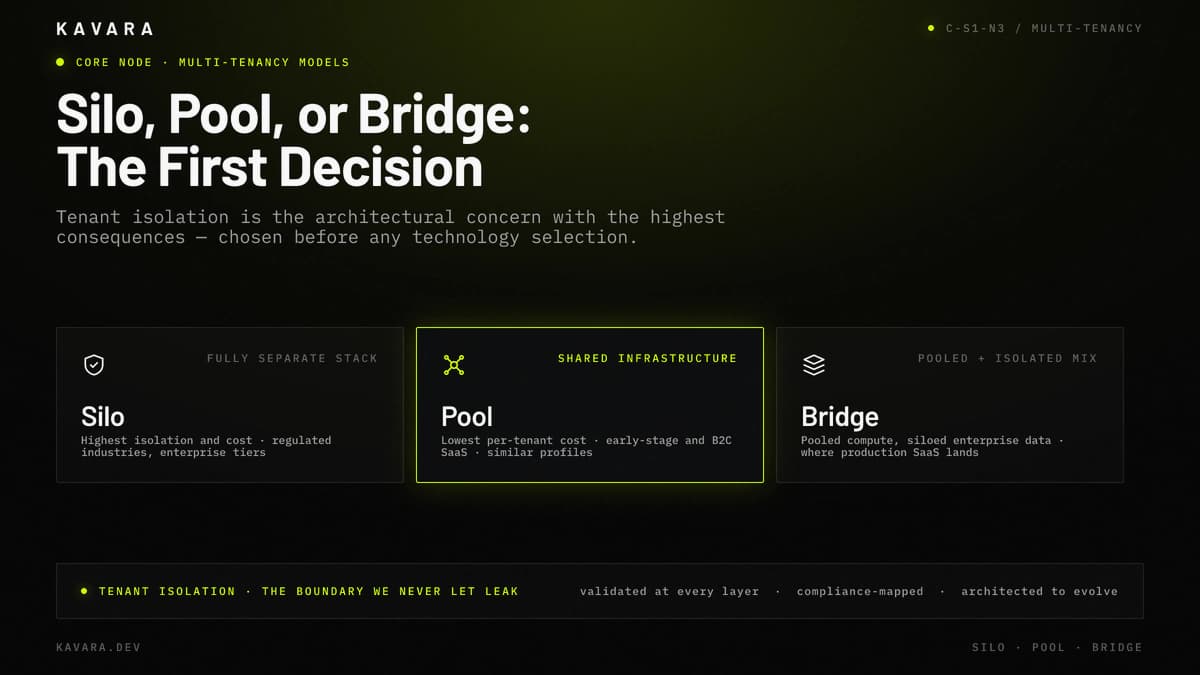
| Model | Resource Sharing | Cost per Tenant | Operational Complexity | When We Use It |
|---|---|---|---|---|
| Silo | None — fully separate stack | Highest, scales linearly with tenants | Lowest per-tenant; highest total | Regulated industries, enterprise contracts, premium tiers |
| Pool | Full — shared application and database | Lowest, marginal cost approaches zero at scale | Lowest total; highest in tenant isolation enforcement | Early-stage SaaS, B2C, similar tenant profiles |
| Bridge | Mixed — pooled compute, isolated data | Medium, varies by tenant tier | Highest — must support both models | Mid-market SaaS serving small and enterprise customers |
Within these isolation models, the database layer carries its own three-way decision: shared schema with a tenant ID column for pool isolation, schema-per-tenant for moderate isolation without per-tenant database costs, and database-per-tenant for silo and bridge enterprise tenants. PostgreSQL row-level security (RLS), documented in the PostgreSQL documentation, enforces tenant isolation at the database level even in shared-schema deployments — collapsing the gap between the cheapest isolation model and a stronger guarantee, which is why we default to PostgreSQL with RLS.
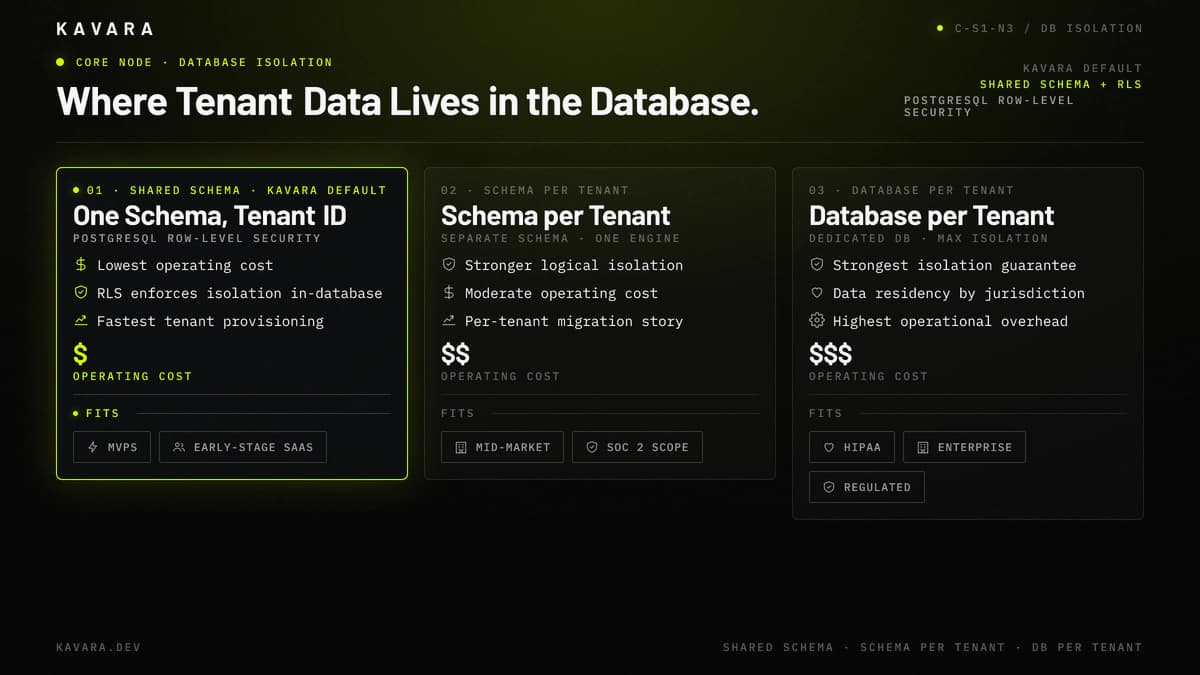
The architectural mistake we see most often is starting silo by default, which adds operational complexity without the revenue to justify it. Most mid-market SaaS platforms should start in pool and evolve toward bridge as enterprise customers arrive. The multi-tenancy model determines how the platform is organized at the resource level; the technology stack is how we build each layer of it.
The Six-Layer SaaS Stack We Build With
Our production SaaS technology stack is composed of six layers — frontend, backend, data, billing, authentication, and infrastructure — and each answers a different architectural question than the same layer in a standard web application would. This is not a checklist of technologies; it is the sequence of decisions we make in every engagement.
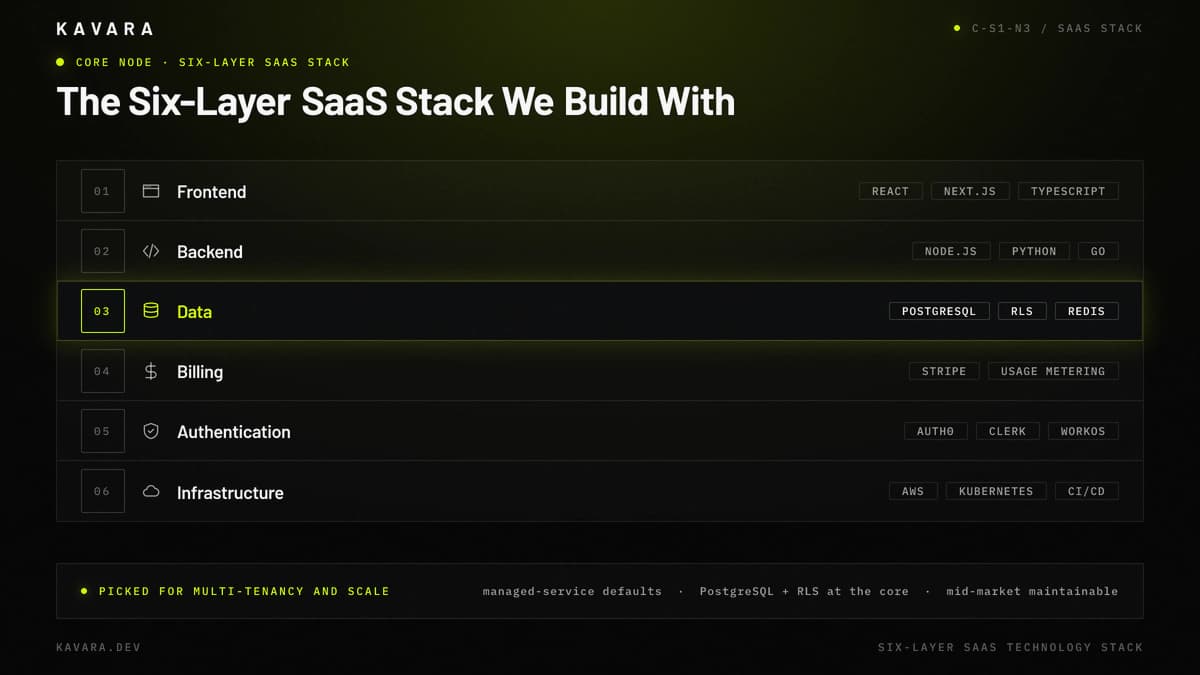
| Layer | Technologies We Build With | The SaaS-Specific Question This Layer Answers |
|---|---|---|
| Frontend | React, Next.js, TypeScript | How do we support tenant-level theming and white-labeling without forking the codebase? |
| Backend | Node.js, Python, Go | How do we enforce tenant context in every request and prevent cross-tenant data leaks? |
| Data | PostgreSQL (with RLS), Redis | Which isolation model fits our client's compliance and cost requirements? |
| Billing | Stripe, custom usage metering | How do we tie product entitlements to subscription state in real time? |
| Authentication | Auth0, Clerk, WorkOS (or custom SSO) | How do we support both end-user logins and enterprise SSO with tenant-scoped RBAC? |
| Infrastructure | AWS / GCP / Azure, Kubernetes or managed services, GitHub Actions | How do we deploy continuously without disrupting service for any tenant? |
We build the frontend with React and TypeScript by default, because component-based architecture supports tenant theming through configuration rather than code forks, and we layer in Next.js when customer-facing SaaS pages need SEO. We architect theming as configuration data from day one — retrofitting white-labeling onto a codebase that did not anticipate it is one of the more expensive SaaS rebuilds we have seen.
The defining backend decision is not the language but how tenant context propagates through every request. Whether we build with Node.js, Python, or Go — a choice driven by the client's team and by whether the platform follows monolithic and microservices patterns — we enforce that every query, cache lookup, and external API call carries tenant context the data layer uses to scope access.
The data layer is where we default to PostgreSQL for one reason above all others: row-level security lets a shared schema enforce tenant isolation at the database level, making the lowest-cost isolation model viable for clients we would otherwise place on more expensive strategies. Redis sits alongside it for caching and tenant-scoped session state.
We integrate Stripe in the billing layer for every engagement where standard subscription billing is sufficient, layering custom usage metering on top when the product needs consumption-based pricing — the layer the next section treats as architecture rather than feature.
The authentication layer is rarely just login: mid-market clients need end-user auth, enterprise SSO through SAML and OIDC, tenant-scoped RBAC, and audit logging. We use managed services — Auth0, Clerk, WorkOS — by default, and build custom auth only when integrating with a pre-existing identity system those services cannot reach.
The infrastructure layer is where continuous deployment and horizontal scaling across all tenants become SaaS-specific constraints we architect for from the start, so blue-green deployment, feature flags, and zero-downtime database migrations are baseline requirements rather than advanced techniques. We use managed cloud services such as RDS, ECS, EKS, and Cloud Run to keep operational overhead low enough for mid-market teams to maintain post-launch. Of the six layers, billing is the one most often miscategorized, and the way we treat it shapes the data model.
Why We Treat Subscription Billing as Architecture, Not a Feature
In every SaaS platform we build, we treat subscription billing as an architectural layer that shapes the data model, the API surface, and the runtime behavior of every other layer — not as a feature added after the core product is built. Billing-as-feature thinking creates platforms where billing state is disconnected from product state, with plan logic scattered across the codebase and billing drift from product reality.
Subscription state is a property of the tenant — active, trialing, past-due, canceled, or paused — and we make it authoritative so every other system reads from it: authentication, feature access, and API rate limits. The plan and entitlement model belongs in data, not code: the mistake we see most often is encoding plans in application code with checks like `if user.plan === 'pro'`, and our correction is entitlements as data, where code reads `entitlements.maxUsers`, so a new plan requires no code deployment.
Usage metering is the next architectural concern. Every billable event — an API call, a stored byte, a processed record, a seat-day — is captured as a metric tied to tenant and timestamp, and we architect the metering pipeline by the pricing model: streaming aggregation for real-time billing, batch processing for periodic billing. Stripe serves as the system of record for subscription state wherever standard subscription primitives are sufficient, because PCI compliance, dunning, and tax handling are domain problems a specialist solves better than we would rebuild. Using Stripe rather than building billing in-house is also a cost decision — for how billing and other architectural choices affect what we quote, see our analysis of how much SaaS development costs.
When we treat billing as architecture, adding a new plan takes hours; in the billing-as-feature codebases we inherit during legacy modernization engagements, it takes weeks. Billing is where SaaS work diverges most sharply from general custom web application development — a standard application has no subscription state to make authoritative. Subscription state determines what a tenant is entitled to; the next layer, authentication and authorization, determines which user within that tenant can act on those entitlements, and that is also where we enforce tenant isolation as a security boundary.
How We Build Authentication, Authorization, and Tenant Isolation
In our SaaS engagements, authentication is rarely just "login." A single-tenant application verifies who the user is; a SaaS platform verifies who the user is, which tenant they belong to, what entitlements that tenant carries, and what role within the tenant they hold. Four questions, one system — which is why we treat authentication and tenant isolation as one layer in our architecture work.
Tenant context propagation is the first component we build. When a user authenticates, the auth system returns a token — typically a JWT — carrying tenant ID, user ID, roles, and entitlement claims, and every downstream system reads tenant context from it, following AWS SaaS Factory's identity-and-isolation pattern: scope acquired at authentication, enforced at every resource access. Tenant-scoped RBAC is the second component: access control in SaaS is two-dimensional, because a user might be an admin in Tenant A and a viewer in Tenant B, and we architect the data model to support this from day one.
Enterprise SSO support is the third component: mid-market and enterprise customers expect SAML and OIDC integration with their identity provider — Okta, Azure AD, Google Workspace — and for B2B SaaS this is not optional, so we use managed auth services that implement it quickly. Audit logging is the fourth component, treated as an emission of the auth layer rather than a system bolted on for compliance; for SOC 2, HIPAA, and enterprise contracts, every authorization decision is logged with tenant context, timestamp, and outcome.
Tenant isolation, in our practice, is a security boundary. Broken access control is the number one application security risk in the OWASP Top 10, and in multi-tenant SaaS, broken tenant isolation is broken access control at its most severe level. We architect defense in depth, enforcing tenant isolation at the auth token, at the application middleware, and at the database row level, so a failure at any single layer is caught by the next — the reason we have not had a tenant isolation incident in production. Defense in depth applied to tenant isolation is part of the broader web application security practices we build into every SaaS platform. Authentication establishes the tenant boundary; the way we scale the platform determines whether that boundary holds under production load.
How We Scale Multi-Tenant Platforms in Production
Scaling a multi-tenant SaaS platform is not the same problem as scaling a single-tenant web application — every scaling decision has to account for tenant heterogeneity, noisy neighbors, and the reality that some tenants generate ten times the load of others. Horizontal scaling is our default: we architect every SaaS backend as stateless application servers behind a load balancer, with state held in the database and cache layers, so adding capacity means adding instances. That scalable architecture is only possible if the application was architected statelessly from the start.
Noisy neighbor mitigation is the discipline we apply to every pool-isolated platform. AWS SaaS Factory frames noisy neighbor as the principal cost of pool isolation, and our mitigation patterns address it directly: per-tenant rate limiting at the API gateway, database query budgets through tenant-scoped statement timeouts, CPU and memory quotas in containerized environments, and bulkhead patterns with separate connection pools per tenant tier. Noisy neighbor problems are inevitable in pool isolation — what differs between platforms is whether the architecture detects and contains them or lets them cascade.
Database scaling is specific to multi-tenant work. We add read replicas for analytical queries that would otherwise compete with transactional load, and we size connection pools by tenant count rather than user count, because every tenant context introduces overhead. Zero-downtime deployment is our baseline — blue-green deployment, feature flags, and database migrations that work with both old and new application code — because every deployment runs against all tenants simultaneously, so a five-minute outage hits every customer.
Per-tenant observability is something we instrument from day one, because platform-level monitoring is insufficient for SaaS. We surface per-tenant latency, error rate, and resource consumption so we can diagnose which tenant is degrading and bill accurately on consumption-based plans. These patterns turn a stateless backend into a genuinely scalable architecture — which brings us to how we choose the right architecture for each product we engage on.
How We Choose SaaS Architecture for Each Product
We choose SaaS architecture by working from each client's business requirements backward to architectural decisions — compliance, expected tenant count, and tenant heterogeneity determine the right multi-tenancy model before any technology selection. We run the same five-step sequence in every engagement.
- Compliance requirements first. If the product serves regulated industries — healthcare under HIPAA, financial services under SOC 2 or PCI — some compliance frameworks effectively mandate the bridge or silo model.
- Tenant heterogeneity second. If tenants will have vastly different load profiles, we architect for bridge from the start; if all tenants look similar, pool isolation suffices longer.
- Expected tenant count and growth curve. Pool is most efficient for high tenant counts; silo hits operational complexity walls past a few dozen tenants. We size the architecture to the realistic three-year tenant trajectory.
- Technical stack defaults. PostgreSQL with RLS, a React and TypeScript frontend, a Node.js or Python backend, Stripe billing, managed auth, and managed cloud infrastructure — we deviate only when a client requirement forces a different choice.
- Build for the next stage, not the final stage. We build for current scale plus the next year of growth, and expect to re-architect at least once over the product's life.
The mistake we see most often is over-architecting for hypothetical scale — clients arrive having been pitched microservices and database-per-tenant for a product that has not yet found product-market fit. Our SaaS development services begin with an architecture discovery workshop that maps compliance, scale, and tenant heterogeneity to the right multi-tenancy model, technology stack, and migration path before we write code. The questions that follow come up most often in those workshops.
What Is the Difference Between SaaS Architecture and Standard Web Application Architecture?
SaaS architecture differs from standard web application architecture in three fundamental ways — and in our practice, these differences drive every distinct decision we make in a SaaS engagement compared to a portal or dashboard build. Standard web applications serve one customer or one organization; SaaS serves many simultaneously, so every architectural decision compounds across the tenant base, which is why we treat SaaS work as a separate practice from our general custom web application work.
The three differences are precise: tenant isolation is the defining concern we architect for rather than an afterthought; subscription state shapes the data model rather than being a feature; and continuous deployment across all tenants is a baseline requirement we build for rather than an advanced practice. Standard web application architecture is, in effect, a subset of what we build for SaaS. For the general web application architecture patterns that apply across all the SaaS, portal, dashboard, and enterprise software we build, see our complete guide.
Should You Build Multi-Tenant from Day One or Migrate Later?
Build multi-tenant from day one if the product is a SaaS platform — in our experience, migrating from single-tenant to multi-tenant later typically costs three to five times what designing for multi-tenancy at the start would have. Single-tenant-to-multi-tenant migration is one of the engagement types we are most often called in for, because converting the data model, application layer, and auth layer to be tenant-aware touches nearly every part of the codebase.
Our exception: if the product is genuinely uncertain whether it will become SaaS, we recommend a single-tenant MVP — but we design the data model with tenant ID columns from the start, even if the value is always "1." If validation-first development is the priority, our MVP development practice builds validation-ready SaaS products with multi-tenant foundations from day one. The mistake we see clients make is building a single-tenant MVP without that architectural foundation, assuming the conversion is straightforward. It is not — we do those conversions, and we know what they cost.
What Technology Stack Do Most Production SaaS Platforms Use?
Most production SaaS platforms in 2026 use a similar core stack: React or Next.js for frontend, Node.js or Python for backend, PostgreSQL for primary data with Redis for cache, Stripe for billing, a managed auth service for identity, and a cloud provider for infrastructure. We build and deploy against that stack by default because each component solves a SaaS architectural problem well.
Common does not mean right for every product. AI-heavy products push us toward Python, high-throughput services may justify Go, and data-residency requirements may dictate cloud-region choices. The more important question than which stack to adopt is what each choice solves for the SaaS architecture.
How Do You Prevent Noisy Neighbor Problems in SaaS?
Prevent noisy neighbor problems through a combination of per-tenant rate limiting, database query budgets, resource quotas in containerized workloads, and per-tenant observability — the four patterns we deploy in every pool-isolated platform we operate. A noisy neighbor problem occurs when one tenant's heavy resource consumption degrades performance for others; it is inherent to pool isolation, so the question is detection and containment, not prevention.
Per-tenant rate limiting at the API gateway caps requests per tenant per time window. Database query budgets — statement timeouts and connection limits per tenant — prevent runaway queries. Resource quotas in containerized workloads cap CPU and memory per tenant tier. Per-tenant observability surfaces latency and error rates by tenant so we can diagnose degradation early. Silo or bridge isolation eliminates noisy neighbor entirely by giving heavy tenants their own resources.
What Are the Most Common SaaS Architecture Mistakes?
The SaaS architecture mistakes we see most often in client engagements are building a single-tenant application with the assumption it can be made multi-tenant later, treating subscription billing as a feature rather than an architectural layer, and over-engineering for scale before product-market fit is confirmed. Each one is reversible, but expensive.
Single-tenant first, multi-tenant later triggers the costliest re-architecture engagements we take on. Billing as feature, not architecture, scatters plan logic across the codebase. Premature microservices add operational complexity without the scale to justify it, which is why we recommend a well-structured monolith for nearly every mid-market SaaS we start from scratch. Tenant isolation enforced only at the application layer leaves a single point of failure, so we architect defense in depth with database-level RLS plus application-level enforcement.
The SaaS architecture and technology stack decisions we make in the first weeks of every engagement determine the platform's capabilities and constraints for years, which is why we treat architecture and technology as one integrated practice. The multi-tenancy model — silo, pool, or bridge — is the foundational decision every other choice flows from. Subscription billing belongs in the data model because the treatment of subscription state determines how every other layer can evolve, and PostgreSQL with row-level security is the data layer we default to because it collapses the cost-isolation trade-off. Most mid-market SaaS platforms should start in pool isolation and evolve toward bridge as enterprise customers arrive. Every Kavara SaaS engagement begins by mapping product requirements to multi-tenancy model, technology stack, and migration paths before we write code so the platform can launch and scale. See our full custom web application development capabilities to see how our SaaS architecture practice connects to the rest of our custom web application development work, and contact Kavara's team to start with a SaaS architecture discovery workshop and a scoped estimate based on your requirements.