How Much Does Mobile App Development Cost
Mobile app development costs between $80,000 and $350,000 depending on whether you build cross-platform or native, how complex the app is, and whether it shares a backend with an existing web application. That range is not vague pricing — it splits cleanly by approach. Cross-platform development with React Native or Flutter runs $80,000 to $250,000 for one shared codebase across iOS and Android. Native iOS or Android runs $100,000 to $350,000 because separate codebases require parallel engineering, platform-specific QA, and independent release management.
Mid-market product owners and CTOs building a business case need real US-agency numbers before they contact any development partner. Offshore rate cards blur $20,000 prototypes with production builds, which makes a mobile app development cost estimate impossible to defend to a finance team. Kavara publishes US-agency, production-grade ranges because we build mobile applications the same way we build web applications — as deployable software that survives real users, real devices, and real app store review.
The single largest cost lever is platform approach: native versus cross-platform. The second is whether the mobile app shares a backend with an existing web platform, which saves 20% to 30% over building web and mobile independently. For Kavara, mobile sits inside custom web application development — the mobile client is one more surface on the same architecture. This page breaks mobile app development cost down by platform approach, complexity tier, phase allocation, team model, and the hidden costs that most first-time estimates miss, then closes with a budgeting framework.
What Determines Mobile App Development Cost
Mobile app development cost is determined by five factors that set scope, delivery speed, and long-term maintenance load. These cost drivers compound, because a mobile app must run on hardware the team does not control, across operating systems that update every year.
Platform Approach is the single largest cost driver. Native app development — iOS in Swift plus Android in Kotlin — means two codebases, two platform engineers, and parallel QA. Cross-platform development with React Native or Flutter ships one shared codebase and typically reduces total cost versus building two separate native apps. Our mobile application development services scope native and cross-platform builds so the platform decision is made against real cost and maintenance tradeoffs, not defaults.
Backend Strategy — shared versus standalone — is the second driver. A companion app that consumes an existing web or SaaS backend reuses authentication, business logic, and data models, while a standalone app needs a new backend built from scratch. Sharing a backend saves 20% to 30% versus building web and mobile independently — the core efficiency of doing mobile inside custom web application development.
Feature Complexity adds engineering and QA scope. Offline sync, real-time data, in-app payments, media handling, and background processing each expand the build. Device features — camera, GPS, biometrics, push notifications, Bluetooth — add native-integration work that browser-based apps avoid entirely.
Device Fragmentation and Compliance widen the test matrix. Supporting many screen sizes and OS versions, especially across Android, expands QA. Regulated industries add compliance architecture — HIPAA for healthcare, SOC 2 for fintech — that mid-market companies cannot defer once real users are involved.
App Store Requirements carry scope that web apps never pay for. App Store and Google Play review, privacy manifests, and store metadata each add development and timeline cost.
These factors resolve into two pricing axes — the platform you build on, and how complex the app is. Platform comes first, because it sets the floor for everything else.
Mobile App Development Cost by Platform Approach
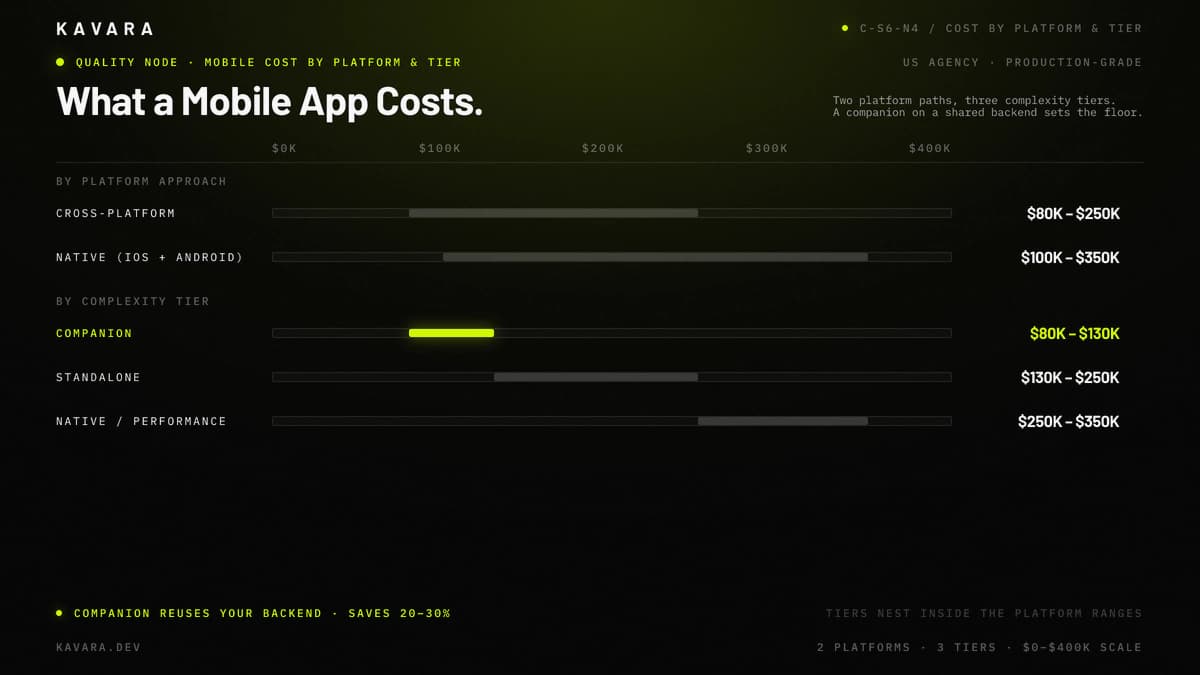
Platform approach sets the cost range for a mobile app before a single feature is scoped. The two production paths a US agency builds against are cross-platform and native, with the ranges pinned to the same figures Kavara uses across every cost guide. The chart below visualizes those two platform ranges and the complexity tiers they contain.
| Platform Approach | Cost Range | Timeline | What It Buys |
|---|---|---|---|
| Cross-Platform (React Native / Flutter) | $80,000-$250,000 | 3-7 months | One shared codebase across iOS and Android; near-native performance for most business apps; the fastest path for companion and standalone products. |
| Native (iOS Swift + Android Kotlin) | $100,000-$350,000 | 5-9 months | Separate platform codebases; maximum device and API access; required when hardware, animation, or platform performance defines the experience. |
Cross-platform development is cheaper because one team ships one codebase; native costs more because iOS and Android are engineered, tested, and released in parallel. React Native is Kavara's default for production-grade mobile application development where workflow access matters more than extreme device performance, and it shares React expertise with our web development, keeping a combined web-and-mobile team on one skill set. A single-platform native app — iOS-only or Android-only — sits at the lower end of the native range, while dual native covering both platforms sits at the top. The ranges above match the figures Kavara publishes for every application type, so a mid-market buyer comparing mobile against web, SaaS, or dashboard budgets is working from like-for-like numbers.
Platform sets the range; app complexity places you within it. The next section breaks the range into three tiers by what the app actually has to do.
Mobile App Development Cost by Complexity Tier
Complexity tier places a mobile app inside its platform range by what the app has to do. The three tiers below stay within the platform ranges above — each is a within-envelope breakdown, not a new number.
| Tier | Cost Range | Typical Platform | Timeline | Key Characteristics |
|---|---|---|---|---|
| Companion App | $80,000-$130,000 | Cross-platform | 3-5 months | Extends an existing web or SaaS product; consumes the existing backend, API, and auth; core mobile UX, push notifications, light offline support. Lowest cost because the backend already exists. |
| Standalone Product App | $130,000-$250,000 | Cross-platform | 4-7 months | New backend, full authentication, third-party integrations, offline sync, analytics, in-app payments. Where most mid-market standalone apps land. |
| Native / Performance-Critical App | $250,000-$350,000 | Dual native (Swift + Kotlin) | 5-9 months | Separate iOS and Android codebases, deep hardware and performance work, advanced security, and compliance architecture such as HIPAA or SOC 2. |
The jump from Companion to Standalone is primarily the new backend and integration surface — a companion app inherits both, while a standalone app pays to build them. The jump from Standalone to Native is the second codebase plus performance and compliance engineering. Each jump reflects real engineering scope, not arbitrary pricing. Companion apps are the cheapest mid-market path precisely because they reuse an existing web platform's backend, which is why a company that already runs a web application should price a companion tier first. That shared-backend advantage is the difference between adding mobile as an increment and funding it as a separate product.
Tiers tell you what the investment buys — phase allocation shows where the money goes inside a build.
Mobile App Development Cost by Development Phase
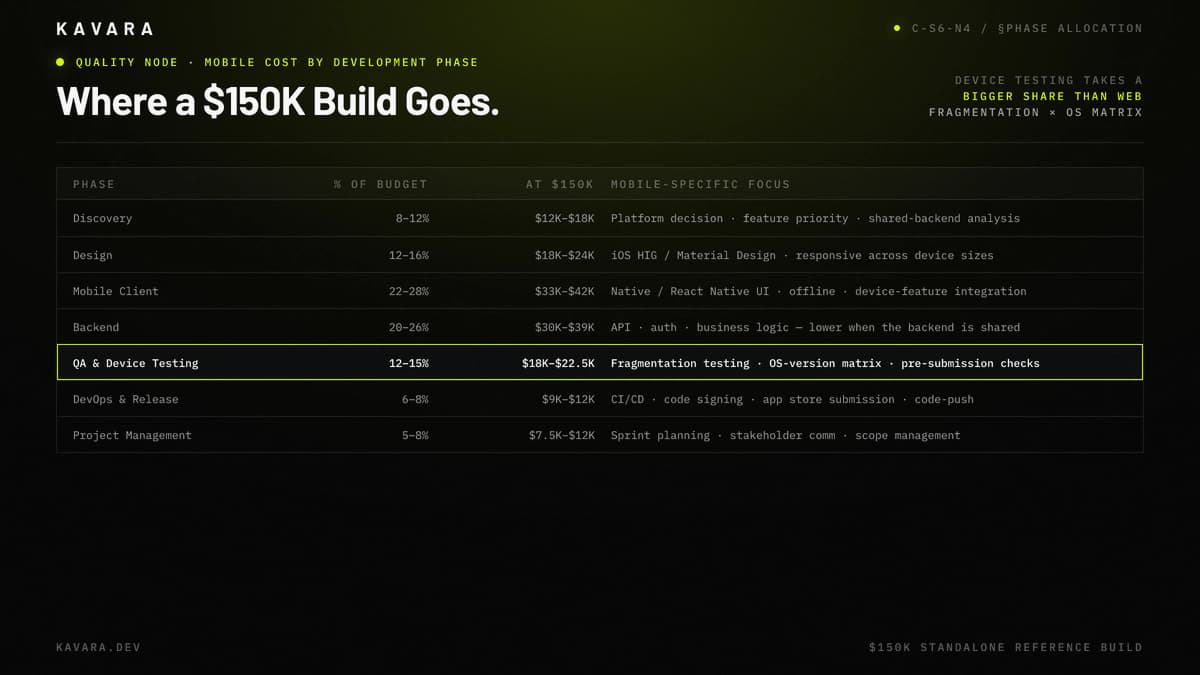
Mobile app development cost distributes across seven phases, and the split differs from a web build in one visible way. The following allocation is based on a $150,000 standalone mobile app — the mid-range tier where most production mobile apps fall. Device testing consumes a larger share than in web projects because mobile must be validated across screen sizes, OS versions, and device models before an app store release.
| Phase | % of Budget | Estimated Cost at $150K | Mobile-Specific Focus |
|---|---|---|---|
| Discovery | 8-12% | $12,000-$18,000 | Platform decision, feature prioritization, shared-backend analysis |
| Design | 12-16% | $18,000-$24,000 | Platform UX patterns (iOS HIG / Material Design), responsive across device sizes |
| Mobile Client (frontend) | 22-28% | $33,000-$42,000 | Native or React Native UI, offline behavior, device-feature integration |
| Backend | 20-26% | $30,000-$39,000 | API, auth, business logic (reduced when sharing an existing web backend) |
| QA & Device Testing | 12-15% | $18,000-$22,500 | Fragmentation testing, OS-version matrix, app-store pre-submission checks |
| DevOps & Release | 6-8% | $9,000-$12,000 | CI/CD, code signing, app store submission, code-push setup |
| Project Management | 5-8% | $7,500-$12,000 | Sprint planning, stakeholder communication, scope management |
QA and device testing take a higher percentage than a comparable web build because device fragmentation, especially across Android, multiplies the test matrix — every screen size and OS version is another combination to validate before release. Backend drops toward the low end of its range when the mobile app is a companion sharing an existing web platform's backend, since auth and business logic are already built. The percentage ranges are approximate and overlapping; the estimated-cost column is calculated for a $150,000 standalone build, and a specific project lands within these bands based on scope.
Phase allocation shows where the money goes — who does the work determines how much each phase actually costs.
How Team Model Affects Mobile App Development Cost
Team model affects mobile app development cost because mobile application development carries release management and device-testing overhead on top of ordinary engineering. The rate a team charges is only part of the equation — coordination friction and app store release experience decide the total.
| Team Model | Typical Hourly Rate | Mobile Suitability | Trade-offs |
|---|---|---|---|
| US Agency (like Kavara) | $150-$250/hr | High — full-stack teams that build web and mobile on shared architecture, with device-testing and release experience | Higher rate, faster delivery, lower total risk, one partner across web and mobile |
| Freelancers | $75-$200/hr | Medium — for simple companion apps with defined scope | Lower rate, higher coordination overhead, gaps in device testing and release management |
| Offshore Agency | $30-$80/hr | Low-medium — communication friction extends mobile timelines and release cycles | Lower rate, slower iteration, quality and app-store-compliance variance |
| In-House | $180-$300/hr (loaded) | Low for a one-time app — separate iOS and Android hires for a finite project | Full control, highest fixed cost, recruitment delay |
US-agency rates of $150 to $250 per hour look higher than the offshore rates competitors headline, but mobile carries release and device-testing overhead that offshore coordination tends to inflate rather than absorb. An agency that already builds your web platform can ship the companion app on the shared backend, which removes 20% to 30% of the cost a mobile-only vendor would rebuild from scratch. That is the mobile-specific reason hourly rate is a poor proxy for total cost. For a full total-cost-of-ownership comparison across every team model — including management overhead, rework, and timeline impact — read our agency vs freelancer vs in-house comparison.
Team model and phase allocation cover the visible build cost — but mobile apps carry recurring costs that most estimates miss entirely.
Hidden Costs of Mobile App Development
Beyond the build, mobile apps carry recurring costs that web applications avoid — and first-time buyers consistently underestimate them:
- App Store Fees and Developer Accounts — Apple Developer Program membership is $99 per year, while Google Play Console Help lists a $25 one-time registration fee for Play Console developer accounts. The Apple membership is a fixed annual cost for as long as the app stays published in the App Store.
- OS-Update Maintenance — iOS and Android ship major OS versions every year, forcing compatibility testing and updates. Budget 15% to 25% of the initial build annually. Skipping this cycle leads to broken behavior and eventual store removal.
- Device-Fragmentation QA — every release must be re-validated across screen sizes, OS versions, and device models, and Android multiplies that matrix. This QA recurs with each update, not only at launch.
- Backend and Push Infrastructure — cloud hosting, plus push delivery through Firebase Cloud Messaging for Android and cross-platform and APNs for iOS. Budget $500 to $2,000 per month for a standalone app; a companion sharing an existing backend runs lower.
- App-Store Compliance and Resubmission — privacy manifests, data-collection disclosures, permission rationales, and store metadata are scope, not paperwork. Apple's App Review page says 90% of submissions are reviewed in less than 24 hours, but guideline rejections require fixes and resubmission, adding schedule cost to a launch.
- Post-Launch Iteration — budget 20% to 40% of the build for a v2 cycle driven by real usage data, because the first release is a hypothesis about how people will actually use the app.
- The Cost of Not Sharing a Backend — building a mobile backend separately from an existing web platform duplicates auth, business logic, and data models, adding 20% to 30% that a shared-backend architecture avoids. This is the most common avoidable mobile app development cost for mid-market companies that already run a web application.
Accounting for these recurring costs produces a realistic total budget — and building that budget correctly separates a funded launch from a stalled one.
How to Budget for a Mobile App Project
Budgeting for a mobile app means accounting for both the visible build and the recurring costs that keep the app alive in two app stores:
- Choose your platform and tier — cross-platform companion ($80,000-$130,000), cross-platform standalone ($130,000-$250,000), or native and performance-critical ($250,000-$350,000), based on device needs, performance, and whether you already run a web backend.
- Add 25% to 35% contingency — covering post-launch iteration, app-store compliance fixes, and scope adjustments. A $150,000 standalone app should budget roughly $190,000 to $200,000 total.
- Plan for recurring costs — $500 to $2,000 per month in infrastructure, plus the $99-per-year Apple membership and one OS-update maintenance cycle at 15% to 25% of build.
- Decide backend strategy first — if you already run a web platform, a companion app on the shared backend is the lowest-cost path; if not, factor a standalone backend into the tier.
Total Year 1 for a $150,000 standalone app is approximately $190,000 to $220,000, including build, contingency, one iteration cycle, and twelve months of operating costs. For cost comparisons across every application type — web, SaaS, portal, dashboard, and enterprise software — see our complete web application development cost breakdown.
If you are validating a new product idea rather than extending an existing one, our MVP development cost guide breaks down the leaner validation-scope budget. With a realistic budget set, the remaining questions cover how mobile cost compares to web, whether cross-platform is genuinely cheaper, and what it costs to keep the app running.
How Does Mobile App Cost Compare to Web Application Development
If you already run a web application, the cost of adding a mobile app hinges less on mobile-versus-web pricing and more on one decision: whether the mobile app shares your existing backend. Sharing it typically saves 20% to 30% versus building a separate one. For a company with a live web platform, the number that matters is the incremental cost of a companion app on the shared backend, auth, and business logic, not a standalone mobile budget. Building mobile independently re-pays for engineering the web app already covered.
The full mobile-versus-web comparison — why mobile carries platform, app store, and device-testing overhead that web apps avoid — lives in our broader web application cost guide. For SaaS-specific premiums such as multi-tenancy and billing integration, see our SaaS application cost guide rather than pricing them into a mobile estimate.
Is Cross-Platform Cheaper Than Native App Development
Yes — cross-platform development with React Native or Flutter typically costs less than building two separate native apps, because one team ships one shared codebase instead of maintaining parallel iOS and Android codebases. The saving is structural: one codebase means one round of features, one QA pass on shared logic, and one release pipeline to maintain.
Cross-platform wins for business apps, client portals, field tools, and companion apps, where workflow access matters more than extreme device performance. Native is worth the premium for performance-critical or animation-heavy products, deep hardware integration, or platform-specific UX that defines the experience. Native app development also makes sense when a single platform dominates the user base and the extra polish justifies a dedicated codebase.
Kavara's default is to start cross-platform — React Native shares expertise with our web development — and add native modules only for the specific device features that need them. That approach keeps most mid-market mobile apps in the lower half of their cost range without giving up the performance that actually matters.
What Are the Ongoing Costs After Launching a Mobile App
Ongoing costs for a mobile app typically run $500 to $2,000 per month for infrastructure plus 15% to 25% of the initial build cost annually for maintenance, OS-update compatibility, and iteration. These recurring costs keep the app compatible with new devices and operating systems long after launch.
- Cloud hosting and backend: $300 to $1,500 per month depending on user load
- Push and third-party services (FCM/APNs, analytics, payments): $200 to $500 per month
- App store: Apple Developer Program at $99 per year, with Google Play a one-time $25
- OS-update maintenance and device-fragmentation retesting: 15% to 25% of build annually
- Feature iteration: 20% to 40% of the initial build for Year 1 post-launch
A $150,000 mobile app requires roughly $35,000 to $55,000 in Year 1 post-launch costs to maintain, update, and iterate. These are the costs of keeping the app live in two stores, not optional extras.
How Do Pricing Models Affect Mobile App Development Cost
Fixed-price engagements suit mobile apps with locked scope; time-and-materials suits apps where discovery may shift priorities; and for most mid-market apps a hybrid — fixed-price discovery and design, time-and-materials for development — balances budget certainty with iteration flexibility.
Fixed price gives budget certainty but locks scope, so adjustments run through change orders. Time and materials gives flexible scope but requires disciplined management to control spend. The hybrid model fits mobile app development cost planning because discovery and design can be scoped tightly. Development, meanwhile, benefits from room to adapt to app store feedback and device realities that surface only once the app is on real hardware. For a companion app on a known backend, fixed price is often achievable end to end; for a standalone product with an unproven feature set, the hybrid keeps the development cost adaptable without abandoning budget discipline.
Key Takeaways
Mobile app development costs $80,000 to $350,000 for US-agency production-grade builds, with platform approach — native versus cross-platform — and app complexity as the primary drivers. The biggest avoidable cost is rebuilding a backend the company already has: a companion app on a shared web backend saves 20% to 30% and ships faster. Mobile cost is the cost of extending a product to where users actually are — in the field, on the go, in the app store — not a separate project estimated in isolation. Explore Kavara's full custom web application development services to see how web and mobile share one backend, launch together, and scale as one product. talk to Kavara to scope your mobile build, set a realistic budget, and launch on a foundation built to grow.